
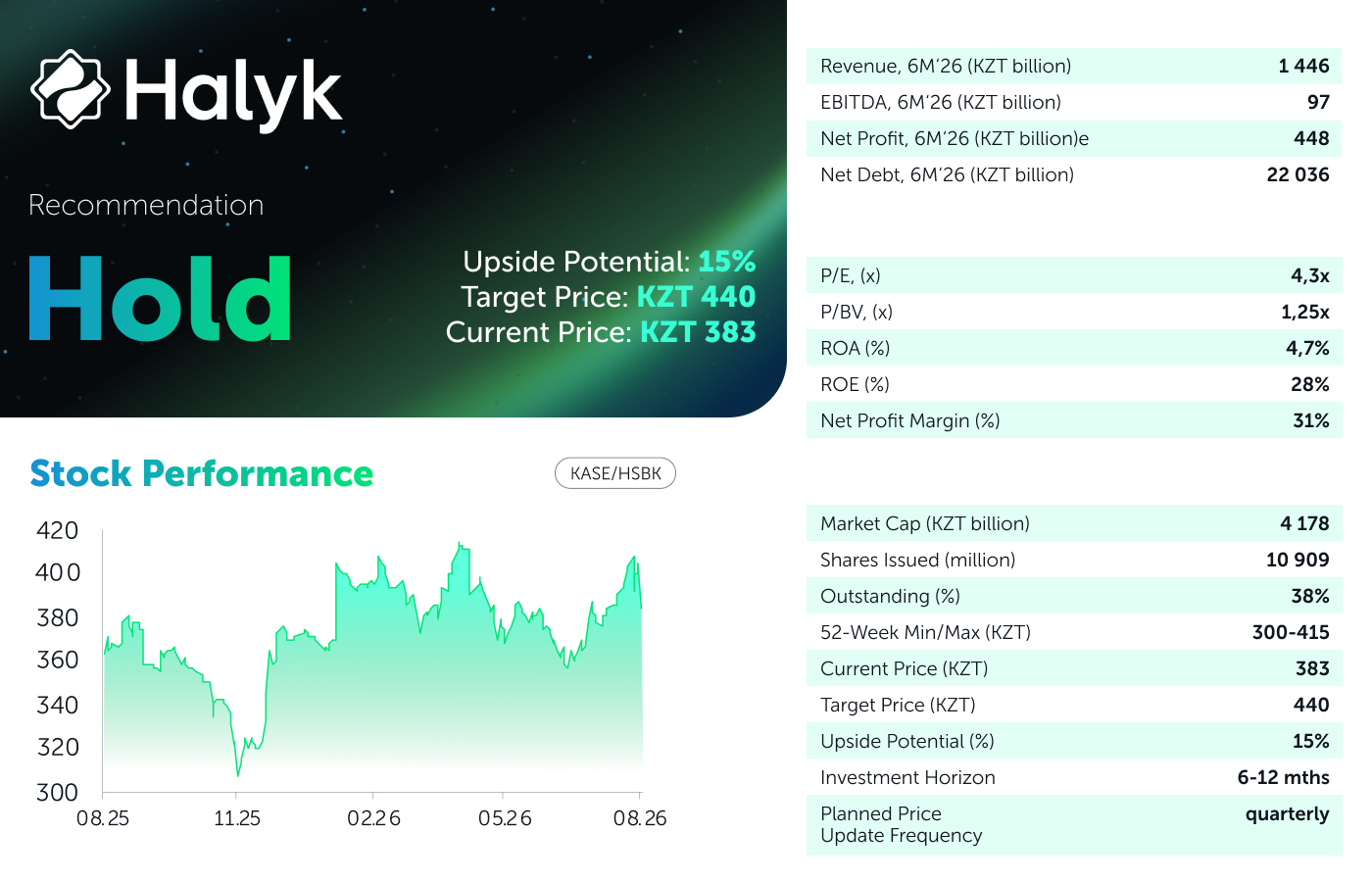
Halyk Bank JSC published its financial results for the Q2 of 2026. We assess the report as moderately negative: quarterly net profit declined by 16% year-on-year and was the weakest result in the past two years. The main pressure came from non-interest income, with the insurance business posting a loss, fee income declining year-on-year, and foreign-exchange trading income also decreasing. Despite the contraction in net interest margin (NIM) due to higher minimum reserve requirements (MRR), year-on-year growth in net interest income accelerated slightly. On the positive side, loan portfolio growth recovered in the second quarter. Management maintained all of its 2026 guidance except for fee income: the net fee income growth forecast was lowered from 5–10% to -10%. In our valuation model, we lowered our forecast for non-interest income and the cost of equity, as well as book equity following the recent dividend cut-off date. As a result, the target price for one Halyk Bank share was reduced from KZT 450 to KZT 440, implying 15% upside potential from current levels. We lowered our recommendation from Buy to Hold.
Core Valuation Factors. The main risk remains pressure on margins and non-interest income. Quarterly NIM declined from 7.0% in Q1 to 6.7%, following the April increase in minimum reserve requirements (MRR). According to management estimates, without the two MRR increases, the first-half margin would have been 7.2% versus the actual 6.8%, meaning the regulatory factor reduced the margin by around 40 bps. The cost of funding from customer deposits increased only slightly during the quarter, from 10.0% to 10.1%. At the same time, the average yield on the loan portfolio rose from 17.2% to 17.3%, while the overall yield on assets declined from 15.1% to 14.9%. Asset quality has also deteriorated: 90+ NPLs increased from 3.0% a year earlier to 5.3%. Non-interest income and expenses also weighed on net profit, driven by a larger insurance loss and lower foreign-exchange trading income, largely due to a high base effect. The insurance loss is largely attributable to mandatory motor insurance, where premiums have lagged behind inflation, as well as a one-off change in the insurance liability valuation model. The key catalyst remains the Group’s strong market position: it holds 29% of the market by assets, 29% by deposits and 30% by loan portfolio. The Group also has 86% penetration among the largest taxpayers. Monthly active users (MAU) of the super app increased to 8.6 million, while payment and transfer volumes through the app grew 14% year-on-year. A recent price catalyst was the second dividend payment this year of KZT 28.09 per share. Combined with the previous payment, this results in a 15% dividend yield based on the latest share price, the highest dividend yield in the KASE Index.
Revenue is growing, but non-interest expenses are putting pressure on profitability. Interest income reached a record KZT 725 billion in Q2 2026 (+10% YoY, +0.5% QoQ). At the same time, interest expenses increased by 16% YoY and 3.4% QoQ to KZT 401 billion, continuing to weigh on profitability. As a result, net interest income before credit losses amounted to KZT 324 billion (+3.0% YoY, -2.7% QoQ). Quarterly credit loss expenses amounted to KZT 48 billion (+24% YoY, -1.7% QoQ), while the cost of risk was 1.4%, compared with 1.5% in the previous quarter and a year earlier. Net fee and commission income declined again year-on-year, amounting to nearly KZT 30 billion (-13% YoY, +18% QoQ). Net insurance income turned negative, falling from a KZT 10.4 billion profit last year to a KZT 14.2 billion loss, becoming one of the key drivers of the decline in net profit. Net profit from foreign-exchange operations also fell by 29%. Operating expenses amounted to KZT 79.9 billion for the quarter (+3.2% YoY). As a result, quarterly net profit amounted to KZT 213 billion, down 16% YoY and 9.4% QoQ. This was the weakest quarterly net profit result in the past two years. Earnings per share (EPS) amounted to KZT 19.52. The Group's assets increased by 5.4% year-to-date to KZT 22.0 trillion. The securities portfolio grew by 13.8% over the first half of the year to KZT 4.9 trillion, while the loan portfolio increased by only 1.8% over the same period. The main driver was growth in the SME and retail loan portfolios, which increased by 4.3%, while the corporate loan portfolio declined by 0.7% in the first half of the year. The share of liquid assets in total assets decreased to 35.7%, compared with 38.4% at the beginning of April, while cash collection of interest income on the loan portfolio remained high at 95%, compared with 94% in the first half of 2025.
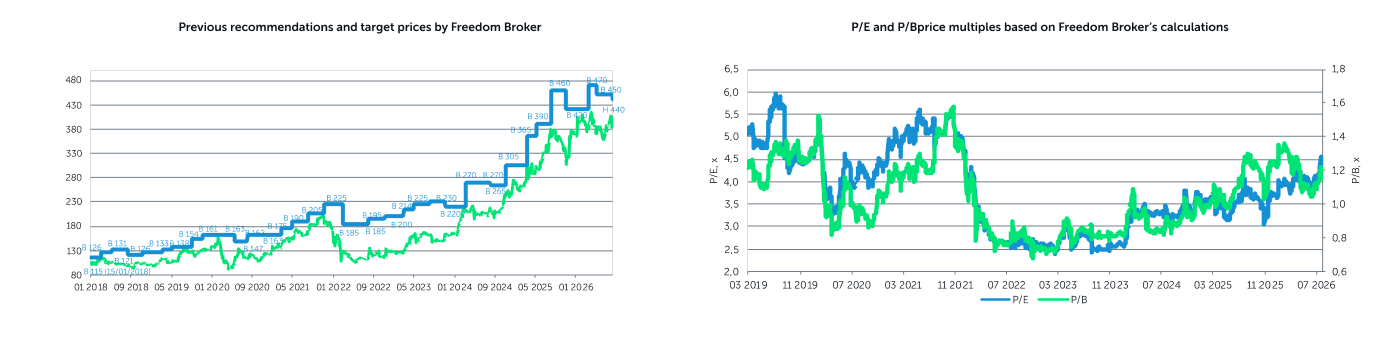
Our Opinion and Changes to the Valuation Model. As expected, net interest margin (NIM) declined in the second quarter following the increase in minimum reserve requirements (MRR). At this stage, achieving the target guidance by year-end does not appear guaranteed. Net profit is currently below the target level of KZT 1 trillion, and reaching this target would require 4% YoY growth in the second half of the year, which appears challenging given the current 16% YoY decline. We also note the downward revision to the fee income outlook. The main surprise was the decline in non-interest income and, in particular, the emergence of an insurance loss. At the same time, we note a significant improvement in loan portfolio growth, although it remains well below the full-year growth guidance. The further expected decline in the base rate should begin to reduce interest expenses with a 2–3 quarter lag, while the long duration of interest-earning assets should support NIM over the next several quarters. In our valuation model, we lowered the cost of equity following the decline in government bond yields. We also reduced our forecast for non-interest income. The recent dividend record date reduced estimated shareholders’ equity, which as of June 30 still included the then-undistributed profit. As a result, the target price for Halyk Bank shares was reduced from KZT 450 to KZT 440, implying 15% upside from the current price. We downgraded our recommendation from Buy to Hold.

Author: Daniyar Orazbayev,
CFA, Investment Analyst
(+7) 727 311 10 64 (688) | [email protected]