
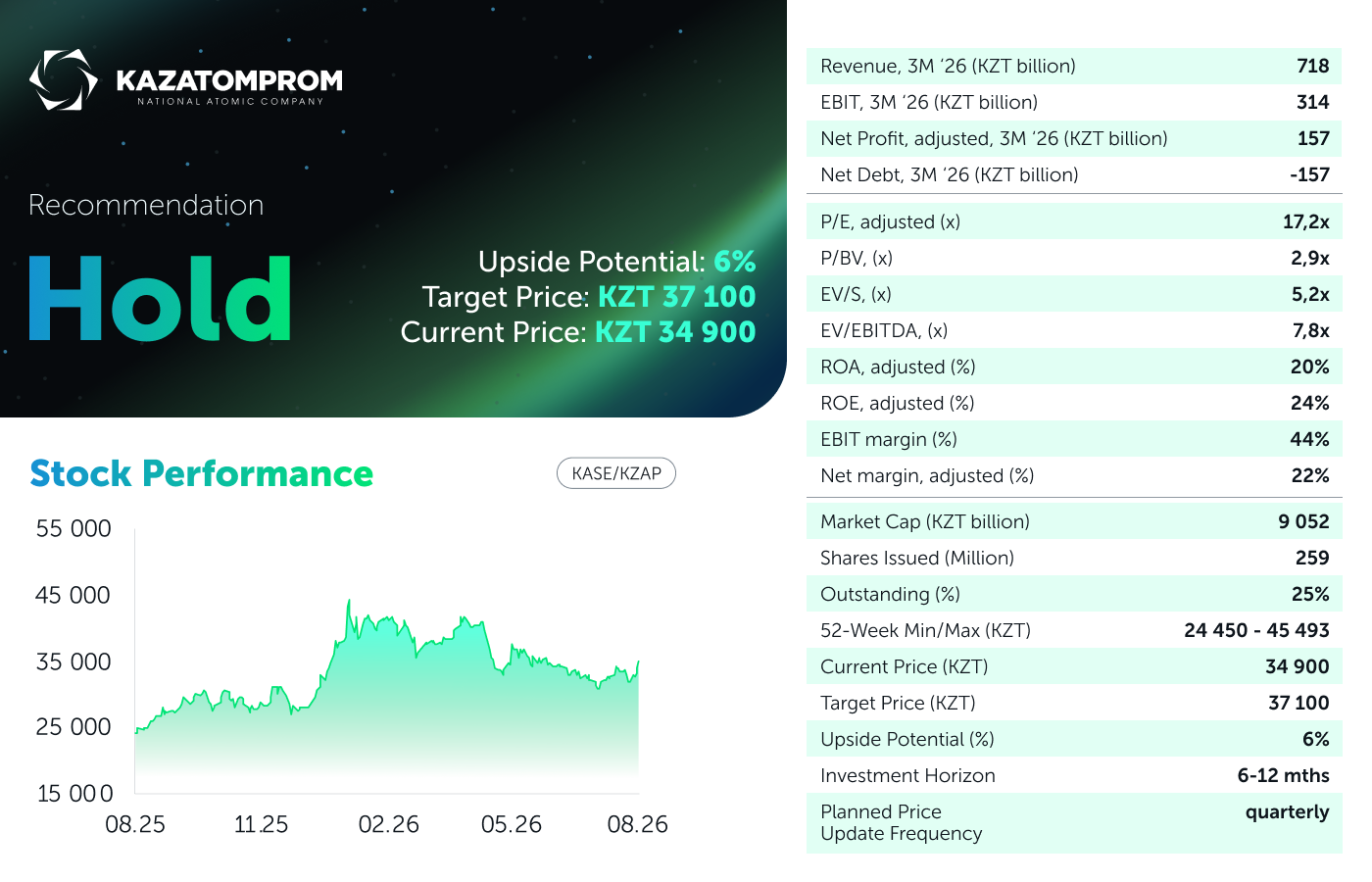
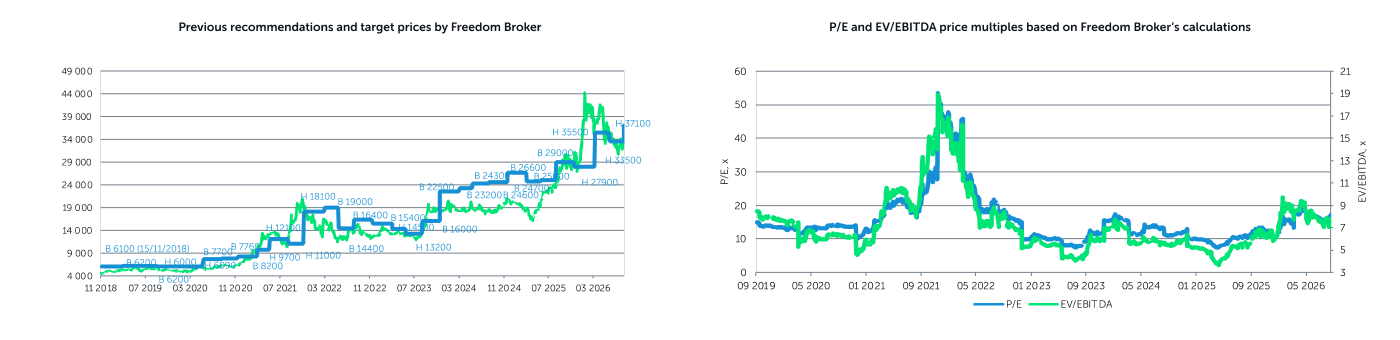
Kazatomprom JSC has published its results for the first half of 2026. We assess the report as neutral, given the expected decline in profitability due to higher mineral extraction tax (MET) rates, which are also being applied to higher market prices. Revenue increased, but primarily due to higher prices, while the growth in costs outpaced revenue growth as a result of an almost twofold increase in tax payments. Production continues to show year-on-year growth, but this did not translate into higher sales due to differences in delivery schedules. Net profit attributable to shareholders decreased by 23% year-on-year. The company reaffirmed its 2026 production guidance but downgraded its forecasts for revenue in tenge and costs in US dollars, largely due to a lower USD/KZT exchange rate than previously projected. In our valuation model, we also lowered our USD/KZT exchange rate forecast, raised our projected market price of uranium, and updated the cost of capital. As a result, we increased our target price for Kazatomprom shares from KZT 33,500 to KZT 37,100, implying 6% upside potential from the current price. Our recommendation remains unchanged at “Hold.”
Core Valuation Factors. The key structural factor remains the differentiated mineral extraction tax (MET) rate introduced on January 1, 2026. This cost component posted the strongest increase, while the Company’s own guidance confirms a 41% year-on-year increase in cash C1 costs and a 32% increase in AISC. Pressure from the low USD/KZT exchange rate also persists, resulting in downgraded management guidance for revenue in tenge and cash costs in US dollars. In addition, management raised its 2026 capital expenditure guidance for mining operations from KZT 415–430 billion to KZT 435–450 billion, which does not materially change our valuation. Operationally, the first half of the year was moderately positive. Uranium production increased by 9–10% year-on-year, depending on the calculation method, largely driven by the relatively new Budenovskoye joint venture, where production increased by 140% year-on-year and net profit rose by 569% year-on-year. An important development was the retention of the Akdala asset within the Group. Following the expiry of the subsoil use contract on March 28, the right was transferred to Kazatomprom on March 29 and, as of April 17, to its wholly owned subsidiary Kazatomprom-SaUran LLP. Production from the field is therefore moving from the 30%-owned associate South Mining and Chemical Company (YUGK) to a fully consolidated asset. The transfer also included a KZT 13.6 billion decommissioning fund.
Revenue: Growth Driven by Higher Prices Despite Shifted Delivery Schedules. Consolidated revenue amounted to KZT 718 billion (+8.7% year-on-year). Revenue from natural uranium sales increased by 9.6% year-on-year to KZT 651 billion, driven by higher prices. The Group’s average realized price increased by 16% year-on-year. Production on a 100% basis increased by 8.6% year-on-year to 13.3 thousand tonnes, while production based on ownership interests rose by 9.7% year-on-year to 7.1 thousand tonnes. However, consolidated sales volumes decreased by 0.5% year-on-year, with most of the decline attributable to shifts in the schedule of uranium deliveries to customers. Revenue from tantalum product sales and processing services also increased. In contrast, revenue from beryllium product sales decreased by 15% year-on-year.
Margins: Tax Pressure Persists. Gross profit increased by 1.3% year-on-year to KZT 290 billion, while gross margin declined from 43.4% to 40.4%. The key structural factor weighing on margins is the differentiated mineral extraction tax (MET) rate introduced on January 1, 2026. Taxes other than income tax included in cost of sales increased by 98% year-on-year to KZT 86 billion. At the same time, the largest expense item, “raw materials and supplies,” decreased by 7.4% year-on-year to KZT 204 billion, in line with lower sales volumes and reduced uranium purchases from joint ventures and associates. Within production costs, sulfuric acid continues to become more expensive: the weighted average purchase price increased by 38.7% year-on-year to KZT 97,312 per tonne, accounting for 15.3% of the cost base, while the commissioning of the TQZ plant has been postponed by 6–12 months. Depreciation and amortization included in cost of sales increased by 30% year-on-year. As costs grew faster than revenue, EBITDA margin declined from 55.6% to 52.5%. Net profit attributable to shareholders amounted to KZT 157 billion, down 23% year-on-year. Total net profit, however, amounted to KZT 240 billion, with a significant portion attributable to the non-controlling interests in the Budenovskoye and Inkai joint ventures, which posted sharp increases in revenue and profit compared with the previous year. An additional headwind came from a KZT 19 billion foreign exchange loss amid the strengthening of the tenge. Operating cash flow fell sharply by 55% year-on-year, while free cash flow decreased by 70% year-on-year.
Our Opinion and Changes to the Valuation Model. We assess the first half as neutral: the decline in net profit attributable to shareholders is almost entirely attributable to structural and non-operating factors, namely higher mineral extraction tax (MET), the strengthening of the tenge, and a greater share of profit attributable to non-controlling interests. From an operational perspective, the period was steady, with growing production, higher realized prices, and confirmed volume guidance. As the Company maintained its production and sales guidance, our valuation model’s volume assumptions remain unchanged. We lowered our USD/KZT exchange rate forecast, as the exchange rate is tracking below our previous expectations. The Company itself revised its exchange rate assumption from KZT 540 to KZT 490 per US dollar, while our forecast is slightly lower, averaging KZT 481 per US dollar in 2026. We also raised our forecast for the market price of uranium in the valuation model, reflecting the actual increase in prices, and updated our cost of capital following higher US dollar-denominated yields in the market. In addition, we deducted the announced KZT 335 billion dividend for 2025 from our valuation, as it remained recognized as a liability as of June 30 and was paid in July. As a result, we raised our target price for Kazatomprom shares from KZT 33,500 to KZT 37,100, implying 6% upside potential. Our recommendation remains unchanged at “Hold.”

Author: Daniyar Orazbayev,
CFA, Investment Analyst
(+7) 727 311 10 64 (688) | [email protected]