
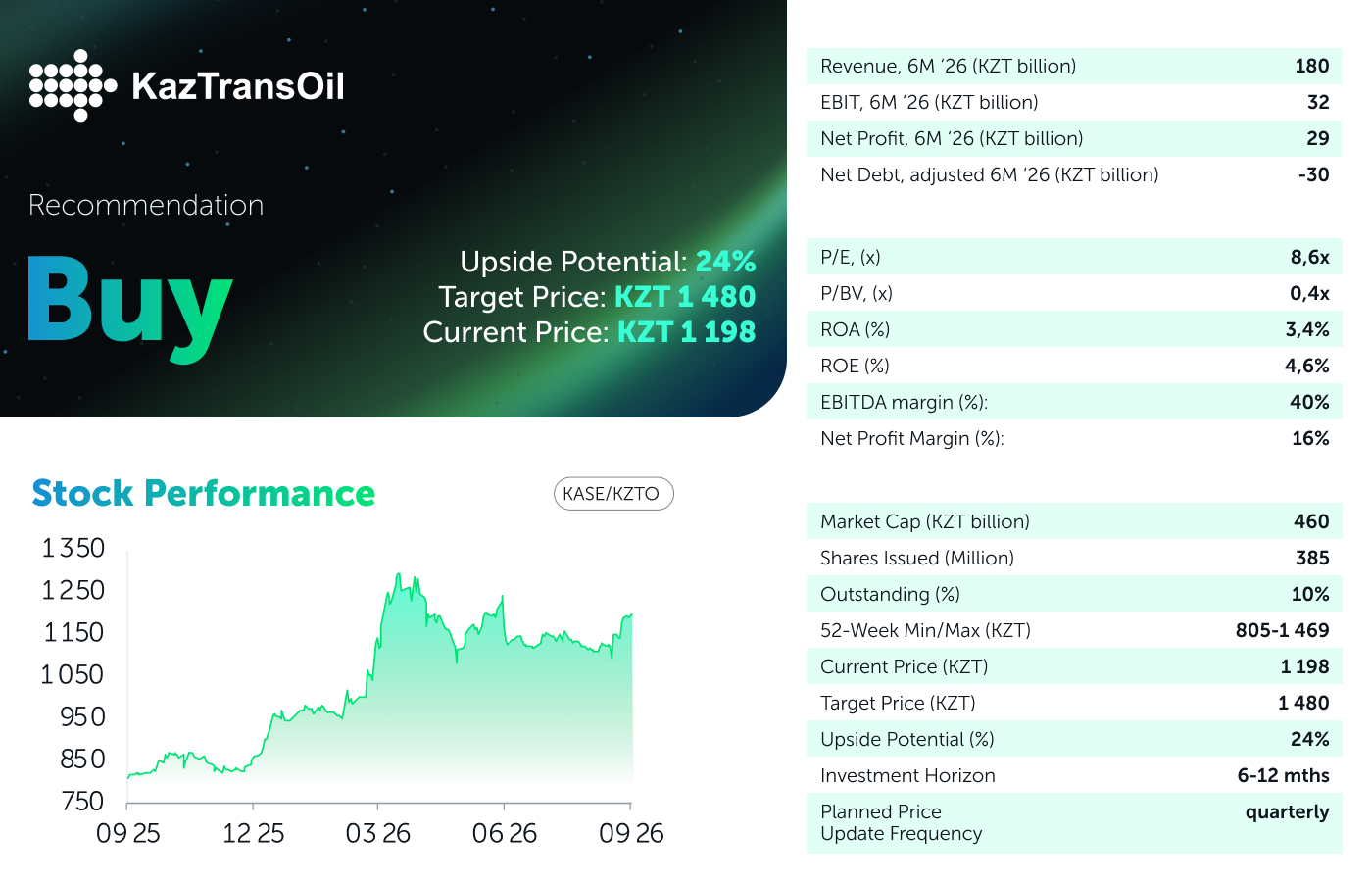
KazTransOil JSC published its financial results for the Q2 2026. We assess the report as neutral, as the cost of sales grew faster than revenue, driven by higher labor costs and depreciation. Nevertheless, the EBITDA margin declined only slightly, while quarterly net income remained broadly stable, showing a modest year-on-year decrease. Free cash flow improved significantly in the second quarter on a standalone basis. From an operational perspective, the quarter was also fairly neutral. In the coming quarters, we expect revenues to increase following the introduction of the new export tariff, which is 11% higher than the previous tariff. We also note the high level of financial income, supported by a strong cash position of KZT 339 per share. In our valuation model, we lowered the cost of capital following its decline in the market. On the other hand, we reduced our margin forecasts following the actual increase in expenses in the second quarter and incorporated a decrease in the oil transportation tariff charged by MunaiTas. As a result, we have lowered our updated target price for KazTransOil shares from KZT 1,490 to KZT 1,480, implying 24% upside potential. Our recommendation remains unchanged at Buy.
Core Valuation Factors. The key catalyst remains the tariff lever, but its impact was only partially reflected in the second quarter. The domestic tariff of KZT 4,963 per tonne per 1,000 km versus KZT 4,462 a year earlier (+11% YoY) is already reflected in the quarterly base, while the new export tariff of KZT 12,500 (+11%) has been effective only since June 1, with its main impact expected in the third quarter. At the same time, the domestic tariff remains 27% below the previously approved tariff schedule. The strategic factor remains the restructuring of export routes in the western direction. Since May 1, the transit of Kazakh oil to Germany via the Druzhba pipeline has been suspended, and volumes have been redirected to the ports of Ust-Luga and Novorossiysk, as well as to the CPC system, where transshipment volumes increased by 40% YoY to 2.5 million tonnes in the first half of the year, while the Atyrau–Samara route remained virtually flat. The picture across joint ventures is mixed: KazTransOil's share of profit from KCP fell by 21% in the first half of the year, while from July 1, MunaiTas's tariff for the domestic market was cut by 15%. Sanctions-related uncertainty has declined substantially, as the OFAC ruling and the UK OFSI license obtained allow operations with Rosneft and Transneft until March 19, 2027 and March 19, 2028, respectively.
Revenue: modest growth driven by tariffs. Quarterly revenue amounted to KZT 90.9 billion (+6.8% YoY). The largest revenue item, crude oil transportation, increased by 7.7% YoY to KZT 65.7 billion despite a 0.6% YoY decline in quarterly transportation volumes. The main growth driver was an 11% YoY increase in the oil transportation tariff for the domestic market, as well as the recent 11% increase in the oil export tariff effective June 1. Revenue from pipeline operation and maintenance services increased by 0.7% YoY, while water transportation revenue posted the highest growth rate among the major revenue streams, rising 10% YoY. The share of profit from joint ventures (KCP and MunaiTas) increased by 27% YoY to KZT 4.6 billion, driven by a 10% YoY increase in MunaiTas's quarterly transportation volumes and an unusually low base in the previous year. At the same time, KCP's profit declined by 15% YoY.
Margin deterioration despite stable net profit. Quarterly gross margin deteriorated from 20% last year to 16%. Cost of sales increased by 13% YoY, driven by higher personnel costs (+11% YoY) and depreciation and amortization (+21% YoY). The former was partly attributable to higher mandatory payroll-related contributions, while the latter resulted from the fixed assets revaluation. Other operating income declined by 29% YoY due to the absence of income from the revision of the asset retirement provision. As a result, operating profit fell by 16% YoY to KZT 14.2 billion. The EBITDA margin deteriorated less significantly than gross margin due to depreciation and amortization, declining from 39.1% a year earlier to 37.6%. Financial income jumped 60% YoY to KZT 5.6 billion and remains elevated, providing positive support to net profit. As a result, quarterly net profit amounted to KZT 12.5 billion, or KZT 32 per share (-1.6% YoY and -26% QoQ). However, excluding the one-off income recognized in the first quarter, quarterly net profit would have declined by 9% rather than 26%. Quarterly cash flow from operating activities increased by 17% to KZT 30.5 billion, while free cash flow amounted to approximately KZT 23 billion, up 62% YoY.
Our Opinion and Changes to the Valuation Model. The report confirms that the tariff lever is working, but in the second quarter its impact was fully offset by higher expenses. A significant portion of the increase is structural: following the revaluation of fixed assets at the end of 2025, accumulated depreciation was reset to zero, resulting in annualized depreciation of KZT 80 billion versus approximately KZT 71 billion in 2025. Cost pressure is likely to persist, particularly as the company expects maintenance activities to be seasonally weighted toward the second half of the year. On the other hand, the full effect of the export tariff will be reflected from the third quarter, while interest income remains elevated. The dividend base remains solid: the KZT 118 per share dividend for 2025 represented approximately 99% of net profit, while free cash flow over the previous four quarters was significantly higher than the dividend payout. At the KASE Issuer Day, the company disclosed its expansion program: the throughput capacity of TON-2 will increase from 10 million to 12.5 million tonnes per year, with investments of approximately USD 54.5 million. For the Kenkiyak–Atyrau and Kenkiyak–Kumkol sections, the company plans to raise USD 327 million in debt financing, with implementation scheduled through 2030. These assets are owned by joint ventures, so their impact on the company's financial statements will be indirect. In our valuation model, we lowered the cost of capital in line with market trends, reduced our margin forecasts following the actual increase in expenses, and incorporated a reduction in the MunaiTas tariff. As a result, we have lowered our target price for KazTransOil shares from KZT 1,490 to KZT 1,480, implying 24% upside potential. Our recommendation remains unchanged at Buy.

Author: Daniyar Orazbayev,
CFA, Investment Analyst
(+7) 727 311 10 64 (688) | [email protected]