
KEGOC: Tariff Increases Lift Margins for a Fourth Straight Quarter; Raising PT, Maintaining Buy
Issuer Analysis
26 November 2026, 16:51
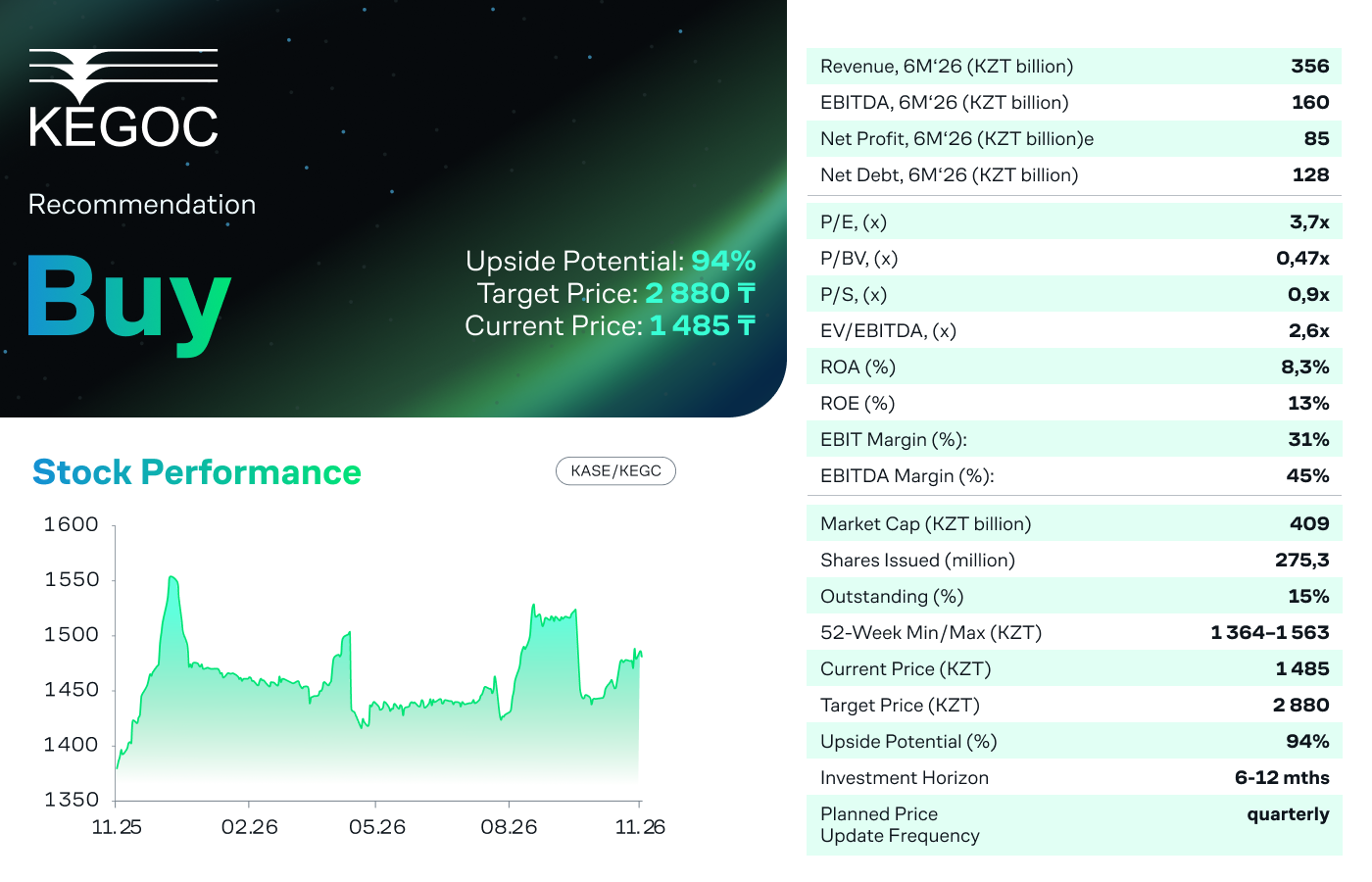
KEGOC reported financial results for 3Q26. We view the report as positive. Quarterly revenue continued to grow, driven by tariff increases of 24% to 31% year-over-year (y/y). Margins expanded for the fourth consecutive quarter on the higher tariffs and, in part, a 6.8% y/y decline in the cost of technical losses.
On the other hand, rising capital expenditures under the new investment cycle kept FCF negative, and the Company’s borrowings increased to KZT 129 billion from KZT 5 billion at the start of the year. As a result, net income growth is likely to have little effect on dividends over the next few years, since the dividend policy now ties payouts to FCF.
In our model, we raised our tariff forecasts in line with the new tariff estimate and lowered our volume forecasts for the main services. We raise our price target for KEGC to KZT 2,880 per share from KZT 2,300, implying 94% upside, and maintain our Buy rating.
Key Valuation Factors
High tariffs and the newly approved five-year tariff schedule remain the main driver of our valuation. 3Q26 was the first full quarter of the tariff increases effective May 1. These increases drove the growth in revenue and margins.
The main risk of prior quarters has been resolved: on August 28, the Committee for the Regulation of Natural Monopolies approved tariffs and tariff estimates for 2026 to 2031. In the first tariff year (October 2026 to September 2027), tariffs are almost unchanged from current levels: transmission rises 1.2%, national grid usage rises 1.7%, dispatch stays flat, and balancing declines 9.3%.
Most of the increase begins in October 2027 (transmission +22%, national grid usage +19%, and dispatch +33% from first-year levels), and by the final year of the schedule, tariffs for transmission and national grid usage will exceed current levels by 66% and 53%, respectively. That said, about half of the revenue increase under the tariff estimates through 2031 covers technical losses and interest on borrowings.
The scale of the investment cycle remains the main structural risk: capital expenditures rose 92% y/y to KZT 145.9 billion in 9M26. Most of the spending goes to two 500 kV transmission lines, one to reinforce the Southern Zone and one to connect the Western Kazakhstan power system to the Unified Power System of Kazakhstan.
To finance these projects, KEGOC increased its borrowings to KZT 129 billion from KZT 5 billion at the start of the year, including KZT 59.8 billion from the Asian Development Bank at 17.0% to 18.6%, KZT 33.6 billion from the European Bank for Reconstruction and Development at the Tenge Overnight Index Average plus 2.75%, and KZT 32.1 billion from the Development Bank of Kazakhstan at 12.6%.
Net debt/EBITDA remains low at 0.5x, but debt/EBITDA under lender covenants is already 1.37x to 1.42x, approaching the 1.5x threshold above which the minimum payout under the dividend policy falls to 50% of FCF from 75%.
Revenue: Tariffs Continue to Drive Growth
Quarterly revenue reached KZT 116 billion (+21% y/y), up 1.8% quarter-over-quarter despite the weak summer season.
The largest revenue item was national grid usage, which grew 33% y/y to KZT 60.9 billion on a 31% y/y tariff increase and a 1.6% y/y rise in quarterly volumes. Transmission revenue rose 23% y/y to KZT 19.6 billion: the tariff increased 30% y/y, while volumes declined 5.5% y/y. Dispatch revenue rose 24% y/y on a 24% y/y tariff increase, with a small 0.2% y/y increase in volumes.
Revenue from sales of balancing electricity on the balancing electricity market (BEM) fell 6% y/y to KZT 14.4 billion. Balancing services revenue rose 30% y/y, while revenue from compensation of interstate power flows declined 48% y/y. Electricity generation in Kazakhstan rose 0.8% y/y in 3Q26, a slower pace than in 2Q26.
Margins: EBITDA Margin Rose to 45%
EBITDA was KZT 52.3 billion (+73% y/y), and the EBITDA margin expanded to 45.2% from 31.6% a year earlier. The expansion extended the margin recovery that began in 4Q25. Gross margin reached 34.9%, compared with 19.7% a year earlier.
Cost of sales fell 2.2% y/y while revenue grew 21% y/y, and gross profit rose 114% y/y. Lower pass-through items more than explain the decline in cost of sales: purchases of electricity on the BEM and for compensation of interstate power flows fell KZT 3.6 billion y/y, compared with a KZT 1.7 billion decline in total cost of sales. Excluding these items, cost of sales rose 3.3% y/y and revenue rose 31% y/y.
The cost of technical losses fell 6.8% y/y to KZT 20.9 billion, the first y/y decline since 1Q23. Electricity purchases to compensate interstate power flows fell 11% y/y. Depreciation and amortization rose only 2.5% y/y to KZT 14.5 billion, and payroll expenses rose 13% y/y.
As a result, quarterly net income rose 175% y/y to KZT 30.1 billion, or KZT 109.2 per share. Net margin reached 26%, compared with 11.4% a year earlier.
Quarterly FCF remained negative, with an outflow of KZT 10.4 billion. The main driver was a 356% y/y increase in capital expenditures, which we had expected given the start of the large investment cycle. Operating cash flow, meanwhile, rose 121% y/y.
Our View and Model Revisions
As expected, the 3Q26 report was fairly positive, with financial results and margins continuing to grow on higher tariffs. The newly approved five-year tariff schedule came in above our expectations: the 2031 weighted-average tariff in our model rose to KZT 5.26/kWh from KZT 3.99/kWh. The new schedule lifted our valuation and cash flow forecasts.
That said, the investment cycle is gaining momentum and weighing on cash generation. Following the change in dividend policy, we do not expect dividends to rise over the next few years, as FCF is likely to remain low. The 1H26 dividend supports this view: KZT 81.25 per share, compared with KZT 80.90 for 2H25, despite 59% y/y growth in 1H26 net income.
In our model, we raised our tariff assumptions in line with the five-year tariff estimate, by an average of 26% across the forecast period. However, we also lowered our volume assumptions for transmission, national grid usage, balancing, and dispatch by an average of 17%. We also raised our cost assumptions for technical losses by an average of 7% to reflect a likely increase in electricity prices.
We maintain our Buy rating on KEGC and raise our price target to KZT 2,880 per share from KZT 2,300, implying 94% upside.