
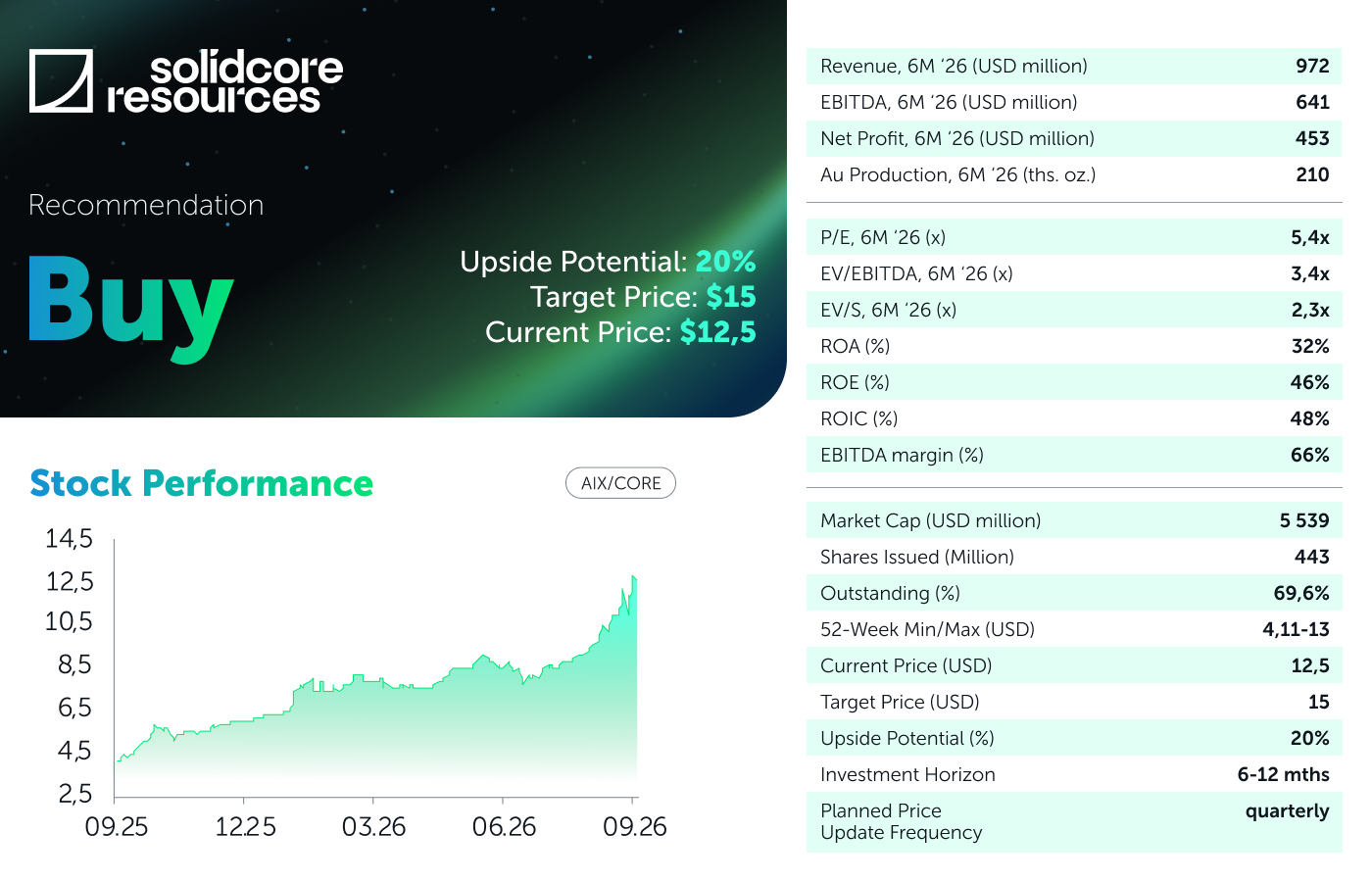
Solidcore Resources has published its financial results for the first half of 2026. We view the report as moderately positive: a sharp increase in the gold price, combined with higher sales volumes from a relatively low base last year, drove growth in revenue and EBITDA. However, compared with the previous half-year period, all key financial metrics declined due to disruptions in doré shipments from Russia following changes to gold export regulations. Deliveries normalized in July, and the company reaffirmed its previous production guidance. The company also announced a $1.2 billion share buyback at $11.66 per share. In our valuation model, we significantly increased our long-term forecast gold prices and also raised our cost assumptions amid the strengthening tenge and higher tax payments resulting from the increase in forecast gold prices. Our updated target price for Solidcore shares is $15, implying 20% upside potential from the current market price. Recommendation: Buy.
Core Valuation Factors. The key positive factor remains the gold price: the average market price in the first half of the year increased by 53% year-on-year, while the current price is approximately 10% above the company’s budget assumption of $4,000/oz. Another positive factor is the confirmed production guidance of 540 thousand ounces (+37% YoY), implying approximately 330 thousand ounces in the second half of the year, partly driven by the release of accumulated inventory. The main risk is related to the large-scale investment cycle: approximately $317 million of capital expenditure, excluding the Syrymbet project, is expected in the second half of the year. If the buyback is completed in full, the company’s balance sheet will show a small net debt position of no more than 0.3x EBITDA. At the same time, $700 million in debt financing for the Yertis Hydrometallurgical Plant project has already been secured. Another important risk is tax pressure: mineral extraction tax (MET) under the new progressive 11% rate accounts for 40% of operating costs and will increase alongside the gold price. Reliance on third-party processing of Kyzyl concentrate remains a structural operational risk until the Yertis Hydrometallurgical Plant project is commissioned, as clearly demonstrated by the delivery delays in the first half of the year.
Revenue: decline on a half-year basis due to delivery delays. Revenue in the first half of the year amounted to $972 million versus $325 million a year earlier (+199% YoY). However, compared with the previous half-year period, revenue was 17% lower due to a decline in gold production and sales volumes. First-half production amounted to 210 thousand ounces of gold equivalent versus 271 thousand ounces in the second half of 2025 (-22% HoH). Nevertheless, volumes increased by 71% year-on-year, driven by a low base, as disruptions in toll processing had almost completely halted sales during the comparative period. The main factor behind the half-on-half decline was Kyzyl, where production fell by 35% HoH but increased by 159% YoY. This was caused by changes to Russia’s gold export regulations, which resulted in delays in doré shipments from the Amur Hydrometallurgical Plant. However, deliveries resumed in July and are now proceeding normally. Varvarinsk showed positive dynamics, with production of 88 thousand ounces in the first half of the year versus 85 thousand ounces in the previous half-year and 76 thousand ounces a year earlier. Gold sales in the first half of the year amounted to 205 thousand ounces (-33% HoH, +97% YoY), including 121 thousand ounces at Kyzyl (-44% HoH) and 84 thousand ounces at Varvarinsk (-8% HoH). The average realized gold price in the first half of the year reached $4,748/oz versus $3,161/oz a year earlier (+50% YoY) and $3,815/oz in the second half of 2025 (+24% HoH).
Margins: slight decline as cost growth outpaced the increase in gold prices. Cash cost per ounce in the first half of the year amounted to $1,435/oz (+40% HoH and -1.6% YoY). All-in sustaining cost reached $1,912/oz versus $2,201/oz a year earlier and $1,307/oz in the second half of 2025. The key drivers of the half-on-half increase in costs were lower Kyzyl sales, inflation, higher mineral extraction tax (MET), and the strengthening tenge. MET increased by 122% YoY and 112% HoH to $142 million, with its share of the cost structure increasing from 25% to 40% over the year. Dollar-denominated labor costs increased by 38% YoY, largely due to the strengthening tenge and higher headcount. Adjusted EBITDA in the first half of the year amounted to $641 million, with a margin of 66%, versus $152 million and 47% a year earlier and $820 million and 70% in the previous half-year period. Net profit for the first half of the year amounted to $453 million versus $85 million a year earlier (+433% YoY) and $577 million in the second half of 2025 (-21% HoH). Operating cash flow in the first half of the year amounted to $436 million versus -$86 million a year earlier, reflecting higher sales volumes. However, compared with the previous half-year period, the figure declined by 37%. Free cash flow in the first half of the year reached $243 million versus -$220 million a year earlier. Compared with the previous half-year period, the figure more than halved. Net cash increased to $653 million, while total debt stood at $225 million (-16% HoH). The company recently signed financing agreements totaling $700 million for the construction of Yertis Hydrometallurgical Plant: $300 million from the EBRD, $300 million from a banking syndicate comprising ING, Société Générale and Abu Dhabi Commercial Bank, and a further $100 million from KfW IPEX-Bank.
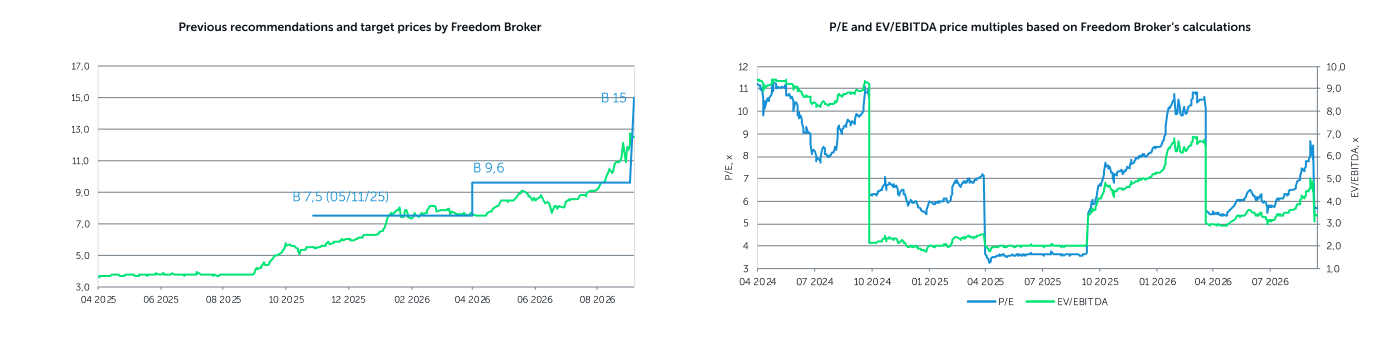
Our Opinion and Changes to the Valuation Model. The decline in the half-on-half metrics is largely temporary: mine-level production remained stable, while delivery delays shifted some metal sales into the second half of the year. We view the $1.2 billion share buyback positively: the offer price of $11.66 is almost 22% below our current target price, making the transaction beneficial for the remaining shareholders, while leverage is expected to remain relatively low following the buyback. However, the company emphasizes that the buyback is a one-off transaction, so investors should not expect regular capital returns. In our valuation model, we significantly increased our long-term gold price forecasts and also raised our cost assumptions to reflect the strengthening tenge and higher tax payments resulting from higher gold prices. Following these changes, we raised our target price for Solidcore shares to $15, implying 20% upside potential from the latest market price. Recommendation: Buy.

Author: Daniyar Orazbayev,
CFA, Investment Analyst
(+7) 727 311 10 64 (688) | [email protected]