
Financier №1 (41) 2026

Yegor Tolmachev
Senior Analyst, Freedom Finance Global
Lisa Su – The Rock‑Solid CEO
How the Head of AMD Overtook Intel in the Processor Market
Lisa Su’s story is a striking business case of female leadership in the tech sector. Her management style serves as a clear example of how, by following a precise and well‑thought‑out plan, one can radically shift the balance of power in an industry.
A Story Reset
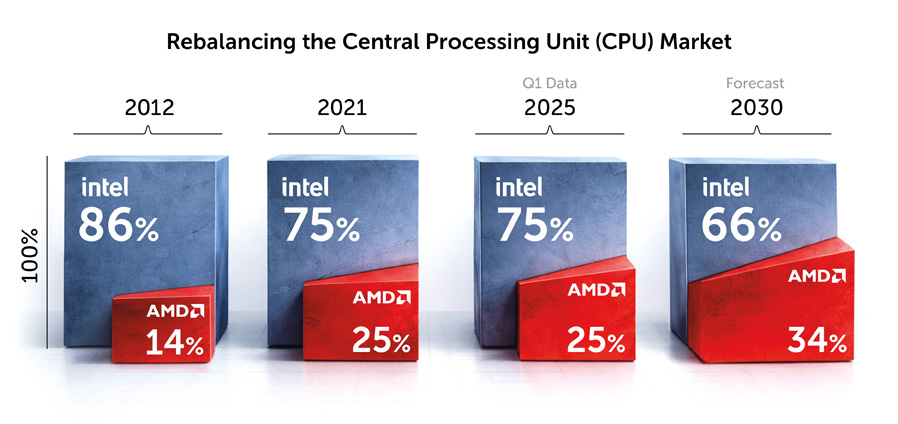
When Lisa Su took the position of CEO at Advanced Micro Devices (AMD), the company was on the brink of financial collapse. Its main rival, Intel (INTC), controlled nearly 90 % of the PC processor market and 99 % of the server chip segment.
A decade later, the picture has changed dramatically. AMD has grown into a company with a capitalisation of over $360 billion. It now holds about one‑third of the server CPU market and roughly a quarter of the PC processor market. Lisa Su’s ambitions do not end with beating Intel: the company is already aiming to surpass the tech giant NVIDIA (NVDA).
*CPU is the central processing unit, the “brain” of a computer, which is responsible for all its operations and calculations
Heir to Two Cultures
Lisa Su was born in Taiwan. When she was just three years old, her family moved to the United States. She studied at one of the world’s most prestigious universities - the Massachusetts Institute of Technology (MIT) - where she earned a PhD in electrical engineering. She spent a year at Texas Instruments (TXN), in a semiconductor product design centre, and then moved to IBM (IBM), where she worked on implementing copper usage in semiconductors. The technology developed at IBM eventually became a new industry standard.
Later, Lisa Su joined Freescale Semiconductor, a company specialising in chip manufacturing. There, she began honing her management skills: she first held the position of R&D (Research and Development) division head, but soon became Vice President and General Manager of the Freescale group of companies. Under Ms. Su’s leadership, marketing, development strategy, and new product creation were all managed.
Source: pcviewed.com
Business Over the Abyss
In 2014, Lisa Su became CEO of AMD, a microchip design company. At that time, due to a sharp revenue decline, the business had to cut staff. The issue was that AMD was trying to make money in several areas at once and was producing a wide range of products - from smartphone microchips to IoT sensors and graphics processors.
Lisa Su decided to change the strategy and focus on developing powerful processors capable of competing with the industry’s flagship products - specifically, with Intel’s offerings, which at the time were the undisputed leader in the sector. The new top manager retained only three business lines: processors for computers and servers, graphics solutions, and custom chips for major clients.
“For a technology company, it is vital to identify what you excel at, because you need to be among the best - number one or two,” was Lisa Su’s guiding principle.
Under the new CEO’s leadership, the corporation doubled its investment in research and development. The main risk for her was the lack of financial resilience: the company simply could not survive a failure of the proposed strategy.
Zen: An Architectural Breakthrough
A key decision in Lisa Su’s tenure as AMD’s CEO was to completely overhaul the internal structure of processors. This project was code‑named Zen. In March 2017, the company unveiled its first processors based on the new architecture. They were significantly better than previous models: they ran faster and consumed less power. This result was made possible by a new approach to design.
It’s worth explaining that before this, both AMD and Intel processors were monolithic silicon dies that looked like a single large wafer. AMD introduced a different approach: processors began to be assembled from several small modules - chiplets. These can be compared to a set of LEGO blocks that connect inside a single “box”. Each such block contains several cores and a portion of memory.
The new approach gave AMD several advantages at once. First, the production of small blocks-chiplets is much easier and cheaper. Second, if one block turned out to be of poor quality, it does not disable the entire processor, because only its defective part can be replaced. And finally, the proposed design allows for flexible power growth: the more blocks, the higher the number of computing cores and better performance.
With the launch of Zen processors, AMD returned to the big game: the new Ryzen chips for PCs and EPYC for servers matched and in some cases surpassed the efficiency of comparable Intel solutions.
Later, AMD released the 3D V‑Cache solution to increase the amount of cache (very fast memory) inside the processor. Figuratively speaking, engineers proposed something like an extra shelf placed directly above the workbench. Thanks to this, everything needed was at hand, rather than in the metaphorical drawers of a separate cabinet. The same applies to data placement in cache: there is no need to access RAM, and the processor processes information almost instantly.
AMD placed an additional layer of cache on top of the processor’s main die - literally in the third dimension. This is where the technology’s name comes from. The effect is especially noticeable in games where the processor constantly works with large amounts of data - such as strategy games (like Total War), flight simulators, and multiplayer online games.
The Engineering of Leadership
AMD’s success was driven by Lisa Su’s management strategy. She believes that leaders are not born but made. The CEO holds meetings on weekends, and work shifts at the company sometimes continue past midnight. “People are inspired by high goals,” says the top manager. At the same time, she creates an environment that enables every team member to make the maximum contribution to the common cause. According to Glassdoor, 400 AMD employees are satisfied with their work‑life balance. Lisa Su’s approval rating stands at 95 %.
Challenges Ahead
When Lisa Su took the helm at AMD, the company’s shares were trading at around $3. Those who invested $100 in AMD stock in 2012 have earned $6 700 by now. AMD’s capitalisation soared from $2.5 billion to an impressive $338 billion by mid‑February 2026. In 2022, the company surpassed Intel in this metric for the first time.
Despite these outstanding achievements, AMD also faces serious challenges. One of them remains the dominance of NVIDIA in the AI chip segment, which holds roughly 85 % of the market share.
An interesting fact: Lisa Su is a second cousin of NVIDIA CEO Jensen Huang
Meanwhile, long‑time rival Intel is not backing down either. The corporation is actively strengthening its advantages over other players in the sector. The company’s new leader, Lip‑Bu Tan, has chosen a path similar to the one Lisa Su once took. While AMD relies on Taiwan Semiconductor Manufacturing (TSM) for chip production, Intel is striving to revive its own manufacturing capacity - a move that could give it a crucial edge in the race for market leadership.