
Financier №1 (41) 2026

Eldar Shakenov
Analyst, Financial Analysis Department, Freedom Broker
Cherchez la Femme
Why Businesses Are Focusing on the Female Audience
Female demand has become one of the new drivers of corporate growth in the early 2020s. Companies that build their marketing strategies around women’s needs and tailor their products and services to this audience demonstrate more sustainable and stable growth compared to those that ignore this segment.
The Engine of Consumption
According to surveys in the US, women influence 70–85 % of purchasing decisions. They spend 50 % more than men on home improvement and household goods. In addition, women purchase 62 % of new cars and 85 % of total sales in this category are driven by their demand. Finally, in 91 % of cases, a family buys a house based on the wife’s proposal.
Women account for about 40 % of the global workforce, and this share is growing year by year. In the US, more than 40 % of employed women earn more than their husbands.
Between 2019 and 2024, the number of companies controlled by businesswomen increased by 11.5 %, exceeding the growth rate of businesses owned by men. In 2025, 42 % of US companies generating $1.9 trillion in revenue were owned by women. The average revenue of women‑owned businesses reaches $520 thousand, with an annual growth rate of 15 %.
Furthermore, women make up 55 % of university graduates worldwide. Holding a higher education further boosts their competitiveness and contributes to higher earnings.
Her Choice
Societal stereotypes do not always reflect women’s real needs. It is enough to list some business segments that are booming precisely thanks to their female user base.
- Video Games. The share of women in the gaming community is approaching 50 %, and they are more active in purchasing games. Nevertheless, marketing in this industry remains predominantly focused on the male audience, which highlights a significant untapped potential.
- Automotive Industry. Premium brands such as Porsche and BMW are noting an increase in their female audience. Honda is increasingly targeting this demographic in motorcycle design, highlighting higher customer loyalty among women and their focus on safety.
- Healthcare. The market for women’s health technologies was valued at $50 billion in 2025. Femtech startups are offering solutions for patients’ reproductive and mental health, as well as innovations related to nutrition and overall fitness.
- Sports. Women demonstrate strong demand for clothing and footwear suitable for everyday use and sports activities (the so‑called athleisure style). Fitness gear and home exercise equipment remain highly sought after, but many manufacturers in this sector still develop new products with a focus on men.
Who Has Already Profited from the Trend?
Dove: From the Cult of Beauty to Cultural Transformation. The Dove’s Real Beauty Campaign, launched over two decades ago, has become a prime example of how refocusing on female demand can lead to exponential growth. Instead of featuring models with idealized figures and faces, the company chose to showcase real women of various ages and backgrounds. Dove’s revenues grew by 10 % in one year and increased by 60 % over a three‑year period, rising from $2.5 billion to $4 billion. The campaign attracted media attention, and the volume of free publicity was 30 times higher than the corporation’s advertising spend.
Dove launched its Real Beauty Campaign following research from The Real Truth About Beauty: A Global Report: which found that only 2% of women worldwide consider themselves beautiful
Lowe’s (LOW): Aligning with Female Shoppers. In the late 1990s, the home improvement retailer conducted a study and found that women initiate 80 % of home renovation projects. At the same time, the store design had been based on the preferences of the male audience. Considering these findings, the layout was revised: the malls received brighter lighting, wider aisles, and an expanded assortment of storage solutions, cleaning products, and decorative items. For the retailer’s business, this proved to be a true breakthrough: the return on investment (ROI) reached an impressive 400 %. Lowe’s shares appreciated 2.5‑fold from 2001 to 2005, while its competitor Home Depot (HD), which lagged behind the trend and did not consider female shoppers a significant segment, lost one‑third of its market capitalization.
The typical Lowe’s shopper today is a suburban female homeowner aged around 60. Her yearly expenditure at the store is more than $800
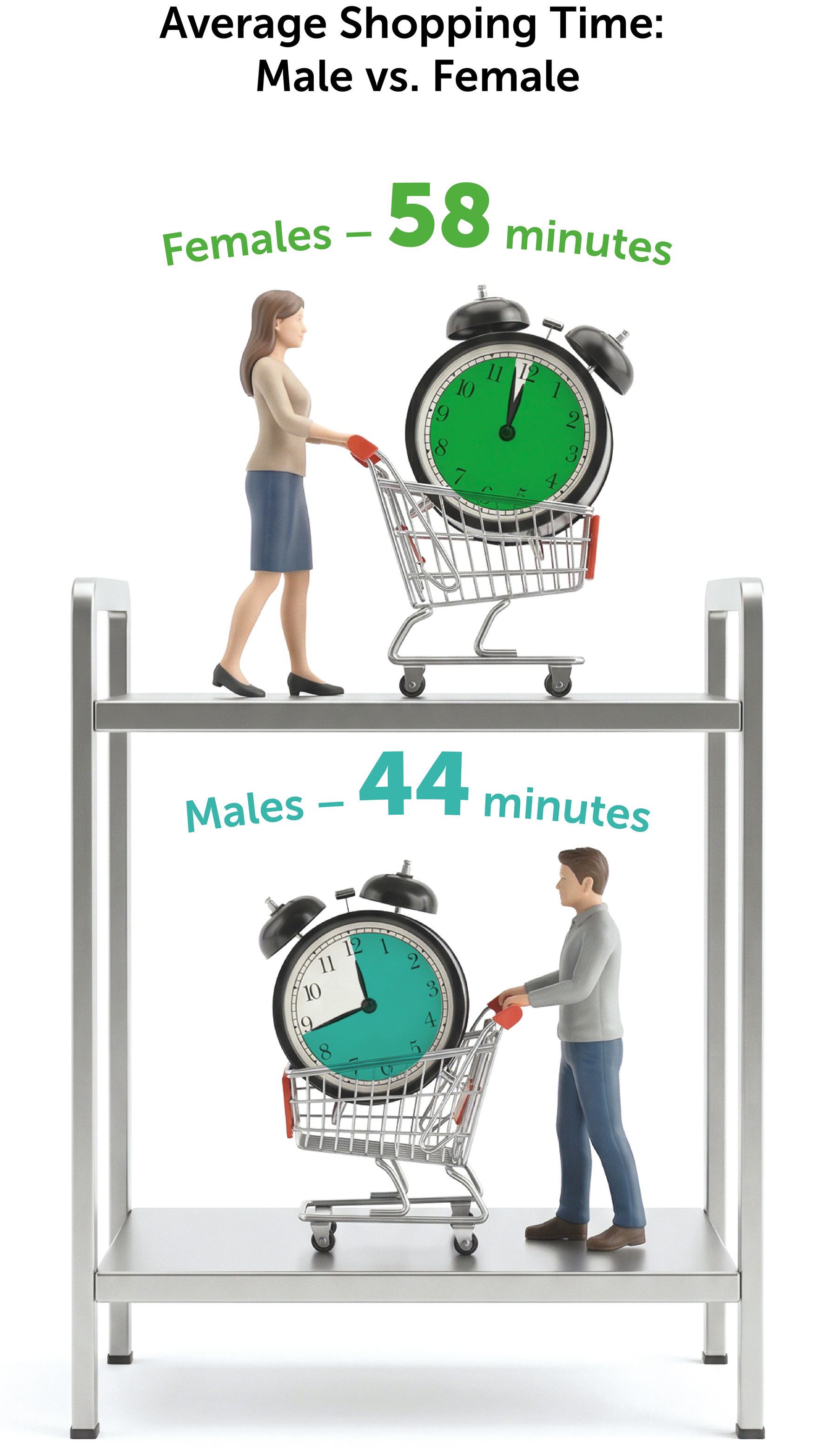
Source: Male vs. Female Shopping Statistics (2025)
REI: An Ecosystem for Women. In 2017, the US‑based outdoor and sports retail chain REI launched the Force of Nature programme. As part of this initiative, the company invested $1 million in 26 non‑profit organisations that support women’s participation in outdoor activities. Hundreds of events were held to engage female audiences in trekking, hiking, and rock climbing. REI itself organised 2 700 workshops and guided trips for 48 000 participants, who spent 2.5 times more than the average customer in the chain’s stores. Additionally, the retailer expanded its assortment of plus‑size outdoor apparel to broaden the engaged audience.
REI’s own research has shown that six in ten women are convinced that in the outdoor sector - both when purchasing equipment and during outdoor activities themselves - men’s interests are taken more seriously than women’s
Volvo: Equality in Safety. The legendary Swedish automaker has built its E.V.A. Initiative (Equal Vehicles for All) around an issue that had rarely been discussed in the industry. The fact is that for decades, car crash tests have been conducted using dummies modelled on the physique of an average man. Studies have shown that due to this approach, women are 47 % more likely to sustain serious injuries in a traffic accident than men. Volvo has published 40 years of crash test results, calling for safer vehicles for everyone. The E.V.A. Initiative has attracted considerable media attention, been covered by hundreds of media outlets, and sparked an industry‑wide shift towards a gender‑neutral approach to safety. While Volvo did not gain direct financial benefits from this initiative, it has strengthened its status as the manufacturer of the safest cars.
In the late 1980s, Volvo created an internal group of female employees who tested new models early on and suggested how to make them better.
Demand Influences Top Management
As women now make a substantial contribution to overall consumption, companies are re‑evaluating the gender composition of their leadership teams. An increasing number of female executives are joining top management ranks, providing a more comprehensive understanding of modern consumers’ needs (for more details, see pages 34–35). When marketing and product teams include women, companies gain better insights into what truly matters to their female customers. However, representation remains an issue: only 37 % of chief marketing officers (CMOs) in the Fortune 500 are women.