
Financier №3 (43) 2026

Ansar Abuyev
Analyst, Financial Analysis Department, Freedom Finance Global
Fasten Your Seatbelts
How the 2026 Oil Shock Grounded the Aviation Industry
According to the International Air Transport Association (IATA), the global aviation industry was expected to post a record net profit of $41 billion this year. However, the blockage of the Strait of Hormuz due to "Epic Fury" – the US military operation against Iran – has thrown carriers into disarray. Following the oil shock, jet fuel prices jumped from a projected $88 to $162.5 per barrel. As a result, airfares in the US rose by 20.7% in April alone. The civil aviation sector is under pressure not seen since the pandemic. From February to March, the U.S. Global Jets ETF (JETS), an exchange-traded fund comprised of leading airlines, fell by more than 20%. How has the 2026 oil shock already affected air carriers, and what further challenges lie ahead for them?
The Scale of the Problem
The spike in jet fuel prices, occurring amid record‑high demand for US air travel services, posed a serious challenge to many carriers’ business models. To analyze the impact of this shock, it is necessary to understand the key pricing mechanisms in the industry. For airlines, fuel is the second‑largest cost item after personnel expenses, accounting for 25–30% of operating costs. This share is higher for low‑cost carriers and lower for premium operators. Nevertheless, a doubling of jet fuel prices hits profitability across the board - albeit with varying intensity depending on a company’s positioning. Airlines have historically been able to adapt to oil price cycles, but this time they proved less prepared. There were three main reasons for this.
- The speed of fuel price growth. In its March review, IATA explicitly highlighted that what matters for flight economics is not just the absolute level of jet fuel prices but the rate at which they change. Sudden shocks are more dangerous than high but stable prices. In 2008, a 40% price spike drove companies’ operating margins from 4% down to −1%. The new shock follows a similar nature.
- Refusal to hedge price risks. Before the pandemic, many airlines hedged their fuel costs by entering into forward contracts to lock in future fuel purchase prices and protect themselves against price rises. During COVID‑19, air travel demand plummeted and oil prices collapsed, yet carriers were forced to buy fuel at prices well above the market rate. After this costly experience with hedging, most US airlines abandoned the practice to avoid repeating such losses. Today, many of them pay for fuel at the prevailing market price without any insurance, which increases their exposure to sharp price swings.
- Aging fleet. The average age of the global aircraft fleet now exceeds 15 years - a record high over the entire period of observation. Delays in the delivery of new Boeing (BA) and Airbus (AIR) aircraft force airlines to keep operating less fuel‑efficient planes.
A large airliner may require as much kerosene for a single intercontinental flight as a passenger car would not use in decades of operation.
Surviving the Shock
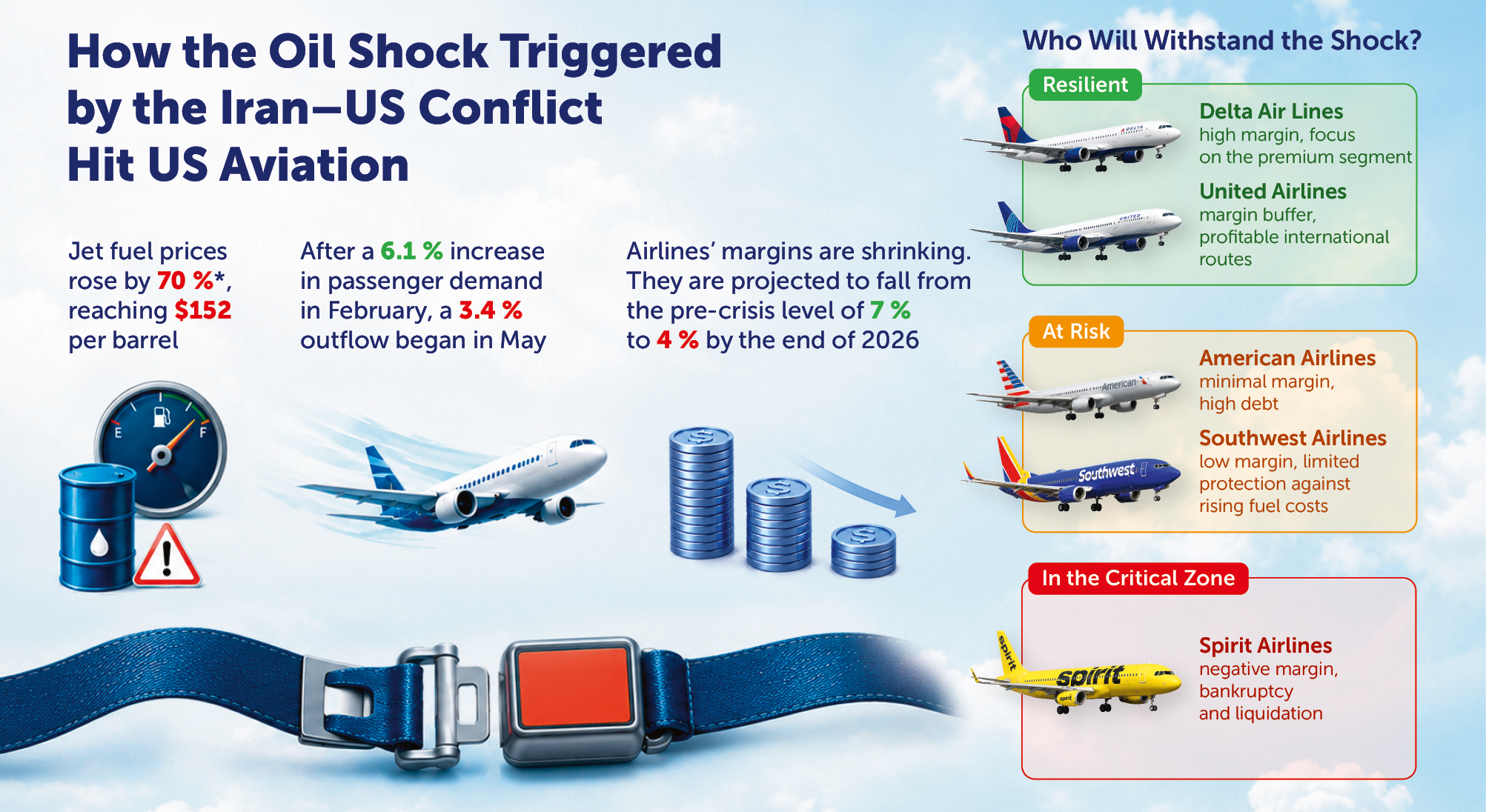
Publicly traded air carriers entered the oil shock from very different positions - ranging from relatively well prepared to near collapse. The case of low‑cost carrier Spirit Airlines is particularly notable. Its business had been unprofitable since 2019. In November 2024, the company went through bankruptcy proceedings; in August 2025, despite having resolved some issues, it was forced to file for insolvency again. By early 2026, Spirit was operating with a negative operating margin and had accumulated $7.4 billion in debt and lease obligations. Its market share on key domestic US routes was being eroded by Frontier (ULCC), a financially healthier competitor. The spring surge in oil prices triggered an irreversible process leading to another bankruptcy for Spirit. The company could no longer pass the increased fuel costs on to consumers while maintaining its original business model. Government‑led rescue negotiations failed. The low‑cost carrier delisted and began liquidating its assets.
In a different position was aviation giant Delta Airlines (DAL), which had focused on developing its premium segment. In 2026, the company posted record revenue for the Q1, with an operating margin of 3.2%. Revenue from premium services grew by 9% YoY, although revenue in the core segment fell by 7%. The company’s net debt had already declined before the March spike in oil prices, enabling it to navigate the turbulence without major losses.
American Airlines (AAL) also reported record revenue for January–March 2026, but its underlying financial metrics remain weak. At the time of the energy crisis, its business margin was still negative and shareholders’ equity was below zero, making it the most vulnerable player in the “Big Three,” which also includes Delta and United Airlines (UAL).
United’s position, by contrast, is more stable: for the first three months of the year, its operating margin rose to 6.8%, partly thanks to a focus on international routes and the premium segment, which helped offset fuel cost increases.
Boeing and Airbus might have been expected to suffer significantly from the Middle Eastern force majeure. Yet their businesses remain resilient due to a robust backlog of long‑term orders. As of June 2026, the combined order book of these manufacturers stood at a record 16,000 aircraft, ensuring a stable workload for both for more than a decade ahead. Investors recognize this and continue to hold the companies’ shares in their portfolios. Still, the oil shock had a substantial impact on the manufacturers’ financial performance: for example, Boeing’s stock price in June 2026 was 12% lower than in January.
Shock Therapy
Global demand for civil aviation services remained strong despite fuel challenges and geopolitical uncertainty. According to IATA, global passenger traffic increased by 4% YoY over the first four months of 2026. Of course, the shock of March slightly dented the trend, primarily due to a 60.8% drop in utilization rates among Middle Eastern carriers, caused by the closure of airspace along their key routes.
The most realistic target for net profit for the aviation industry is $25–30 billion, not the $41 billion forecast by IATA. And that's assuming oil prices normalize in the second half of the year.
Three parallel processes are likely to unfold in the civil aviation sector. Market leaders, primarily Delta and United, will be able to offset margin declines by expanding their premium offerings and reducing capital intensity. Second‑tier carriers, such as American Airlines, Southwest Airlines (LUV), and JetBlue (JBLU), will see profits fall to multi‑year lows. Ultra‑low‑cost carriers will remain in a high‑risk zone, as their business model is critically dependent on fuel price dynamics. The world’s major aircraft manufacturers are expected to weather the consequences of the Strait of Hormuz crisis without major difficulties, as demand for aircraft equipped with energy‑efficient engines is likely to grow in the wake of the oil shock.
*Compared to the average price in 2025. Sources: finviz.com, IATA Air Passenger Market Analysis, IATA Economics, U.S. Bureau of Labor Statistics