Financier №3 (43) 2026

Vladimir Chernov
Analyst, Freedom Finance Global
The Guardians of Balance
Who Keeps the Oil Market from Swinging to Extremes
Oil prices have never been particularly stable. To help stabilize them, two major mechanisms have been established; for decades, they have helped smooth out the most dramatic imbalances between global supply and demand.
The first mechanism is driven by the Organisation of the Petroleum Exporting Countries (OPEC), and over the past decade, also by the members of the OPEC+ agreement. The second mechanism relies on the US Strategic Petroleum Reserve (SPR) and European stockpiles held under the mandate of the International Energy Agency (IEA).
Below, we explain how these tools help the market pull itself out of the extreme states it periodically falls into.
OPEC: Collusion or Cooperation?
In 1960, Iran, Iraq, Kuwait, Saudi Arabia, and Venezuela came together to form a cartel*. These countries, which controlled vast oil reserves, wanted to influence the price and supply terms themselves, rather than remain a raw‑material appendage to Western oil producers and refiners. In effect, they declared: “Since we own the subsoil resources, we will set the terms,” and proceeded to nationalize their oil assets. For the geopolitical landscape of the time, this was a bold move - and, as history has shown, a rather forward‑looking one.
*A grouping of independent companies or countries that agree to coordinate their actions in the market in order to exert greater influence over it
Despite all the talk about OPEC’s decline, the organisation’s influence remains substantial today. The US Energy Information Administration (EIA) estimates the cartel’s share in global crude oil production at roughly 35%, and in global exports at approximately 50%. Traders watch every OPEC meeting as avidly as football fans watch the Champions League final. The members cannot simply set a price that benefits only them, but their announcements regarding production quotas can reshape market expectations for months ahead - and, consequently, change prices.
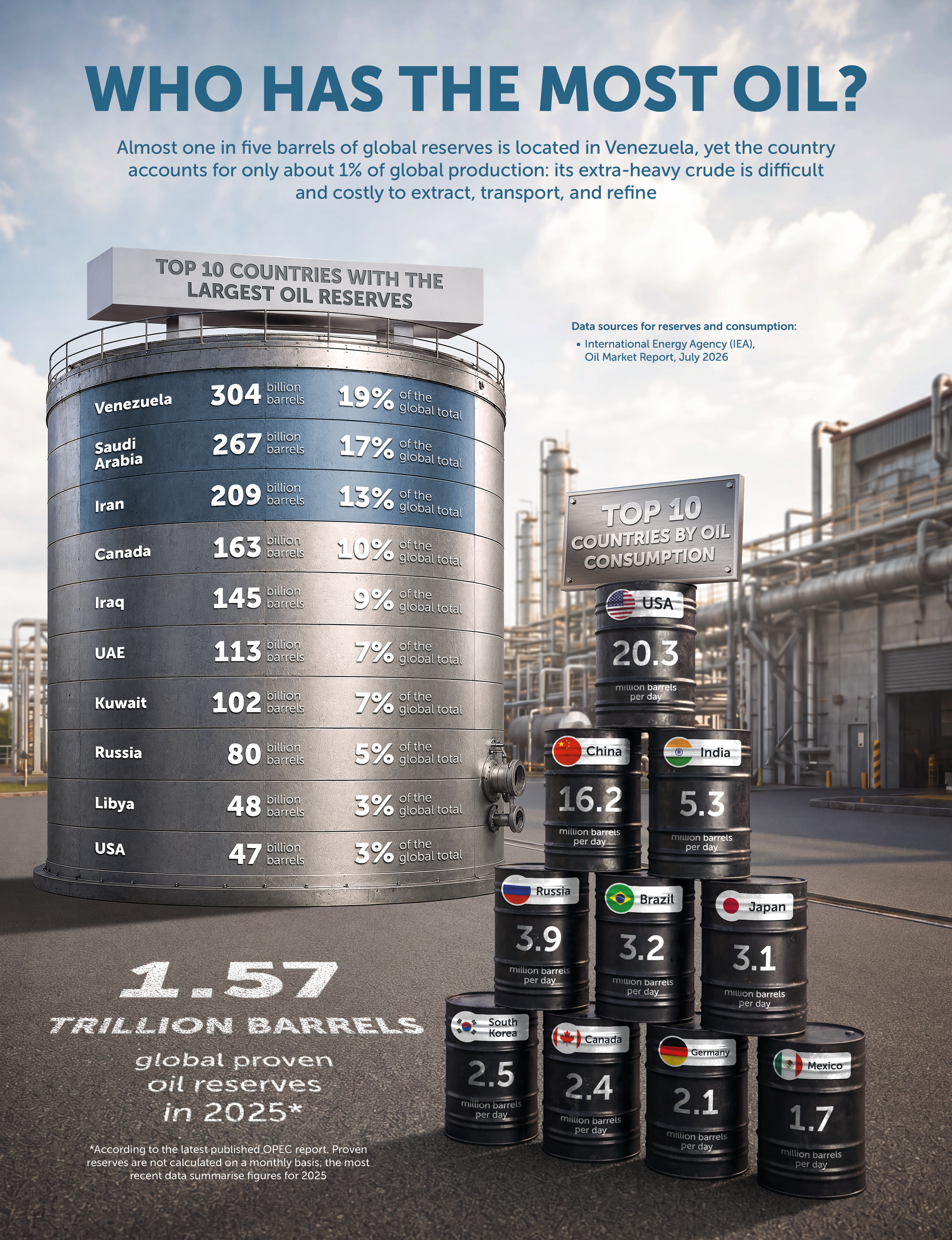
However, the key factor is not even current production levels, but what lies literally underground. According to OPEC’s own data, the global proven crude oil reserves amounted to about 1.567 trillion barrels at the end of 2024. Of these, member countries accounted for 1.241 trillion - roughly 80% of the oil that the world will consume over the coming decades.
In the mid‑2010s, the organisation informally expanded to include other major oil producers, such as Russia, Brazil, and Kazakhstan. After the price collapse that began in 2014, the biggest players met in December 2016 and agreed to jointly cut production. OPEC reduced output by 1.2 million barrels per day, while the other parties to the agreement accepted an additional 558,000 barrels per day.
OPEC+ proved its value most clearly in 2020, during the pandemic. Oil demand plummeted, prices tumbled, and futures contracts even fell into negative territory. Starting in May of that year, the cartel and its partners agreed on a historic production cut - a reduction of 9.7 million barrels per day. This was one of the most powerful collective measures to support prices in the history of the market - and it worked. Over time, the price of “black gold” stabilized, and an oversupply crisis was averted.
Collectively, OPEC+ member countries account for roughly 41% of total global oil production and control about 90% of the global proven oil reserves.
Strategic Reserves: A Rapid Response to Shocks
A strategic petroleum reserve is not just a large storage facility; it is insurance against sudden market disruptions. When geopolitical conflicts, sanctions, natural disasters, or major accidents remove part of the supply, a government can dampen buyer frenzy by releasing some of its stockpiles onto the market. The US government’s SPR was established after the 1970s energy crisis (see pages 6–7 for more details). Oil is stored in underground salt caverns along the Gulf of Mexico Coast, close to major refineries. The total capacity of all reservoirs is 714 million barrels.
European countries participating in the IEA mandate follow similar rules: they are required to hold reserves equivalent to at least 90 days of net imports. These can be government or commercial stocks, in the form of crude oil or gasoline. The key requirement is the ability to put millions of barrels on the market quickly to prevent a significant deficit.
According to the US Department of Energy, by early summer 2026, SPR stocks were at their lowest level since April 1983, standing at around 320 million barrels.
Strategic reserves have several major drawbacks. First, they are not meant to last long, and the stocks must be replenished once released. Second, they are used sometimes as a domestic political tool. For example, in 2022, rising commodity prices amid anti‑Russian sanctions accelerated inflation in the United States. As a result, the Biden administration authorized the release of 180 million barrels from the SPR to curb the rise in gasoline prices. Congress occasionally views strategic reserves as a way to boost the treasury. In 2022, the reserve held 593.7 million barrels; by year‑end, that figure had dropped to 372.1 million. Gradually, the storage facilities began to be refilled - for instance, 59 million barrels of Brent were purchased at $76, while the reserves were released when it was trading around $95... By the way, the historical average price of oil pumped into reserves is only $29.7 per barrel.
A Fragile Equilibrium
The actions of OPEC and the US administration regarding strategic reserves are often criticized. It is precisely the activity of regulators and politicians that seems to trigger one energy crisis after another.
In reality, both mechanisms for controlling the supply of crude serve an important purpose: to prevent prices from staying too high or too low for extended periods. The oil market rests on a delicate balance. The OPEC+ deal shapes how much crude will be available on the market tomorrow. Strategic reserves are replenished gradually - on the one hand, to avoid triggering a sudden surge in demand and a subsequent price spike, and on the other, to be ready to quickly offset any price shock if needed.
Oil price dynamics show that, even with occasional emergencies, the regulatory institutions like OPEC generally succeed in fulfilling this task. So far, no more effective measures have been devised.
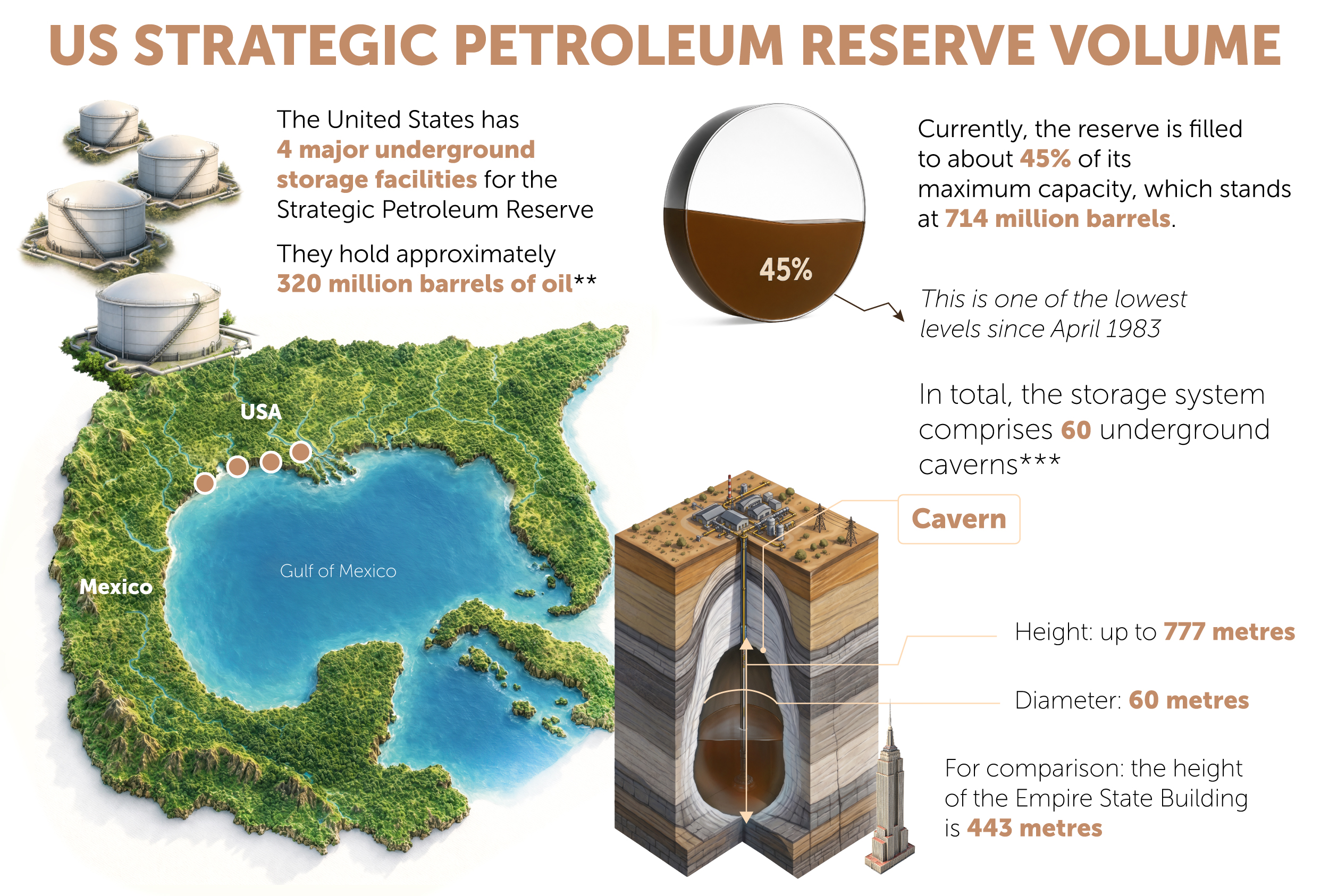
**As of summer 2026
***An artificial underground cavity in a salt formation used for oil storage
Source: U.S. Department of Energy