
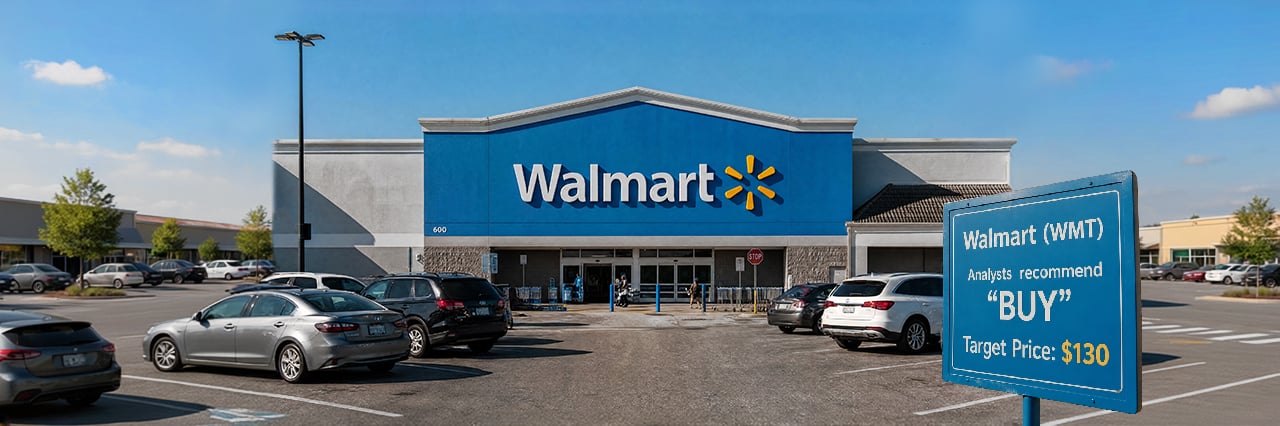
Freedom Broker analysts have set a target price for Walmart (WMT) shares at $130 with a “Buy” recommendation. The upside from the current price ($114) is about 15%. According to experts, the recent pullback in the stock price was excessive and does not reflect the fundamentals of the world’s largest retailer.
Freedom Broker notes that the market reacted too negatively to cautious management comments following the quarterly report, ignoring the continued gains in market share, the expansion of high-margin business lines, and the prospects for earnings acceleration in the second half of the year.
Walmart shares fell despite a strong report
Over the past month, Walmart shares have lost 5.5%, and over the quarter — 10.2%, significantly lagging the consumer staples sector represented by the Consumer Staples Select Sector SPDR Fund (XLP), as well as the S&P 500 index. The correction began after the release of results for the first quarter of fiscal year 2027, even though the company exceeded market expectations for revenue and comparable sales.
Walmart’s management reaffirmed its revenue growth guidance of 3.5–4.5% in constant currency and expects results closer to the upper end of the range.
What supports Walmart’s business growth
According to analysts, Walmart remains one of the key beneficiaries of changing consumer habits. Comparable sales in the U.S. in the first quarter rose 4.1% year over year, and traffic increased 3%. The pace of market share gains in the general merchandise category was the strongest in the past five years.
Experts pay particular attention to the development of high-margin segments. Walmart’s U.S. e-commerce grew 26% year over year, advertising revenue increased 44%, and advertising and subscription services already account for about one-third of the company’s operating profit.
Investors expect Walmart’s earnings to rise
Freedom Broker believes the peak pressure on margins has already passed. In the first quarter, Walmart absorbed about $175 million in additional fuel expenses, maintaining price leadership and not passing costs on to customers. At the same time, the company expects adjusted operating profit growth to accelerate from 5% to 6–8% by year-end thanks to marketplace expansion and supply chain optimization.
Analysts note that after the drop in the share price, the company’s valuation has returned to its two-year average levels. The technical picture points to the stock being oversold and a trend reversal. The shares have already rebounded about 5% from eight-month lows, and long-term investor interest may continue to recover.
Walmart — the world’s largest retailer with revenue of more than $680 billion a year and a network of about 11,000 stores in 19 countries. In addition to traditional retail, the company is actively developing its advertising business, marketplace, Walmart+ subscription, and fintech services, which gradually increases business profitability and reduces dependence on classic retail.
This is not an individual investment recommendation.