
Freedom Broker: BP got a boost from expensive oil, but the upside for the shares is limited
Stock Market News
11 August 2026, 12:32
Freedom Broker analysts raised the target price for ADRs of the UK oil and gas company BP p.l.c. (BP) from $39 to $43 and upgraded the rating to “Hold”. The company delivered a strong Q2 amid rising hydrocarbon prices and high efficiency in trading and refining, but the analysts believe that a significant part of the improvement in results is tied to temporary factors. At the current price of $41.6, the upside to the target price is about 3.4%.
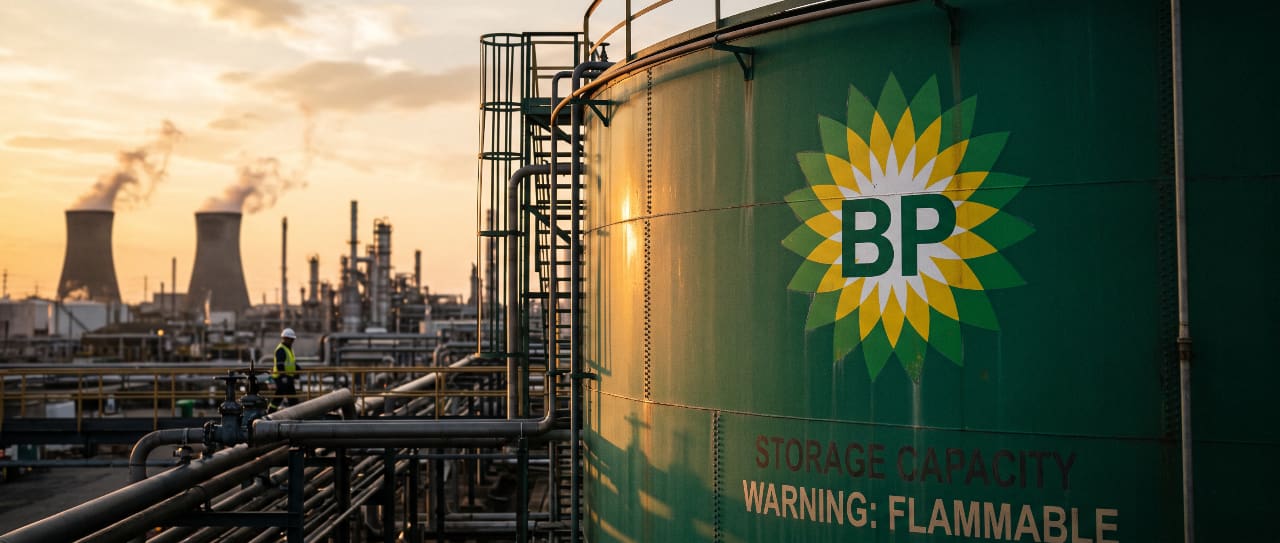
BP is one of the largest oil and gas producers
BP p.l.c. is a UK-based international energy company operating in oil and gas production, refining, trading, and low-carbon energy. The company’s business includes hydrocarbon production, refining capacity, energy trading, and retail operations.
A strong quarter, but the effect may be temporary
Freedom Broker experts viewed BP’s second-quarter results positively: the company was able to fully capitalize on the conflict in the Middle East. According to the analysts, BP’s financial performance was supported by several factors at once: higher oil and gas prices, strong trading and refining dynamics, and tensions in the Middle East. At the same time, the experts emphasize that the quarter’s standout performance is largely driven by temporary market conditions.
BP’s revenue in Q2 rose 48.2% year over year and 32.2% quarter over quarter to $69.1 billion. The average realized hydrocarbon price in the “Gas & Low Carbon Energy” segment increased 29.3% year over year to $52.8 per barrel, and in the “Production” segment it rose 26.8% to $62.2 per barrel.
Adjusted net profit reached $5.7 billion versus $2.5 billion a year earlier. Adjusted earnings per ADR were $2.22, beating the consensus forecast by 13.8%.
Trading and refining became the main driver
The strongest momentum was in the “Trading and Refining” segment. Its operating profit more than tripled year over year to $5 billion, and the refining margin reached $29.6 per barrel, up 148.7% year over year and 75.1% quarter over quarter.
At the same time, operating metrics in the core upstream business deteriorated. Production in the “Gas & Low Carbon Energy” segment fell 2.1% year over year to 0.77 million barrels of oil equivalent per day, and in the “Production” segment it dropped 5.4% to 1.44 million barrels of oil equivalent per day.
Management also expects further production declines due to the Middle East conflict and scheduled maintenance. Refining throughput may fall by about 9% after the sale of the Gelsenkirchen refinery in August of this year.
Cash flow and debt are improving
Despite working-capital growth, BP continued to strengthen its balance sheet. Operating cash flow in Q2 totaled $10.9 billion. In Freedom Broker analysts’ calculations, operating cash flow excluding changes in working capital reached $13.5 billion.
Net debt decreased by $2.9 billion over the quarter to $35.5 billion. Capital expenditures fell 8.2% year over year to $3.1 billion. Freedom Broker expects full-year 2026 capex of about $13.5 billion versus $14.5 billion in 2025.
Cash flows were pressured by a $1.1 billion payment related to obligations from the Gulf of Mexico oil spill.
Asset sales remain a controversial factor
BP continues its portfolio optimization program. In 2025, the company received $5.3 billion from asset sales, and in 2026 it expects total proceeds of $8–9 billion.
One of the largest deals will be the sale of 65% of the lubricants business Castrol, which is expected to bring in about $6 billion. Closing is expected in the second half of 2026.
Target price raised to $43
Against the backdrop of a strong Q2, persistent tensions in the Middle East, and shrinking refining capacity in Russia, Freedom Broker raised BP’s target price from $39 to $43 per ADR and upgraded the recommendation from “Sell” to “Hold”. The main growth drivers, according to the analysts, are a potential further rise in oil prices due to a prolonged Middle East conflict and an attractive dividend yield. The key risks remain a drop in oil prices if the situation in the region normalizes, deterioration in operating performance, and further asset sales.
BP’s next steps
BP’s new CEO, Meg O’Neill, outlined five priorities for the company:
- strengthening the balance sheet;
- simplifying the portfolio;
- more disciplined investment;
- improving operational efficiency;
- enhancing accountability within the company.
The corporation will continue to sell non-core assets, cut costs, and allocate capital to projects with the highest potential returns. At the same time, O’Neill acknowledged that the quarter’s operating results deteriorated and emphasized the need to improve asset reliability and efficiency faster.
How the analysts’ view has evolved
In April 2026, Freedom Broker maintained a cautious view on BP shares. After the Q1 results, the experts raised the target price from $37 to $39 per ADR but kept the “Sell” recommendation. Despite a 11.4% year-over-year increase in revenue to $52.3 billion and adjusted net profit rising to $3.2 billion versus $1.4 billion a year earlier, the analysts noted that a significant portion of the improvement was tied to temporary factors, primarily strong results in trading and refining.
Earlier this year, BP reported the suspension of its share buyback program in order to direct cash flow into investments in oil and gas projects. In Q4 2025, the company’s adjusted net profit rose 32% year over year to $1.54 billion; however, BP simultaneously recognized $4.2 billion in asset impairments. Most of the write-downs were attributed to the Lightsource BP solar business and the U.S. unit Archaea.
This is not an individual investment recommendation.