
Freedom Broker analysts maintained a “Buy” rating on Eli Lilly and Company (LLY) shares and raised the target price from $1.3k to $1.4k. At the current price of $1 181,5, the upside potential is about 18.5%. According to the analysts, the company’s investment case still rests on strong demand for Mounjaro and Zepbound, Eli Lilly’s leadership in the GLP-1 market, and the prospects for the new oral drug Foundayo.
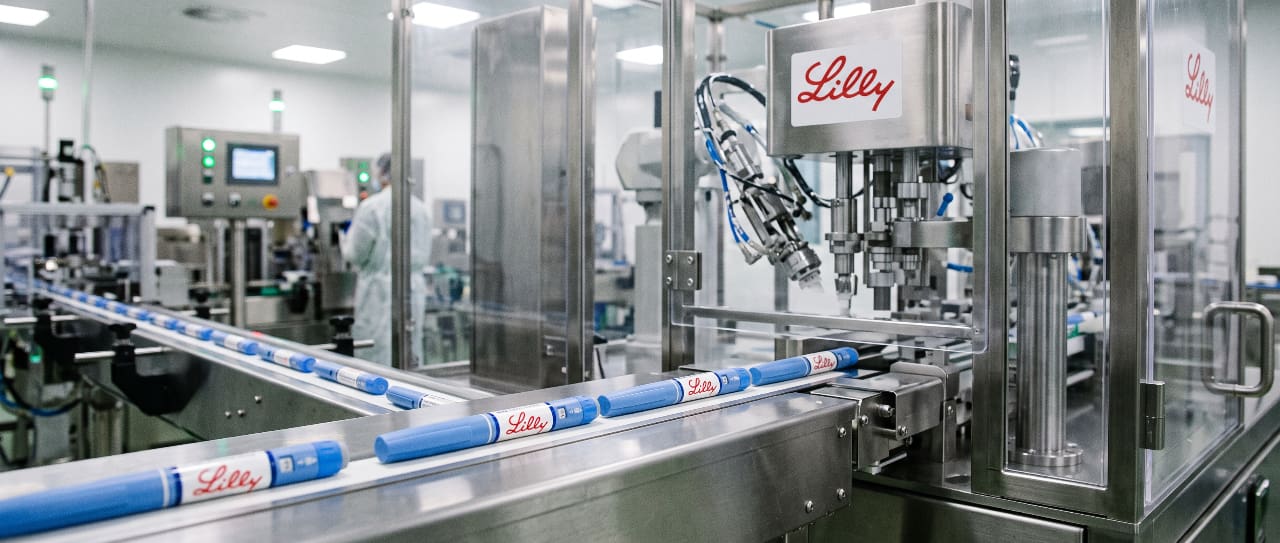
Eli Lilly is a leader in diabetes and weight-loss drugs
Eli Lilly and Company is an American pharmaceutical company that develops and manufactures medicines for diabetes, obesity, oncology, immunology, neurology, and other diseases. In recent years, the company’s main growth driver has been GLP-1 class drugs—Mounjaro and Zepbound—used to treat diabetes and obesity.
According to Freedom Broker estimates, incretin drugs already account for 65.2% of Lilly’s total revenue, and the company’s share of the incretin-drug market has risen to 60.9%. Analysts believe that scaling this segment remains the key factor behind the company’s financial growth.
Mounjaro and Zepbound beat expectations again
In Q2 2026, Lilly’s revenue grew 48% year over year to $23.0bn, while sales volume increased 60%. Volume growth more than offset a 13% decline in realized prices.
Mounjaro and Zepbound made the ключевой contribution. Mounjaro sales increased 91% to $9.94bn, exceeding Freedom Broker analysts’ forecast by $1.37bn. International momentum was particularly strong: sales outside the U.S. grew 172% to $5.2bn, aided in part by China including Mounjaro on its national reimbursement drug list.
Zepbound revenue grew 46% to $4.93bn, beating analysts’ forecast by about $310m. The main factor remains resilient demand in the U.S., despite lower cash-pay prices.
As a result, combined sales of the two ключевых GLP-1 drugs reached $14.8bn, up 73% year over year. For the third consecutive quarter, LLY’s results have significantly outpaced analysts’ expectations, Freedom Broker notes.
Foundayo opens a new source of growth
A key event of the quarter was the commercial launch of Foundayo, an oral GLP-1 drug for the treatment of type 2 diabetes. In its first quarter on the market, the drug generated $98m for Lilly, in line with analysts’ expectations at this early stage. The company also filed an application with the FDA to expand Foundayo’s indications. According to Freedom Broker, the drug’s sales could be around $700m in 2026 and approximately $3bn in 2027.
Analysts expect sales to ускорения in the second half of the year as access expands through the Medicare GLP-1 Bridge program (allows participants to receive certain GLP-1 weight-loss drugs at a fixed price of $50 per month) and telemedicine platforms. The long-term significance of Foundayo is tied to the opportunity to offer patients an oral alternative to injectable GLP-1 drugs.
Profit is rising and margins are improving
Despite large-scale investment in business development, Lilly continues to increase profitability. Adjusted gross margin in Q2 was 86.3%, up 1.3 pp year over year. The Non-GAAP figure rose 9 pp to 54.8%, which, according to the analysts, confirms the positive effect of operating leverage.
R&D expenses increased 14% to $3.8bn, while SG&A (selling, general and administrative expenses) rose 25% to $3.4bn. The company is actively investing in new drugs and stepping up the promotion of current and будущих products.
Lilly raises guidance for the third time in a row
The company once again improved its 2026 guidance. The expected revenue range was raised from $82–85bn to $85–87bn. At the same time, Non-GAAP EPS guidance changed from $35,50–37,00 to $35,50–36,50. Analysts say this does not indicate deterioration in the business: a $2.78 per-share increase in the underlying profit outlook was more than offset by one-off IPR&D (in-process research and development) expenses of $3.03 per share.
Freedom Broker views the revenue and margin guidance increase as a more important signal, confirming resilient demand and the strength of the core business.
Retatrutide could become the next driver
Over the long term, analysts highlight Retatrutide, a next-generation drug that targets GLP-1, GIP and glucagon receptors simultaneously and is intended for treating obesity and metabolic disorders. In a Phase III clinical trial, weight loss in obese patients without diabetes reached nearly 30% versus placebo, and more than 45% of participants on the maximum dose achieved a one-third reduction in weight.
Lilly plans to file for U.S. approval of Retatrutide in Q1 2027. Freedom Broker expects the start of commercial sales before the end of 2027 and sees it as a potentially powerful growth driver in the obesity-drug segment. Another promising area, analysts say, is Eloralintide, a selective amylin receptor agonist. The drug showed a 12% reduction in body weight versus placebo after 48 weeks, with a favorable tolerability profile.
Key facts about Eli Lilly
In early 2026, Eli Lilly prepared for the launch of Foundayo: in February, the company said it had increased the value of pre-launch inventory to $1.5bn versus about $550m a year earlier. Lilly stated it was ready to roll the drug out to several countries’ markets simultaneously after U.S. approval.
In Q1 2026, the company delivered strong business momentum: revenue rose 55.5% year over year to $19.8bn, mainly driven by GLP-1 drugs. Mounjaro sales reached $8.6bn, Zepbound $4.2bn, and operating margin increased from 29% to 45%. Adjusted EPS was $8.55. On the back of the results, Lilly raised its 2026 revenue guidance to $82–85bn and its EPS guidance to $35,50–37.
In March, Lilly entered into a global licensing and co-development agreement with biotech Insilico Medicine to develop drugs using artificial intelligence. The total deal value could reach $2.75bn, including an upfront payment of $115m. The partnership became part of the company’s broader strategy to expand its product portfolio and reduce dependence on a few key GLP-1 drugs.
This is not an individual investment recommendation.