
Freedom Broker: Cleveland-Cliffs sell-off has created nearly 20% upside potential
Stock Market News
26 августа 2026, 10:06
Freedom Broker experts recommend “Buy” shares of U.S. steel producer Cleveland-Cliffs (CLF) with a target price of $13,5. At the current price of $11,3, the upside potential is about 19,5%. According to analysts, the recent sell-off in the stock amid a possible reduction in U.S. tariffs on Canadian steel looks excessive, while improving company fundamentals and a tightening global steel market create conditions for a rebound in the share price.
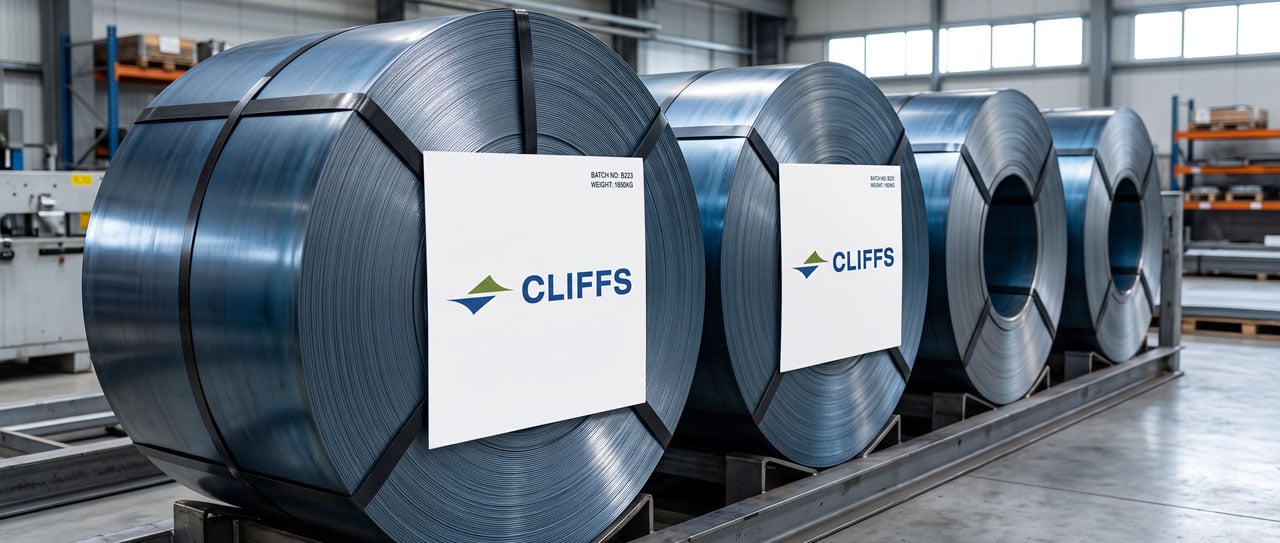
Cleveland-Cliffs: vertical integration provides leverage for growth
Cleveland-Cliffs is the largest producer of flat-rolled steel (rectangular-shaped rolled metal products with uniform thickness across the surface) in North America and one of the most vertically integrated steelmakers in the United States. The company controls a significant portion of the production chain—from iron ore mining to steelmaking and higher value-added products.
Analysts estimate that such a business structure is particularly important amid rising domestic steel prices: price increases can flow directly through to CLF’s financial results thanks to significant operating leverage.
The financial turnaround is already visible
Company revenue rose to $5,2 bn versus $4,9 bn in the first quarter of 2026. GAAP net loss narrowed to $134 mn from $229 mn in the previous quarter, while adjusted net loss fell to $115 mn. Operating cash flow totaled $230 mn, and liquidity as of the end of June was $3,1 bn.
Adjusted EBITDA improved most noticeably: it increased to $286 mn from $95 mn in the first quarter—more than tripling. The average realized steel price rose to $1 124 per ton from $1 048 per ton in the first quarter. Steel segment revenue totaled $5,052 bn versus $4,757 bn a quarter earlier.
Management expects further acceleration
Analysts see the company’s own outlook as the next potential catalyst. Cleveland-Cliffs expects adjusted EBITDA of about $575 mn in the third quarter of 2026—almost twice the second-quarter result. The increase should be driven by higher realized steel prices, rising volumes, and lower costs. Management also expects the second half of 2026 to be the company’s strongest since 2021. For 2026, Cleveland-Cliffs maintains its steel shipment forecast at 16,5–17,0 mn tons and capital expenditures of about $700 mn.
Tariff risk is largely already priced in
The main short-term factor pressuring the stock has been reports of a possible agreement between the U.S. and Canada that could cut tariffs on Canadian steel and aluminum from 50% to 25%. The market took this as a threat to U.S. producers: normalization of cross-border trade could increase Canadian steel shipments to the U.S. and intensify competition in the domestic market, experts believe.
However, analysts say this risk is already largely reflected in the current share price. At the same time, tariff policy remains only one of the factors determining the balance of the global steel market.
Production cuts support prices
Analysts also see additional support for the industry in steel production cuts in China and Europe. In July, crude steel output in China fell 3,6% year on year to 76,9 mn tons—the lowest July level since 2017. Over the first seven months of 2026, the figure decreased 3,1% year on year.
At the same time, European steelmakers are facing damage to production facilities and high energy prices. Reduced output in China and Europe lowers the amount of steel available for international trade and limits the ability of global exporters to put pressure on prices in the U.S. market.
First-quarter results
In the first quarter of 2026, Cleveland-Cliffs had already shown signs of recovery: revenue increased to $4,9 bn, and GAAP net loss narrowed to $229 mn from $486 mn in the first quarter of 2025.
However, the first-quarter result was affected by a one-off negative impact of $80 mn due to a sharp increase in electricity prices caused by extreme cold. In the second quarter, the company returned to positive free cash flow and began reducing debt.
This is not an individual investment recommendation.