
Investment Review №348. Seasonal Rotation
Focus on Hormuz
The ongoing uncertainty in the Middle East has led to a moderate correction on the UAE stock markets
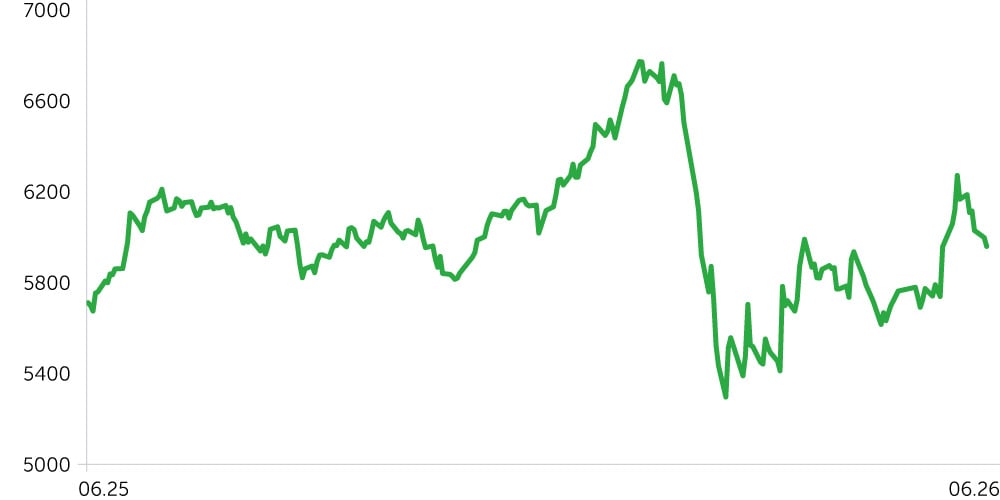
DFM General Index: 1-Year Dynamics
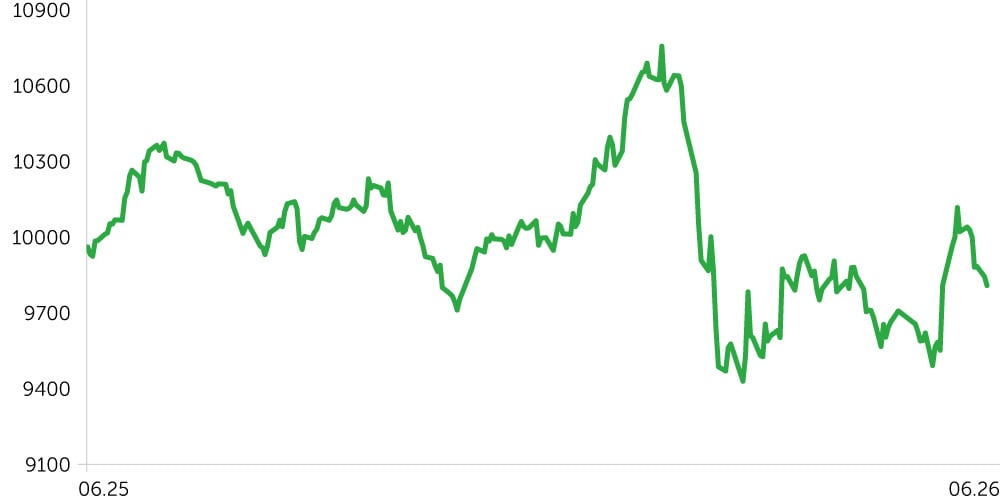
Abu Dhabi Securities Exchange Index: 1-Year Dynamics
Brent Oil, 1-Year Dynamics
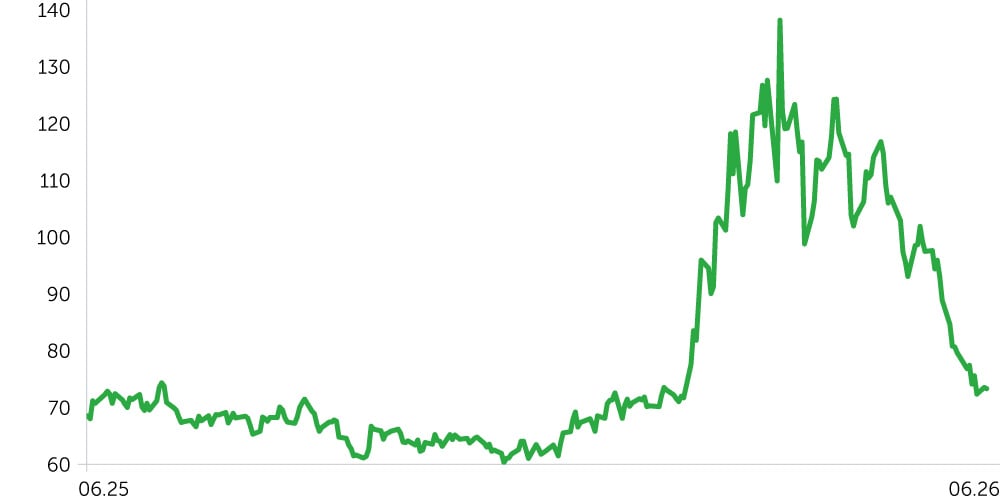
Over the two-week period from June 16 to 30, 2026, UAE equity markets experienced a modest correction as investors repositioned following the prior rally driven by expectations of a potential Iran–U.S. de-escalation. The Dubai Financial Market General Index (DFMGI) declined from 6,055 to 5,956 (−1.6%), while the Abu Dhabi Securities Exchange General Index (ADXGI) eased from 9,963 to 9,804 (−1.6%). By comparison, the S&P 500 edged down just 0.2%, from 7,511 to 7,499. Brent crude fell more sharply from $81 to $73/bbl (−9.4%), largely driven by the partial normalization of shipping flows through the Strait of Hormuz.
Sector dynamics were predominantly negative over the period. Energy (−2.49%) was the worst-performing sector, with ADNOC Drilling falling 6.53% and ADNOC Gas declining 1.71%. Financials lost ~2.1% on average, as First Abu Dhabi Bank dropped 3.30%, Abu Dhabi Commercial Bank fell 2.69%, Emirates NBD declined 1.34%, and Dubai Islamic Bank slid 3.99%. At the same time, Investcorp Capital advanced 5.59% and Amanat Holdings gained 6.15%, standing out as outperformers. Real Estate decreased 2.34%, with Emaar Properties (Emaar Development) falling 5.99%, although Aldar Properties rose 2.10% and RAK Properties climbed 4.85%. The Consumer Staples sector was the only sector with positive dynamics (+1.50%), led by Spinneys (+4.00%). Utilities finished broadly flat (+0.10%), with Dubai Electricity and Water Authority increasing 1.09% and TAQA slipping 0.38%.
Economic Updates
- Moody’s affirmed the UAE and Abu Dhabi sovereign ratings at Aa2 with a stable outlook, citing strong fiscal buffers and ongoing economic diversification. At the same time, the agency projected a ~7% contraction in real GDP in 2026, driven by a 23% decline in oil output linked to the closure of the Strait of Hormuz. Abu Dhabi’s debt burden is expected to remain moderate at ~22% of GDP, below the average for comparable sovereigns.
- Ormuz Memorandum. The U.S. and Iran were expected to formally sign a memorandum of understanding on June 19, 2026, in Switzerland, establishing a 60-day negotiation track and outlining the resumption of transit through the Strait of Hormuz as part of a broader de-escalation framework. The UAE called for full implementation of preliminary U.S.–Iran understandings and separately emphasized the importance of freedom of navigation through the Strait. Minister of Foreign Trade Thani Al Zeyoudi previously stated that the UAE is moving toward “zero dependence” on the Strait of Hormuz. Subsequently, following an attack on a vessel off the coast of Oman, concerns over transit security re-escalated.
- A further sign of normalization in the oil market was the UAE fuel pricing committee’s decision to cut retail fuel prices from July 1, 2026. Super 98 was set at AED 3.40/liter (~$0.93), Special 95 at AED 3.29/liter (~$0.90), and diesel at AED 3.60/liter (~$0.98). The adjustment reflected the correction in global oil prices seen at the end of June.
Corporate News
- Emirates NBD completed a $2.75bn investment to acquire an approximately 60% stake in India’s RBL Bank, with the deal described by the companies as one of the largest foreign direct investments in India’s banking sector.
- Aldar Properties announced the launch of The Orchids at Yas Acres on June 18 — a new project on Yas Island comprising 217 residential units. On June 25, the company reported full take-up of the townhouse segment, with total sales exceeding AED 680m (~$185.2m). Strong demand for the project supported Aldar Properties as one of the key beneficiaries of sustained residential demand in Abu Dhabi.
- ADNOC Drilling announced the early deployment of AD-300, the first AI-enabled artificial island drilling rig featuring a fully automated skidding system between wells, delivered nearly three months ahead of schedule. The rig is the first of six next-generation units under ADNOC Offshore’s capacity expansion program and has the potential to accelerate revenue recognition from new offshore drilling contracts. The development carries strategic significance for the offshore drilling segment, although market reaction over the two-week period remained muted amid weaker oil prices.
Two-Week Outlook
In the near term, the primary driver for UAE markets will remain the trajectory of oil prices and the sustainability of the partial recovery in shipping activity through the Strait of Hormuz. Over the June 16–30 period, Brent declined from $81 to $73/bbl (−9.4%), which has already begun to feed through into lower domestic fuel prices in the UAE from July 1, with potential supportive implications for consumer, transportation, and selected logistics-related themes. At the same time, an incident involving a vessel off the coast of Oman at the end of June highlighted that the geopolitical risk premium has not fully dissipated, leaving room for continued short-term volatility in the energy complex. For the current week, oil prices are expected to rise amid ongoing market uncertainty, while the U.S.–Iran ceasefire appears unstable.
In the base case, UAE markets are likely to enter a consolidation phase over the next two weeks following the June correction, with relative resilience expected in names supported by strong corporate catalysts and domestically driven demand stories. In a more cautious scenario, a renewed escalation around the Strait of Hormuz could temporarily support oil prices and energy equities, while at the same time weighing on sentiment across financials, transportation, and consumer-related sectors.