
Investment Review №356. A Reassessment of Values
In the Wake of the S&P 500
A correction on U.S. stock exchanges triggered a decline on UAE markets
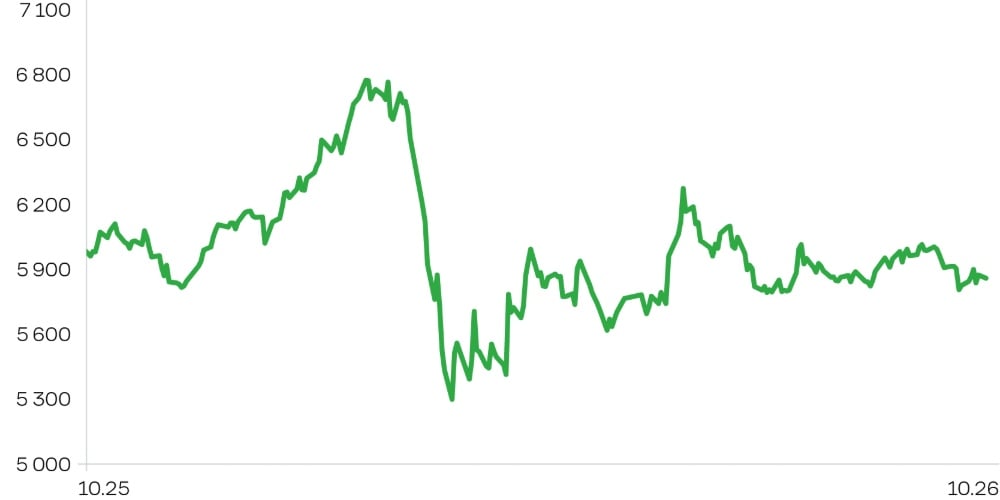
DFM General Index: 1-Year Performance
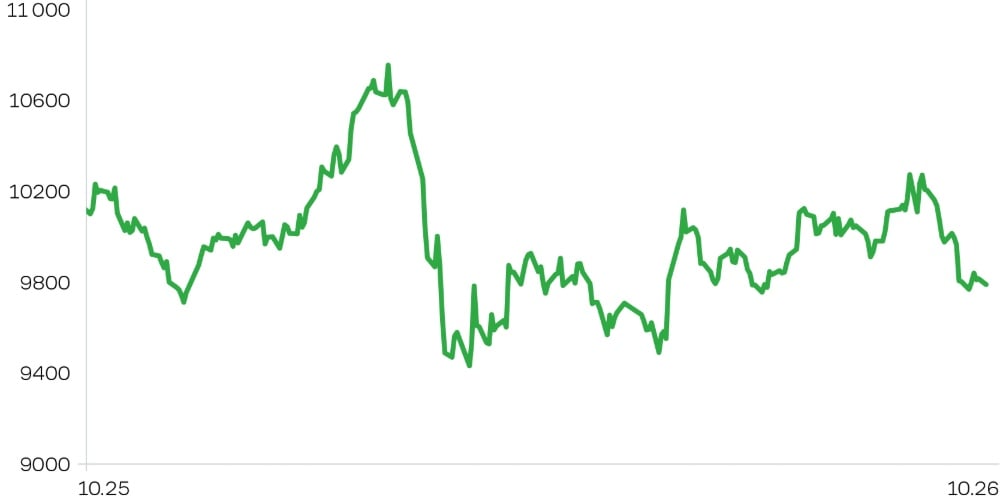
FTSE ADX General Index: 1-Year Performance
Brent Oil: 1-Year Performance
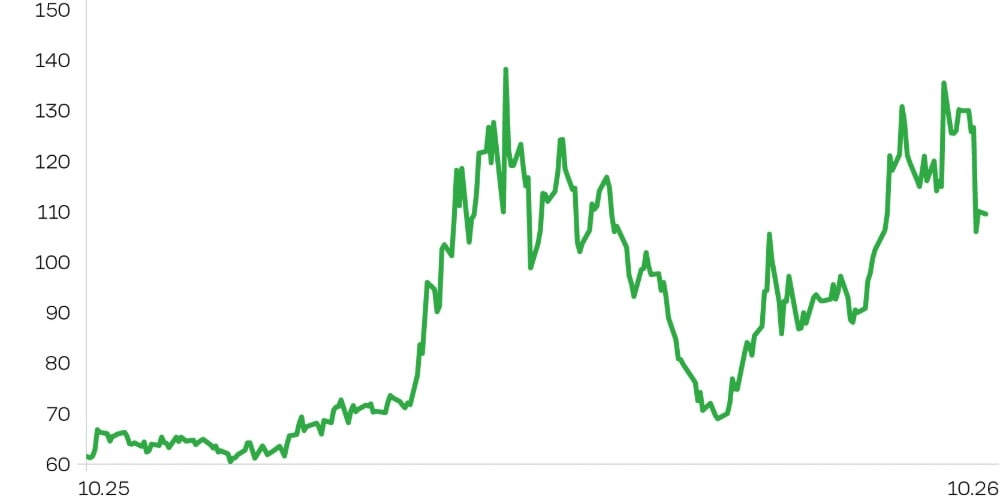
UAE equities declined alongside oil prices between October 5 and 19 amid renewed tensions in the Strait of Hormuz. The DFMGI slipped to 5,851 from 5,908 (−1.0%), the ADXGI declined to 9,783 from 10,011 (−2.3%), and the S&P 500 dropped to 7,691 from 7,774 (−1.1%). Brent crude fell 12.9% to $109.4/bbl from $125.5/bbl. Despite the pullback, attacks on vessels in the latter half of October restored a geopolitical risk premium to oil prices.
Utilities (+2.89%), Consumer Discretionary (+1.47%), and Consumer Staples (+1.29%) outperformed the broader market. Communication Services declined 0.76%, Energy dropped 1.22%, Real Estate lost 1.34%, Financials decreased 1.40%, and Industrials fell 3.19%. Abu Dhabi Aviation (+10.80%), ADNOC Logistics & Services (+5.67%), and Americana Restaurants (+5.60%) were the top performers, while Phoenix Group (−10.54%), Mashreq (−7.59%), and SHUAA Capital (−6.98%) posted the largest declines.
The UAE proxy bond yield fell 45bps to 6.06% from 6.51%, while the U.S. Treasury yield declined to 5.27% from 5.44%. The spread narrowed to 78bps from 107bps. The decline in bond yields coincided with weakness in equity markets.
Economic Updates
- The UAE economy continued to expand in H1 2026, although growth momentum weakened in Q2. Real GDP grew 0.4% YoY to $261.92bn in H1 2026, while the non-oil sector expanded 1.8%, increasing its share of GDP to 79.2%. However, GDP contracted 2.1% in Q2, reflecting disruptions to tourism, transportation, and trade activity.
- The government approved a $79.65bn federal budget for 2027–2029, up 28.3% from the previous three-year budget. Expenditure for 2027 is planned at $24.53bn. Allocations for social development programs and pensions total $9.42bn, accounting for 38.4% of planned spending. Meanwhile, spending in 2027 will be below the level projected for 2026.
Corporate News
- Dubai Investments launched the UAE’s first IPO of 2026, offering a 20% stake in DIP Holding. The deal comprises 1.735bn existing shares, with the subscription period scheduled to run from October 27 to November 3. Trading on the Dubai Financial Market is expected to start on November 11. The IPO will allow Dubai Investments to monetize part of its land-leasing and Dubai Investments Park services business while retaining an 80% stake and control of the company.
- Aldar made its first move into Sharjah's real estate market through a $299.52m forward purchase agreement with Arada. Under the deal, Aldar will acquire more than 1,100 apartments across nine buildings within the Aljada development, with handover scheduled for Q4 2029. The company’s build-to-rent development pipeline will expand to $5.72bn. While the transaction expands Aldar's geographic footprint in the rental housing market, it is not expected to contribute to earnings until construction is completed.
- ADNOC Drilling is expanding its regional footprint while advancing its proprietary technologies. Investments in MB Petroleum Services and SLB Land Drilling have provided the company with access to 30 drilling rigs across the Gulf region. Enersol and Turnwell technologies have reduced well construction times by up to 19.6% and increased drilling speeds by up to 30%.
Two-Week Outlook
Developments in the Strait of Hormuz are likely to remain the key market driver. Concerns over potential supply disruptions, coupled with an 8.6-million-barrel decline in U.S. commercial crude inventories to 415.6 million barrels, continue to support oil prices. At the same time, OPEC has lowered its forecast for global oil demand growth in 2026 to 0.2 mb/d, while raising its 2027 projection to 2.6 mb/d.
Further disruptions could support oil prices while weighing on aviation and transportation stocks. Conversely, any easing of tensions would reduce the geopolitical risk premium embedded in crude prices. Against this backdrop, companies with stable cash flows, long-term contracts and moderate leverage appear best positioned to provide portfolio resilience.