
Investment Review №358. The AI Skeptics' Moment
Market Review as of November 16
Global Perspective
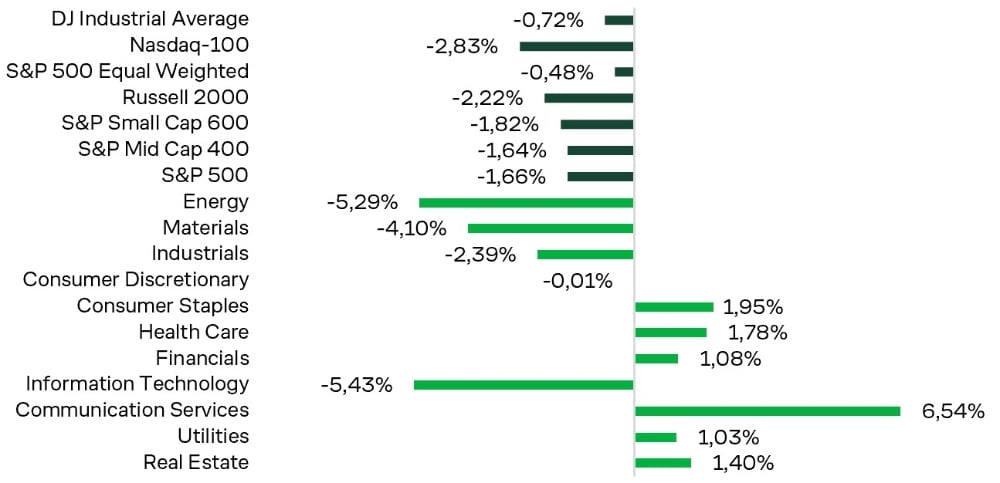
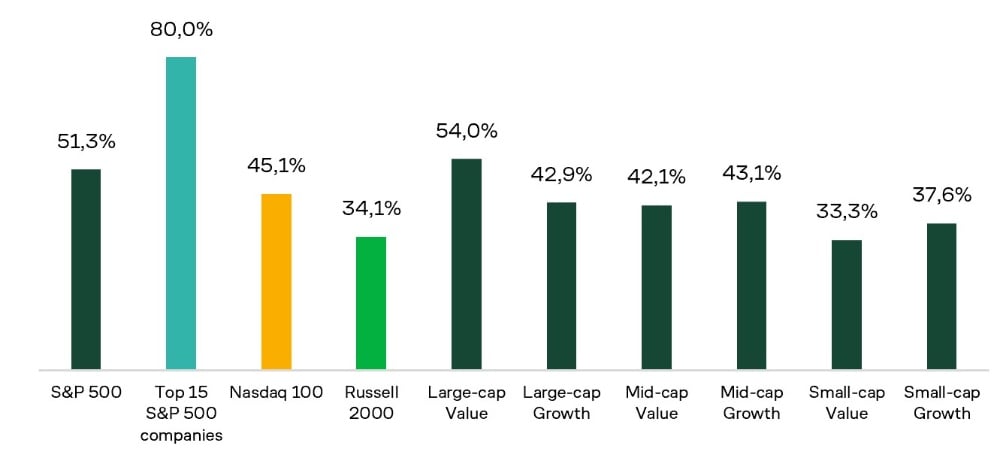
Over the period under review, all major U.S. equity indices closed lower. The equal-weighted S&P 500 (RSP) proved the most resilient, declining just 0.48%, while the Dow Jones fell 0.72% and the S&P 500 shed 1.66%. The NASDAQ-100 underperformed sharply, dropping 2.83% as AI-linked equities remained under pressure. Defensive rotation continued, albeit at a measured pace, with Consumer Staples (XLP, +1.95%), Health Care (XLV, +1.78%) and Utilities (XLU, +1.03%) leading sector performance. Importantly, the broader market weakness masked pockets of resilience: 51.3% of S&P 500 constituents advanced, alongside 80% of its 15 largest constituents.
Communication Services led sector performance, gaining 6.54%, with AppLovin (APP) serving as the primary driver. The stock surged 81%, becoming the sector index's third-largest constituent. Strong earnings and upbeat Q4 guidance triggered a material upward revision to earnings expectations. Revenue grew 55% YoY, while adjusted EPS jumped 76%, both comfortably ahead of consensus. Growth was underpinned by continued improvements in its gaming advertising model and successful expansion beyond gaming-related advertising.
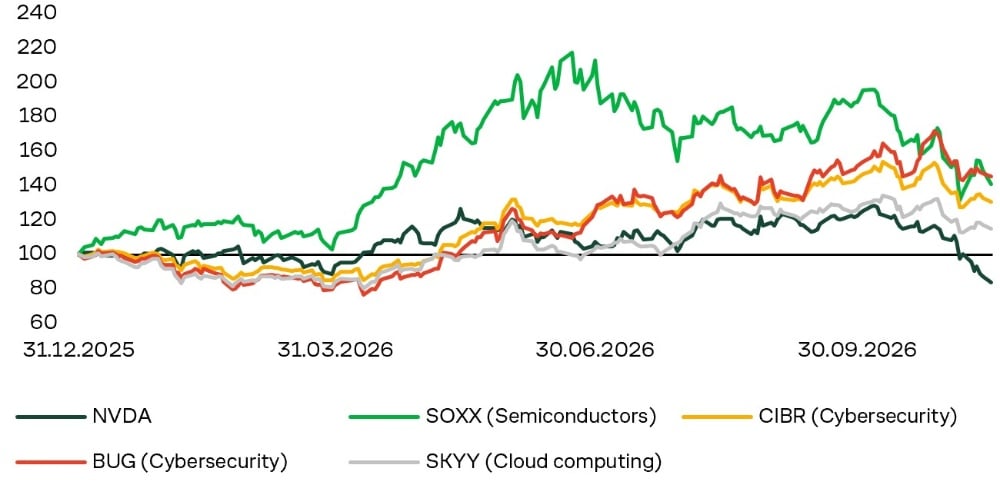
Information Technology was the worst-performing sector, falling 5.43%. NVIDIA (NVDA) was at the epicenter of the sell-off, with shares plunging 23%. Following Jensen Huang's departure, CFO Colette Kress assumed the CEO role, while several Wall Street analysts cut their price targets on the stock. The leadership transition is particularly consequential given the market's focus on the durability of NVIDIA's two key growth engines: accelerator sales outside the U.S. and incremental orders from customers that have yet to secure the necessary financing. The sell-off extended beyond semiconductors into cloud technology and cybersecurity, pointing to a broader repricing of the technology complex. However, weakness across adjacent subsectors should not be attributed solely to NVIDIA-specific developments.
U.S. authorities are investigating whether Singapore-based Megaspeed diverted NVIDIA chips to China in circumvention of export controls. Separately, the SEC is examining whether NVIDIA misled investors in its public disclosures. Neither investigation establishes that NVIDIA violated any laws. Nevertheless, tighter scrutiny of end customers could delay shipment approvals even in the absence of any adverse findings. NVIDIA's board has established a national security and export controls committee to strengthen internal oversight. Meanwhile, the Trump administration's plans to position NVIDIA as a U.S. national champion offer no guarantee of regulatory relief: support for overseas expansion by U.S. companies can coexist with restrictions on China's access to advanced accelerators.
In the U.S., Democrats' victory in the midterm elections has increased the risk of tighter permitting requirements for new data centers. The more immediate threat to the industry is not a federal moratorium, but longer approval timelines and higher grid interconnection costs. At least 39 of 45 local ballot measures failed to secure support for construction. Potential restrictions over 2026-2030 could affect projects representing 45GW of capacity across Texas, Ohio, Pennsylvania and Georgia, with Texas accounting for 24GW. Importantly, only a fraction of the announced capacity is currently under construction. As a result, restrictions are more likely to delay project timelines or redirect investment geographically than to halt development outright. Conversely, sites with secured permits and access to power could become increasingly valuable.
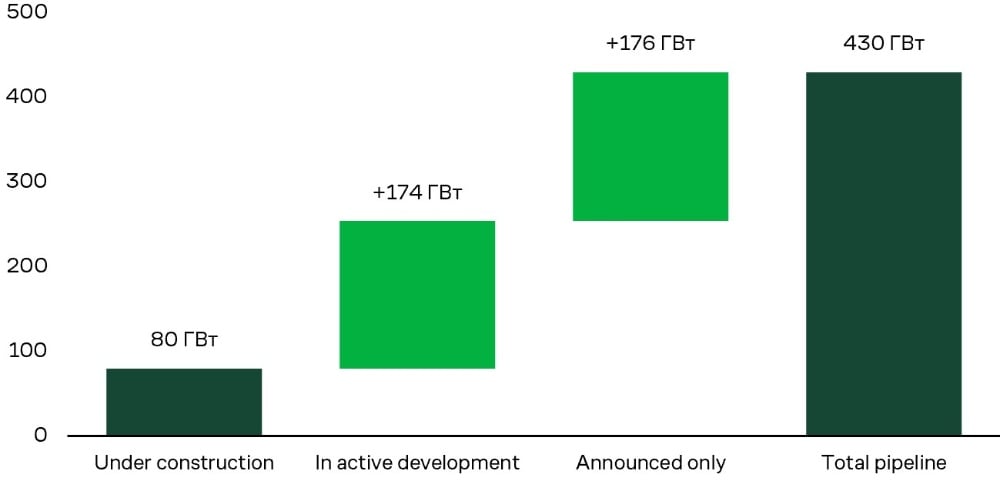
Delays are particularly affecting developers and cloud providers, who incur costs long before their capacities come online and rely on external funding. This raises a question for NVIDIA’s new leadership: if the company becomes more selective in providing guarantees to customers, some of them will find it more difficult to fund their purchases of accelerators. For NVIDIA and other hardware suppliers, this primarily involves the risk of order deferrals: high demand for AI may persist but translate into shipments and revenue more slowly than the market expected.
In this context, Anthropic (ANT)’s long-awaited IPO will test the public market’s willingness to finance the continued growth of AI companies. Anthropic has set its offering price at $83 per share; trading on the Nasdaq under the ticker ANT is set to begin on November 19. The base offering volume totals roughly $81bn, of which the company will receive ~$79bn before expenses. Anthropic will get access to capital amid significant commitments to purchase compute capacity. But the offering solves only part of the problem, as the funds raised neither eliminate the risks of delays at infrastructure partners nor guarantee a return on investment.
On the macro front, October U.S. labor market data came in stronger than expected: non-farm payrolls rose 165k vs 65k anticipated, while the unemployment rate stood at 4.1% vs 4.2% consensus. Average hourly wages increased 0.4% MoM (forecast: 0.3%), while slowing to 3.1% YoY. The main contributors to the employment growth were professional and business services, healthcare, and transportation. Besides, stronger demand for workers came together with an expansion in labor supply: the labor force increased 421k over the month. This combination implies a resilient labor market but does not mean it is overheating or wages pressure is intensifying.
Simultaneously, the October consumer inflation report surprised to the upside. Headline CPI rose 0.35% MoM (forecast: 0.3%), while the core index, excluding food and fuel, grew 0.30% MoM (consensus: 0.2%). Elevated price pressures were observed for two months in row across a wide range of categories: food, housing, utilities, transportation, and leisure services. While fuel price growth slowed from 5.2% to 0.7% MoM, the cumulative increase in fuel and transportation costs continued to affect pricing for other goods and services. The report, therefore, revealed that inflationary pressure remains steady and is not limited to the direct impact of fuel, although so far, there are no signs of a sustained acceleration in core inflation.
Market Focus
Since early November, WTI crude prices have fallen 5% to $86/bbl, their lowest since August. The main driver behind the decline was the Democrats’ win in the U.S. midterm congressional elections, which raised expectations for a diplomatic resolution to the conflict with Iran. Reports from OPEC and the IEA, confirming the restoration of balance in the oil market and projecting an oil surplus in Q4, put additional pressure on oil prices.
It’s worth noting that since early November, tensions between the U.S. and Iran have escalated: the U.S. made a series of strikes on Iranian targets around the Strait of Hormuz, and Iran responded with drone attacks on U.S. military facilities in Bahrain for the first time in two months. On November 15, a third aircraft carrier group entered the U.S. Central Command’s area of operations, increasing the likelihood of further escalation. A resumption of large-scale hostilities could push WTI above $100/bbl, while with no further escalation, oil prices may move sideways, as market-surplus expectations will be counterbalanced by geopolitical risks. The earnings season is drawing to a close, with 460 index companies having already reported. Analysts highlight several prints that may attract heightened investor interest.
On December 1, Marvell Technology (MRVL) will report its Q3 FY27 results. The company is heading into the earnings print on the heels of a strong second quarter, in which revenue grew 37% YoY to $2.7bn, exceeding its own guidance by $39m. Demand for AI infrastructure remains the primary driver: revenue growth in the data center segment accelerated to 46%. A partnership with Alphabet (GOOGL), covering AI inference chips, storage controllers, and network controllers for TPU systems, opens up additional opportunities. Management expects growth to accelerate further and has raised the FY28 revenue outlook from $16.5bn to $18bn. Yet the previous report caused a roughly 6% drop in the stock price, and the raised forecast missed high expectations. Investors will monitor order trends, the partnership with Alphabet, and the acquisition of new customers for specialized chips. The consensus price target for Marvell shares is $317.
CrowdStrike (CRWD) will release its Q3 FY27 results on the same day. The company is approaching its earnings report after a record second quarter, with revenue up 26% YoY to $1.47bn and adjusted EPS at $0.31 versus the expected $0.29. GAAP net income reached $5.3m, compared to a $70.2m loss a year ago. ARR rose 25% to $5.84bn, and net increase for the quarter was a record $333m. The key drivers remain demand for protection against AI threats and the expansion of platform sales through Falcon Flex, which allows customers to flexibly integrate security tools. For Q3, management forecasts revenue of $1.52-1.53bn and adjusted EPS of $0.31. Investors will be watching for subscription revenue growth, major contracts, and the company’s ability to convert demand for AI security into sustainable profits. The consensus price target for CrowdStrike shares is $256.
Broad Market Technical Analysis
The S&P 500 has fallen to 7,313 and is trading below its 20-, 50-, and 100-day moving averages, running from 7,568 to 7,685. The RSI has slipped to 35, indicating a persistent downward momentum, but it has not yet reached oversold conditions. Market breadth has deteriorated: the percentage of index stocks trading above their 50-day moving averages has shrunk to 56%. We assess the risk balance for the next two weeks as moderately negative. A daily close below 7,322 will increase the odds of testing support at 7,240. A break below this level will heighten the risk of a decline toward 7,000. A rebound above 7,322 would ease the downward pressure, but a more convincing sign of stabilization would be a sustained move above the 20-day moving average at 7,568.
Expected Trading Range
We anticipate the S&P 500’s movements between 7,250 and 7,650.