
Financier №1 (41) 2026

Sergey Pigarev
Senior Analyst, Freedom Finance Global
Breaking the Glass Ceiling
How Women in Management Boost Company Profits
Over the past decade, the share of women in senior leadership has increased, according to the Global Gender Gap Report 2025* by the World Economic Forum. Growth is also occurring in industries where women have historically been underrepresented: technology, energy, logistics, and transportation.
*An annual analytical report that assesses the level of gender equality in different countries
Changes at the Top
Until recently, women leading global corporations were seen as a rare exception, especially in traditionally male‑dominated fields. According to a gender equality report based on LinkedIn data from 155 countries, in 2022, women held about 31 % of leadership positions. However, the figure was only 20 % in the energy sector, 19 % in manufacturing, and 16 % in infrastructure industries. In education, healthcare, and non‑profit sectors, leadership roles are nearly equally distributed between genders.
Now, industries long considered closed to female leadership are restructuring their HR practices, signalling deep systemic shifts.
One of the latest appointments took place in January 2026, when Dina Powell McCormick was named President and Vice Chair of the Board of Directors at Meta Platforms (META). Her role involves overseeing the company’s large‑scale investments in AI infrastructure and global projects. This appointment demonstrates that women’s presence is strengthening at the strategic management level.
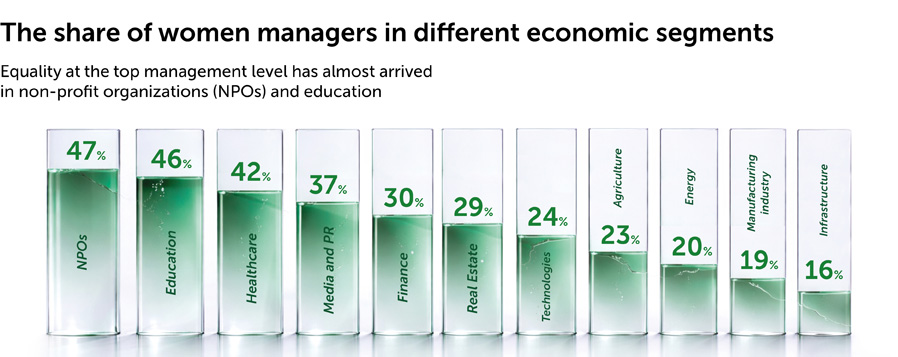
Source: Global Gender Gap Report 2022, World Economic Forum
Women CEOs Making History: Meg O’Neill and BP
In late 2025, the board of directors of British energy giant BP (BP) announced that Meg O’Neill would lead the company starting 1 April 2026. For the first time in over a century of BP’s history, a woman will hold the CEO position.
Founded in 1908 by William Knox d’Arcy, BP has evolved from risky exploration projects to a diversified energy holding. Energy is considered one of the most conservative industries in terms of management, so appointing a woman as CEO of a corporation of this scale reflects major changes in the sector’s HR policies.
Since 2021, Meg O’Neill has led the oil and gas company Woodside Energy. She oversaw the merger with BHP Petroleum International - the largest energy corporation on the Australian Stock Exchange. For the previous 23 years, Ms O’Neill worked at ExxonMobil (XOM), one of the key players in the global oil and gas sector.
In 2025, women led 11 % of Fortune 500 companies - a historic record since 1955, when the first such list was compiled.
Women leaders tend to underestimate their abilities. According to Russell Reynolds, 70% of men and only 50% of women believe they are ready to take the position of their superior
Gender balance in the leadership of Fortune 500 companies is still far from being achieved. The positive trend - the growing number of women CEOs - is driven by career advancement within a single company. This reflects an increasingly strong willingness of corporations to entrust women professionals with the top of the management pyramid.
The Economics of Female Leadership
Investors are primarily interested in how gender balance in top management affects business financial results. Researchers have no doubt that this impact exists and is measurable.
Analysis of issuers included in major stock indices shows that where the share of women in leadership exceeds the median, return on equity (ROE) increases by approximately 30 % within a year. At the same time, the risk of profit decline decreases by roughly the same amount. Corporations where women hold at least 25–30 % of management positions not only achieve higher profitability but also demonstrate more predictable results.
Carnegie Private Wealth attributes the economic effect of female leadership to a combination of management approaches that directly improve business quality. These include:
- Teamwork. Women leaders more often emphasise communication, develop a culture of feedback and engagement. As a result, employees feel more satisfied and productive, staff turnover is lower, and strategies are implemented more effectively.
- Balanced risk management. On average, men are more inclined towards “high‑risk, high‑reward” strategies, while women demonstrate a more cautious but systematic approach. Businesses with women in top management are less likely to be involved in financial scandals or declare default. This positively affects shareholder capital protection.
- Closer to the customer - closer to profit. Management teams with women identify new growth opportunities faster because they better understand diverse customer groups. Women’s business experience helps account not only for the needs of the average consumer but also, for example, the preferences of female shoppers and family‑oriented market segments.
- Transparency and ethics. Companies with more women in leadership have stronger corporate governance structures, pay greater attention to compliance (ensuring adherence to legal and industry standards) and ethical norms. This increases investor confidence and reduces regulatory risks.
- Talent attraction and retention. The presence of women in top management signals an inclusive, modern corporate culture. This helps attract qualified professionals and boosts employee loyalty, especially among younger staff, for whom alignment of personal values with employer values is highly important.
Thus, female leadership is becoming a source of long‑term competitive advantage. Today, this is reflected both in financial reporting results and in management quality.
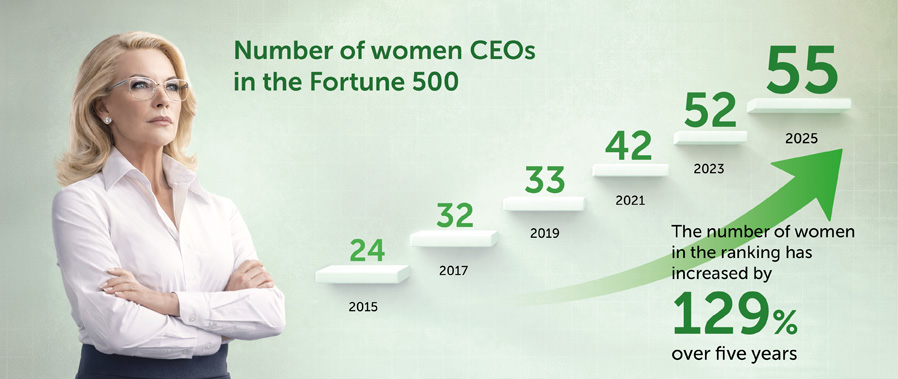
Source: Fortune Magazine (One of the oldest business magazines in the United States)