
Freedom recommends buying Nike shares with a target price of $55
Stock Market News
4 August 2026, 19:44
Freedom believes that Nike’s (NKE) current share price does not reflect the company’s potential as its business recovery begins. The target price is set at $55 per share, implying upside of about 30.7% from the price at the time of the analysis ($42.07).
The author of the investment idea is Vadim Merkulov, Director of the Analytical Department at Freedom Finance Global. To limit potential losses, the analyst recommends setting a stop-loss at $34.
More interesting insights about companies — in the new Investment Review No. 350 from Freedom analysts.
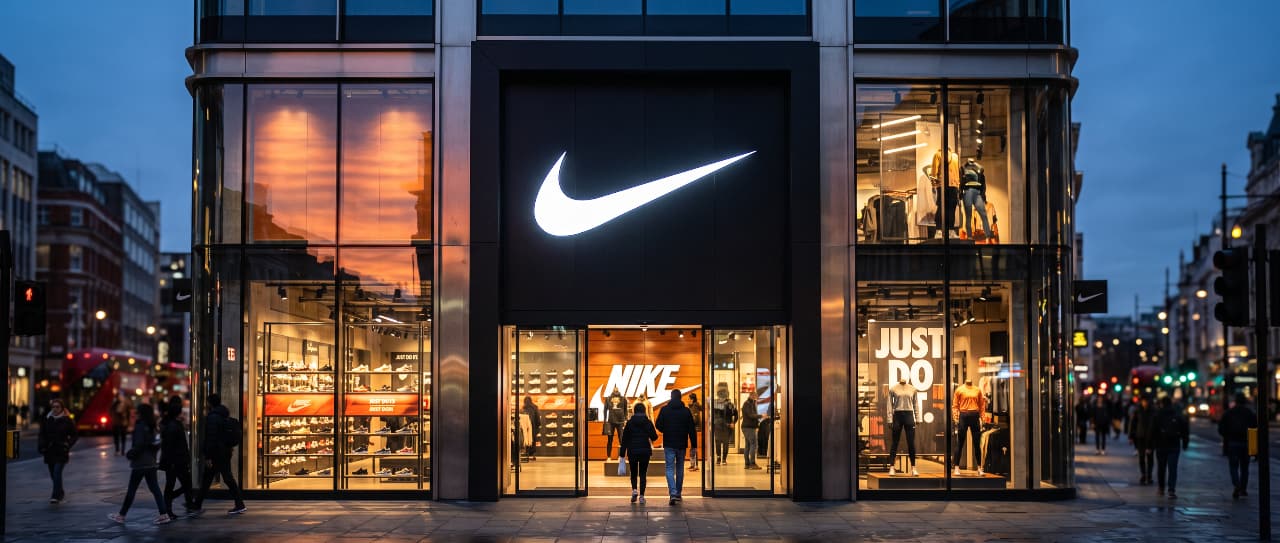
Nike (NKE): what the company does and how much it earns
Nike (NKE) is one of the world’s leading corporations specializing in the production of athletic footwear, apparel, equipment, and accessories, with a widely known, recognizable brand. The company’s annual revenue exceeds $46 billion. Nike was founded in 1964, and its headquarters is located in Beaverton, Oregon.
Why buy Nike shares: Freedom’s investment thesis
Although the decline in footwear sales in Greater China continues, Nike is showing the first results of its business recovery strategy. In its home market, the U.S., footwear sales rose 5% year over year. Additional support for financial results came from the return of about $1 billion under the IEEPA — compensation for import duties deemed unlawful, introduced by the Donald Trump administration in 2025.
Roughly the same amount is estimated for the company’s net cash position, providing it with sufficient liquidity for strategic initiatives. At the same time, Nike is gradually shifting brand positioning toward the premium segment and continues to optimize its direct-to-consumer model.
Since the beginning of the year, Nike shares have fallen by about 35%, and over the past five years they have lost around 75% of their value. At the same time, the company’s shares are included in the Dow Jones Industrial Average and the S&P 500, as well as a number of sector indices. When portfolios are rebalanced, passive funds automatically increase the weight of issuers included in the relevant indices, which may become an additional supportive factor for their quotes.
Short interest in Nike shares totals about 63 million shares, or 5.5% of the free float. This corresponds to roughly three average daily trading volumes. If market sentiment improves, mass short covering could trigger a noticeable short-term rise in the share price.
Nike pays dividends quarterly and raises the payout annually. The current dividend yield is about 4%, which makes the shares more attractive to long-term investors and partially limits the risk of a further decline in the share price.
Nike financial forecasts: revenue and profit through 2030
According to Freedom analysts’ forecasts, Nike’s revenue will decline from $51.4 billion in fiscal 2026 to $46.3–46.4 billion in 2025–2026, after which it will gradually recover — to $51.4 billion by 2030. By 2030, analysts expect earnings per share to recover to $3.46 amid EBITDA margin expansion from 9.89% in 2026 to 12.86% by 2030.
Freedom’s recommendation is to buy NKE shares with a target price of $55, which corresponds to an upside potential of 30%.
What Nike (NKE) was remembered for this year
Earlier, Freedom reported that RBC Capital Markets downgraded Nike shares from “outperform” to “sector perform” and cut the target price from $70 to $50, citing a slower recovery than expected.
Later, it became known that Nike’s shares fell to an 11-year low amid weak sales in China and intensifying competition from Adidas and new players such as On Holding.
Despite this, Nike’s fourth fiscal quarter results beat forecasts: the company posted profit of $1.07 billion versus $211 million a year earlier, even though revenue declined and sales in China fell 12%.
After the earnings release, Freedom cut its Nike target price to $54, noting that the company has delivered results above consensus estimates for the seventh straight quarter, but ongoing pressure in China and the lack of official guidance for fiscal 2027 are keeping analysts from taking a more optimistic view of the stock.
Not an individual investment recommendation.