
Oracle’s cloud business growth may support the stock, but debt remains a risk – Freedom Broker
Stock Market News
11 September 2026, 20:33
Oracle (ORCL) reported nearly 30% revenue growth in the first quarter of fiscal 2027, to $19.35 bn, beating market expectations of $19.14 bn. After the results were released, the company’s shares rose 7% in after-hours trading to $160, though later the gain slowed to 4%.
The acceleration of the cloud business confirms that Oracle’s investments in artificial intelligence infrastructure are beginning to pay off, says Freedom Broker analyst Vladimir Chernov. At the same time, high leverage, negative free cash flow, and large-scale capital expenditures remain key risks to the stock’s valuation.
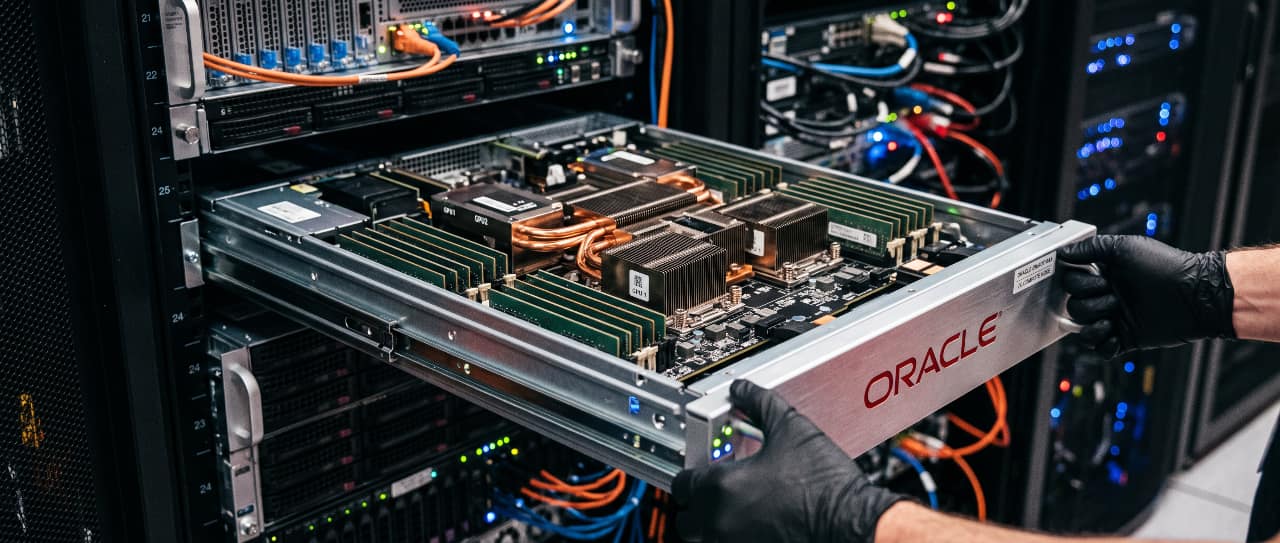
What Oracle does
Oracle (ORCL) is a U.S. software developer and provider of cloud computing capacity. The company is known for database management systems and enterprise software, and in recent years it has been actively building data centers to train and run artificial intelligence models.
Oracle’s cloud infrastructure allows clients to rent computing power, servers, and data storage online. This approach frees customers from having to buy and maintain expensive equipment on their own.
Cloud revenue rose 121%
Oracle’s cloud infrastructure revenue increased 121% year over year to $7.4 bn. Analysts had expected $7.19 bn. Total cloud revenue, including enterprise applications, rose 62% to $11.61 bn, also beating the market forecast of $11.51 bn.
The main source of demand is computing power for artificial intelligence. Over the quarter, Oracle brought online data centers with total capacity of 850 megawatts.
Meanwhile, the traditional software business showed weaker momentum. Its revenue fell about 3% to $5.55 bn, below the expected $5.61 bn.
Oracle’s adjusted profit rose 31% to $1.92 per share, versus analysts’ forecast of $1.74. Net income increased 60% year over year and reached $4.68 bn, or $1.56 per share.
Contract backlog reached $664 bn
Oracle’s remaining performance obligations under signed contracts reached $664 bn, above the forecast of $630.6 bn. The metric reflects revenue the company is expected to receive in the future under agreements already signed but not yet recognized in the financial statements.
According to Vladimir Chernov, this volume of obligations provides good visibility into Oracle’s future income. It shows that demand for the company’s cloud capacity remains high, even if the actual receipt of revenue is spread over several years.
For the second quarter, Oracle projects revenue growth of 30–34% year over year and adjusted earnings of $1.85 to $1.93 per share. For the full fiscal 2027 year, the company expects revenue of at least $90 bn and adjusted earnings of $8.10 per share.
Oracle’s debt rose to $125 bn
Rapid development of cloud infrastructure requires significant investment. Oracle’s capital expenditures for the quarter increased from $8.5 bn to $28.5 bn, and for the current fiscal year the company expects the figure to be $70 bn. Another $20–25 bn is planned for upfront payments for certain hardware components.
Oracle’s debt reached $125 bn. Free cash flow was negative at $5.4 bn versus a negative $362 mln a year earlier. This means that after funding ongoing operations and acquiring long-term assets, the company spent more cash than it generated.
Vladimir Chernov notes that Oracle is currently operating in an aggressive investment mode rather than generating sustainable cash flows. Therefore, the stock’s дальнейшая dynamics will depend not only on cloud revenue growth but also on the company’s ability to control costs and gradually reduce its need for external financing.
Since the beginning of 2026, Oracle shares have lost more than 21%, and from the peak reached on June 1 they are down 38%. Investors were concerned about the cost of building data centers, rising debt, and large projects’ dependence on a limited number of customers.
Earlier, Freedom Broker wrote about Oracle’s plans to raise $45 bn to $50 bn to expand cloud infrastructure and artificial intelligence capacity. In addition, the company postponed the completion of construction of some data centers for OpenAI from 2027 to 2028 due to a shortage of labor and materials. OpenAI develops artificial intelligence models and services, including ChatGPT. The company remains private, so it does not have a listed ticker.
This is not an individual investment recommendation.