
Freedom analyzed the results of Nike, Carnival, IDT, Nvidia, and Micron
Stock Market News
12 October 2026, 21:43
Quarterly results and guidance from the largest companies triggered mixed reactions from investors. Nike shares fell after a warning of further sales declines, while Carnival stock rose on the back of record revenue. In a new Freedom Broker investor review, analysts also looked at improvements in IDT’s profit mix, an expansion of Nvidia’s share buyback program, and Micron’s outlook.
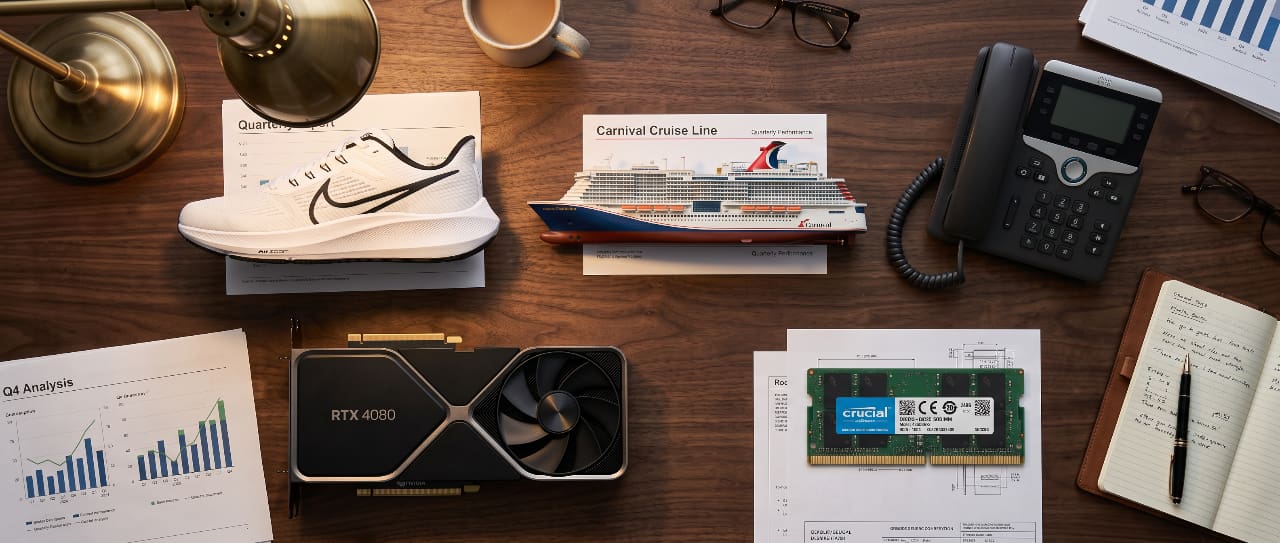
Nike: weak guidance intensified pressure on the stock
Shares of Nike (NYSE: NKE), the athletic apparel and footwear maker, lost another about 8% after the quarterly results were released and fell to their lowest level since 2013.
In Q1 of fiscal 2027, revenue fell 4.3% year over year to $11.21 billion, coming in below market expectations. Sales in China declined 22% in dollar terms. Analysts also note a marked drop in direct sales.
The biggest disappointment was management’s guidance. The company does not expect to stabilize the business quickly: in Q2, revenue is expected to decline by about 4%, and for the full fiscal year—by a high single-digit percentage. This points to a continuing downturn despite measures to restore sales.
Carnival: record revenue supported the shares
Cruise operator Carnival (NYSE: CCL) reported results for Q3 of fiscal 2026 on September 29. Revenue reached a record $8.44 billion.
Adjusted earnings per share were $1.43 versus the expected $1.35. Adjusted EBITDA—earnings before interest, taxes, and depreciation and amortization, adjusted—reached $2.99 billion. Both metrics were roughly in line with last year despite a 36% increase in fuel costs.
Cruise yields in constant currency rose 2.4% versus prior guidance of around 1.2%. Unit costs excluding fuel increased 1.8% instead of the expected 2.8%. Customer deposits reached a record for the third quarter of $7.6 billion. On the day of the report, the stock rose 13%.
Earlier, Freedom Broker reaffirmed its “Buy” rating on Carnival after the Q2 results. The new results show the company continues to combine strong demand with cost control.
IDT: higher-margin segments increase their contribution to results
IDT Corporation (IDT) provides payment and communications services, as well as retail solutions.
In Q4 of fiscal 2026, revenue rose 7% to $339 million. Adjusted EBITDA increased 22% to $41.2 million, and for the year—17% to $154.6 million, exceeding management’s revised guidance.
Freedom highlights a shift in the profit mix. The combined share of the NRS, fintech, and net2phone segments in total EBITDA increased from 46% to 53%, even though they generate only about one-third of revenue. NRS offers point-of-sale and payment solutions for stores, while net2phone provides cloud communications services for businesses.
For fiscal 2027, management forecasts adjusted EBITDA growth of about 15%. Analysts expect NRS to maintain its pace of development and see an additional boost from the expansion of financial services.
Nvidia: share buybacks complement strong operating results
Nvidia (NVDA) increased its share repurchase authorization by $150 billion on September 28. The remaining capacity of the program reached $235 billion, with execution through the end of fiscal 2028.
According to Freedom’s assessment, the decision reflects management’s confidence in the durability of AI demand and the attractiveness of its own shares. However, the scale of the program amounts to only about 4.2% of the company’s current market capitalization.
Analysts also draw attention to the valuation: the price-to-expected-earnings ratio for the next 12 months is more than 50% below the nine-year average. This valuation looks moderate relative to the company’s history, but in itself does not guarantee share price gains.
Micron: long-term contracts strengthen the business outlook
Memory maker Micron Technology (MU) reported strong results for Q4 of fiscal 2026 and provided guidance for the next quarter on September 30.
Revenue, gross margin, and earnings per share exceeded market expectations and Freedom’s benchmarks. A significant contribution came from higher prices. The company expects the memory shortage over the next two years to be more acute than it is now.
Freedom considers the expansion of long-term agreements with customers to be important. Their number reached 26, and the volume of remaining contract obligations was $150 billion. At the same time, increased shipments remain constrained by a shortage of production facilities.
New contracts are being signed at prices below those in the current, tighter market. Therefore, it is important for investors to assess not only the volume of orders but also the future profitability of fulfilling them.
This is not an individual investment recommendation.