
Freedom analysts raised the target price for BP (BP) American depositary receipts from $43 to $51, maintaining a “Hold” rating. Strong refining and high hydrocarbon prices helped the company increase profit and sharply reduce debt. However, experts believe a significant part of the improvement is due to temporary market conditions, while production continues to decline.
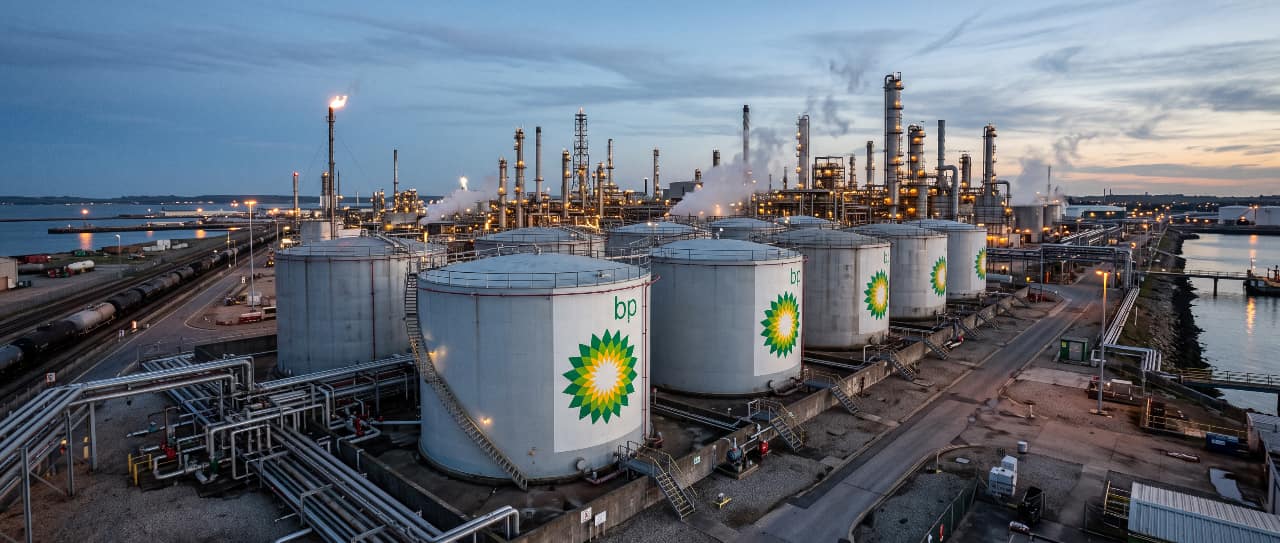
About the British energy company
BP is a British international energy company. It produces oil and gas, processes raw materials, trades energy commodities, operates retail networks, and develops low-carbon projects.
Refining drove a sharp increase in profit
In Q3 2026, BP’s revenue increased 41.3% year over year to $68.4 bn due to higher realized hydrocarbon prices. Compared with the previous quarter, the figure declined by 1%. Adjusted net profit reached $8.5 bn versus $2.2 bn a year earlier. Profit per depositary receipt amounted to $3.26, beating the consensus forecast by 15.4%.
The trading and refining segment delivered particularly strong results: its operating profit quadrupled year over year to $6.9 bn. The refining margin—an indicator of profitability from converting crude oil into petroleum products—reached $46.7 per barrel. This is nearly three times last year’s level and 57.8% higher than the Q2 result. According to Freedom, favorable pricing conditions largely explain the scale of the improvement in financial results. Their persistence cannot be considered guaranteed.
Production remains the weak spot
Operating momentum in the upstream business was negative. In the natural gas and low-carbon energy segment, output fell 2.7% year over year to 0.78 mn barrels of oil equivalent per day. In the oil production segment, the decline was 7.7% to 1.44 mn barrels.
In Q4, management expects a further 2.7% reduction in production. The reasons include the conflict in the Middle East, weather conditions in the Gulf of Mexico, and seasonal weakness in gas demand.
Refining throughput may also decrease by 15% due to the sale of the Gelsenkirchen refinery and maintenance work. Therefore, profit support from high prices is accompanied by a reduction in the business’s physical volumes.
Debt decreased by $8.4 bn over the quarter
Analysts consider the strengthening of the balance sheet the main positive change. Net debt BP, including leases, decreased by $8.4 bn over the quarter to $27.2 bn. This was helped by strong cash flows and a $1.4 bn release of working capital.
Operating cash flow excluding working-capital changes totaled $13.4 bn versus $7.3 bn a year earlier. Cash and equivalents at quarter-end reached $43 bn with short-term debt of $9 bn. Capital expenditures declined 10.2% year over year to $3 bn. However, in Q4, investment spending may increase to $4.1–4.6 bn: the annual guidance is $13.5–14 bn.
Dividends maintained; share buybacks remain on hold
The board of directors maintained the quarterly dividend at $0.52 per depositary receipt. The payment is scheduled for December 18; the ex-dividend date is November 13. In Q3, BP did not conduct share buybacks. The company is directing free funds to strengthen the balance sheet and to early repayment of the remaining obligations from the Gulf of Mexico accident, totaling about $5 bn. This approach reduces financial risks but limits capital returns to shareholders via buybacks.
Asset sales will support the balance sheet but reduce future income
Over nine months, proceeds from asset sales totaled $0.8 bn. In the near term, the company expects to close the sale of a 65% stake in the Castrol lubricants business, which should bring in about $6 bn. Overall, in 2026 BP may receive about $8 bn from asset disposals.
The company also completed the sale of the Gelsenkirchen refinery, agreed to sell its network of filling stations in Austria, and began searching for buyers for North Sea assets and the Archaea business.
Freedom positively assesses the exit from low-carbon projects for which BP recognized $4.1 bn in impairments, mainly in Lightsource bp and offshore wind power. At the same time, the sale of Castrol and North Sea assets will reduce the base of future operating cash flows.
Why the rating remained “Hold”
The new $51 target reflects strong quarterly results, lower debt burden, and the continued high hydrocarbon prices. After Q2, analysts raised their estimate from $39 to $43 and upgraded the recommendation from “Sell” to “Hold.”
Now the key question is the sustainability of earnings. In Freedom’s forecast, adjusted profit per depositary receipt declines from $9.43 in 2026 to $5.37 in 2027. This assessment assumes that the current exceptionally favorable conditions will gradually normalize, and the company will need to offset declining production and the sale of income-generating assets.
Not an individual investment recommendation.