
McDonald’s changes its business structure: why Freedom recommends holding the stock
Stock Market News
9 November 2026, 15:11
Analysts at Freedom Broker believe that the weak revenue growth of McDonald’s (MCD) only partially reflects demand issues: the company is transferring company-owned restaurants to franchisees, reducing reported sales while maintaining high profitability. Nevertheless, the experts downgraded the recommendation from «Buy» to «Hold» and cut the target price from $305 to $298. At the current price of $272.29, the upside potential is about 9.4%.
About the company
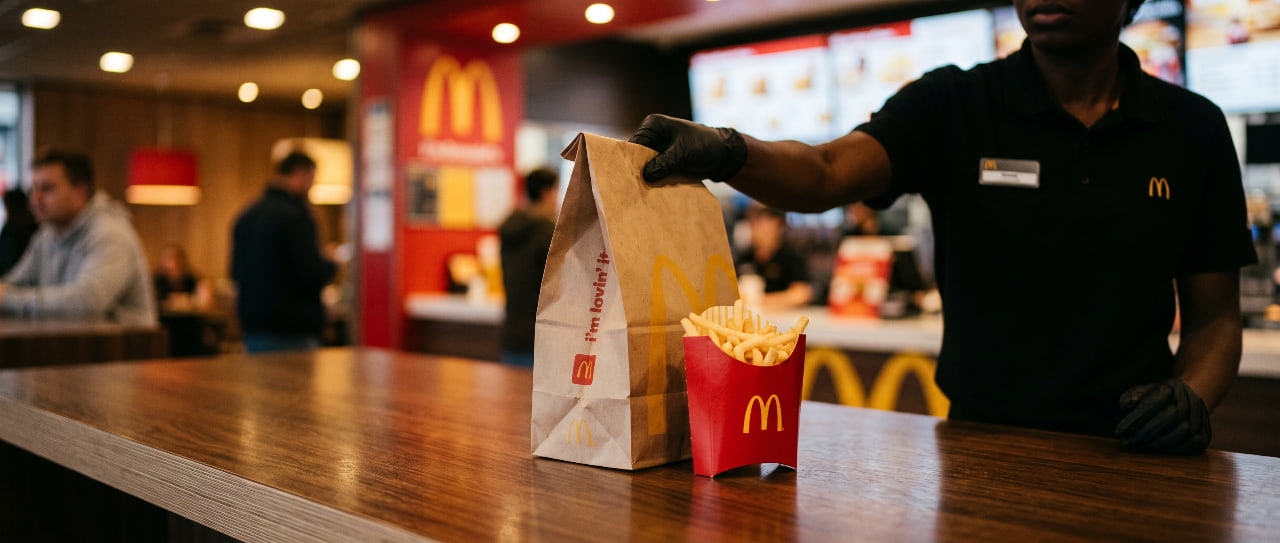
McDonald’s develops an international fast-food restaurant network, predominantly operating under a franchise model. Partners run the outlets, while the company receives rent payments and royalties. McDonald’s now intends to increase the share of franchised restaurants to 98% by the end of 2028.
Why revenue is becoming a less informative benchmark
In Q3, McDonald’s revenue rose by 1% to $7.16 billion, coming in below the market forecast of $7.28 billion. However, Freedom analysts consider the results better than they appear at first glance.
Since the beginning of the year, the company has transferred about 175 restaurants to franchisees. After such a deal, McDonald’s stops recognizing the outlet’s full revenue and instead records rent payments and royalties—according to Freedom’s estimate, about 14% of the restaurant’s sales. At the same time, the profitability of these receipts is significantly higher.
Analysts attribute about half of the quarterly revenue shortfall versus their own forecast precisely to the reduction in the number of company-operated restaurants. Therefore, weak sales growth does not imply a comparable deterioration in the business’s ability to earn money.
Taking these changes into account, Freedom lowered its revenue forecasts for 2026–2028 by 2–9%, but left its expectations for EBITDA and earnings per share virtually unchanged. For investors, this means revenue dynamics should be viewed alongside changes in the network structure and profitability.
Profit growth requires an adjustment for income from restaurant sales
Adjusted earnings per share increased by 11% to $3.57, beating market expectations of $3.39. The adjusted operating margin rose from 48% to 51%. However, nearly half of the increase in operating profit was driven by higher other operating income. In particular, profit from the sale of restaurants to franchisees reached $97 million versus $35 million a year earlier. Additional support came from the share of profit from associates.
Freedom does not assume all of this income will remain at the current level. Excluding other operating income, adjusted operating profit was about 2% below analysts’ forecast. Thus, it is important for investors to separate the effect of the business-model change from a sustainable improvement in restaurant operations. Strong quarterly profit does not yet mean consumer demand has fully recovered.
What will show whether customers are returning
The key metric remains comparable sales—the performance of restaurants that have been operating long enough for a proper comparison. In the U.S. in Q3, they fell by 0.2%: higher average check nearly offset lower traffic.
By the end of the period, signs of improvement emerged. According to management, in September comparable sales turned positive after digital offers were reinstated and marketing priorities were adjusted. Positive underlying traffic momentum continued in October, but management did not promise an acceleration in Q4 results.
Freedom expects flat comparable sales growth in the U.S. in the final quarter of the year and growth of 2–3% in 2027. Affordable combo meals should support the recovery. The company is testing such offers in about 1,900 restaurants, and partners at another roughly 4,000 outlets are rolling out similar sets early. A nationwide launch is planned for early 2027. In analysts’ view, the test results will be one of the ближайших factors affecting changes in expectations for the business.
Why Freedom downgraded its recommendation
The shift toward franchising supports profitability, but by itself does not guarantee further share-price gains. In its November 5 analysis, Freedom tied the downgrade primarily to valuation: after the post-earnings share-price rise, the room to the target price narrowed.
After Q2, experts still recommended «Buy», although they had already lowered the target to $305 due to slowing comparable sales and a revision of the timeline for network expansion. Now the target is $298, and the recommendation is «Hold».
At the current price of $272.29, the gap to it is about 9.4%. Further improvement in valuation will depend on traffic recovery and the ability to maintain profitability without such a significant contribution from income from restaurant sales.
What shareholders have besides upside potential
McDonald’s continues returning capital to investors. In Q3, the company paid $1.3 billion in dividends and allocated $519 million to share buybacks.
The quarterly dividend was raised by 4% to $1.93 per share, payable on December 15. These payments add to investment returns, but they do not eliminate the risks of weak demand and rising costs: in 2027, the company expects inflation in food and packaging costs within 5–9%.
Not an individual investment recommendation.