
Chevron (CVX) reduced net debt by 27.4% quarter-on-quarter, to $20.7 bn. Analysts at Freedom Broker believe that a stronger balance sheet combined with high refining profitability improves the company’s position, and upgraded the recommendation from “Sell” to “Hold.” The target price was raised to $218: at the current quote of $212, the upside potential is about 2.8%, so experts are not yet recommending the stock for purchase.
About the company
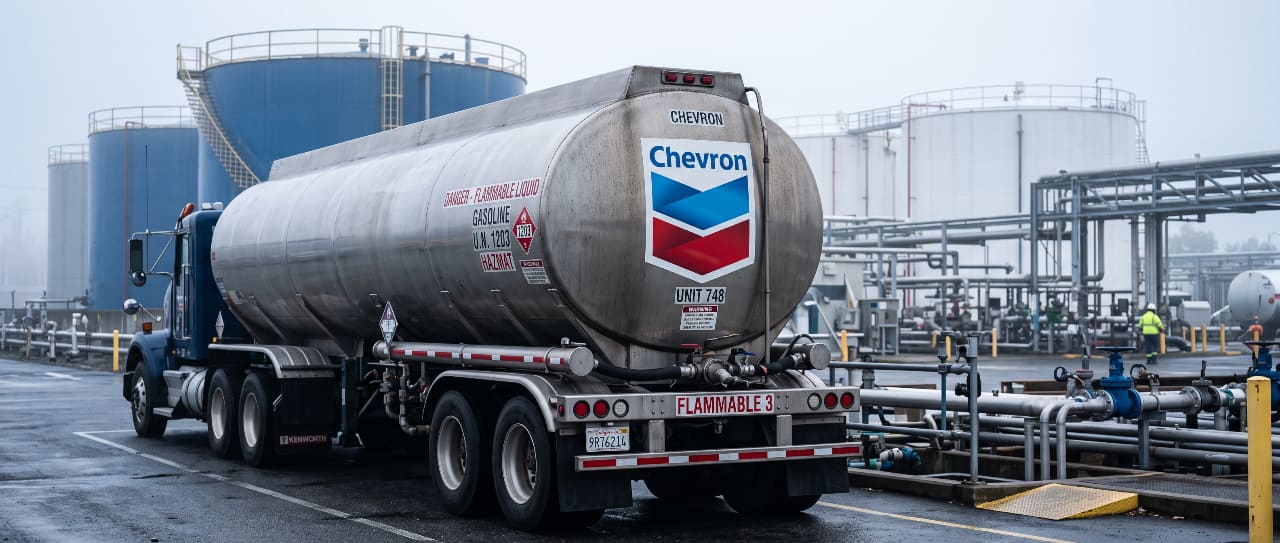
Chevron is an international oil and gas company engaged in oil and gas production, refining, and the sale of petroleum products. This structure makes it possible to generate income at different stages of production: in Q3, the decline in production was accompanied by record profit in the U.S. refining business.
What’s behind the debt reduction
In Q3, Chevron’s net debt decreased by $7.8 bn. The company repaid $3.5 bn in debt and at the same time increased cash by $4.3 bn, to $12.8 bn. For investors, this means stronger financial resilience: the company now has more cash relative to debt obligations. However, the decline in net debt cannot be fully equated to loan repayment—much of the change was driven by higher cash balances.
Cash flows were supported by both operating performance and additional inflows. In particular, Chevron received $1 bn as repayment of a Tengizchevroil loan and proceeds from asset sales.
Operating cash flow before changes in working capital amounted to $16.6 bn—66.5% higher than a year earlier. At the same time, capex fell by 9.7%, to $4 bn. In Q4, investments are expected to rise: management expects full-year spending at the lower end of the $18–19 bn range.
Refining helped offset the decline in production
The main source of improvement in quarterly profit was refining. Adjusted profit in the segment reached $4.9 bn versus $1.1 bn a year earlier. The U.S. unit earned a record $3.6 bn amid high margins and refinery utilization of about 98%.
At the same time, global hydrocarbon production decreased by 2.6% year-on-year, to 3.98 mn barrels of oil equivalent per day. The result was affected by changes in the company’s equity share in production-sharing agreements, restrictions in the Neutral Zone between Saudi Arabia and Kuwait, and maintenance in Guyana and at Angola LNG.
Nevertheless, higher realized prices supported the upstream business. Its adjusted profit rose 72.9% year-on-year to $6.1 bn, although it declined versus the previous quarter. Chevron’s total adjusted profit amounted to $10.4 bn—almost three times last year’s level. Earnings per share reached $5.28, beating consensus by 8.4%.
Why a strong balance sheet doesn’t yet make the stock attractive to buy
Freedom views the results positively but believes the upside in the share price is limited. The $218 target is only about 2.8% above the provided current price of $212.
At the same time, the company’s earnings depend on oil prices and refining margins. Analysts allow for favorable conditions to persist if the conflict in the Middle East drags on. The opposite scenario—normalization of supply and the unblocking of the Strait of Hormuz—could lead to lower oil prices and refining profitability.
Therefore, the quarter’s high cash flow should not be automatically extrapolated to future periods. In Freedom’s forecasts, adjusted earnings per share decline from $18.07 in 2026 to $13.46 in 2027 and $9.58 in 2028.
Management is also staying cautious: despite strong inflows, the company does not plan to change its approach to capital allocation, citing oil price volatility.
Dividends and share buybacks continue
Chevron maintained its quarterly dividend of $1.78 per share, payable on December 10. If the payout remains unchanged over four quarters, at a price of $212 the annual dividend yield would be about 3.4%. In Q3, the company allocated $2.5 bn to buybacks versus $3 bn the prior quarter. For Q4, a $2.5–3 bn range is planned.
These payouts complement the potential result from share price changes. However, Freedom still considers the combination of potential price upside and risks insufficient for a “Buy” recommendation.
How Freedom’s view has changed
After Q2, analysts maintained a “Sell” recommendation with a $175 target. At the time, experts noted that the record results were largely supported by favorable pricing conditions and temporary effects.
Following Q3, lower leverage, high refining profit, and improved prospects for certain upstream assets became grounds for a higher valuation. But with a $218 target, the recommendation is limited to “Hold”: strengthening of the business no longer implies comparable upside potential for the stock.
Not an individual investment recommendation.
seo