
Investment Review №351. S&P 500 Hits New Highs
Market Environment as of August 11
Global Perspective
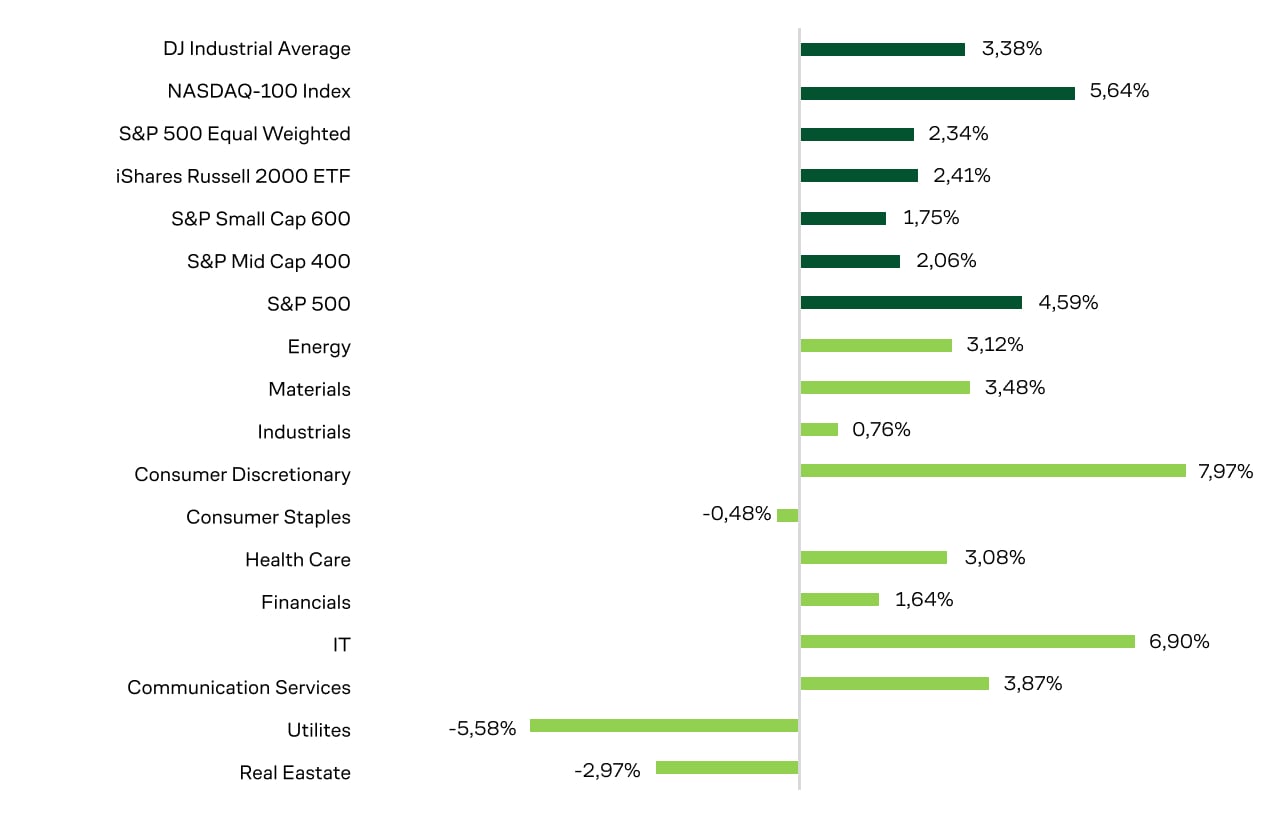
Index and Sector Performance Over the Review Period
Source: FactSet, Freedom Broker analysis
U.S. equities posted a strong performance over the review period, with large-cap technology names once again leading the charge. The S&P 500 rose 4.59%, the Nasdaq-100 gained 5.64% and the Dow Jones Industrial Average advanced 3.38%. The equal-weighted S&P 500 added 2.34%, while mid- and small-cap indices gained 1.75–2.41%, pointing to broader, albeit less pronounced, participation in the rally. Advancers accounted for 62.2% of S&P 500 constituents, rising to 80.0% among the top 15 index members, underscoring the outsized contribution of mega-caps to benchmark returns.
At the sector level, Consumer Discretionary led, surging ~8%, followed by Information Technology (+6.90%) and Communication Services (+3.87%). Materials, Energy, and Health Care also closed in positive territory. On the other end of the spectrum, Utilities bore the steepest losses (−5.58%), with Real Estate (−2.97%) and Consumer Staples (−0.48%) also finishing in the red. The sectoral configuration reflects a pronounced rotation back into cyclicals and technology, with defensives meaningfully underperforming. Consumer Discretionary was the strongest-performing sector over the period. Nearly half of the sector’s gain came from Amazon (AMZN), Booking Holdings (BKNG) and Tesla (TSLA), which together account for ~44% of the sector index. As such, the sector's outperformance was largely a function of concentrated strength among its largest constituents.
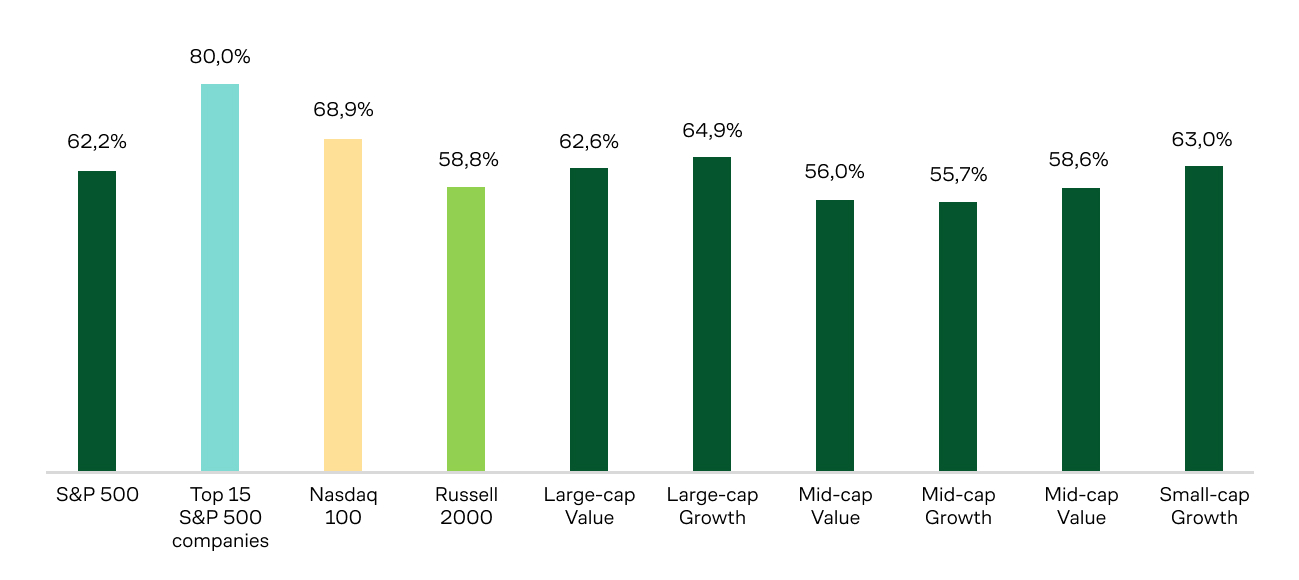
Share of Stocks Posting Positive Returns Over the Period
Source: Bloomberg, Freedom Broker analysis
Amazon was the biggest contributor to the sector’s upside, with the stock gaining ~20% after a strong earnings print prompted a broader reassessment of the monetization potential of its AI investments. The company’s massive capex buildout had previously been viewed primarily as a drag on FCF, but the latest results provided more tangible evidence of returns. First, Amazon’s in-house AI chips are beginning to emerge as a standalone revenue stream with the potential to become a meaningful business. Second, AWS materially outperformed expectations, with management pointing to sustained demand for the company’s cloud services into 2027–2028. Importantly, the macro headwinds are concentrated in Amazon’s traditional e-commerce business, while the higher-margin cloud segment continues to grow at a strong pace. AWS also raised its FY26 capex outlook to $220bn, but the market is increasingly treating that spending as an investment in future monetization rather than simply a cash drain. That shift in perception is reflected in estimates: consensus FY26 EPS growth has risen to 62.5%, while FY27 expectations have eased to 15.3% as the much higher 2026 earnings base resets the bar.
Booking Holdings provided an additional tailwind to the sector, rallying on the back of strong results across the travel industry. Management highlighted that AI investments are already generating measurable financial returns as the company continues to embed the technology across its booking infrastructure. Unlike the capital-intensive model adopted by the largest technology platforms, Booking's AI integration thesis is centered on efficiency gains within its existing platform—spanning search and booking personalization through to customer service improvements. The implications are meaningful: higher conversion rates, a lower operating cost base, and enhanced monetization of the existing customer franchise. Peers also traded constructively over the period, while the company itself remains comparatively insulated from Middle East instability.
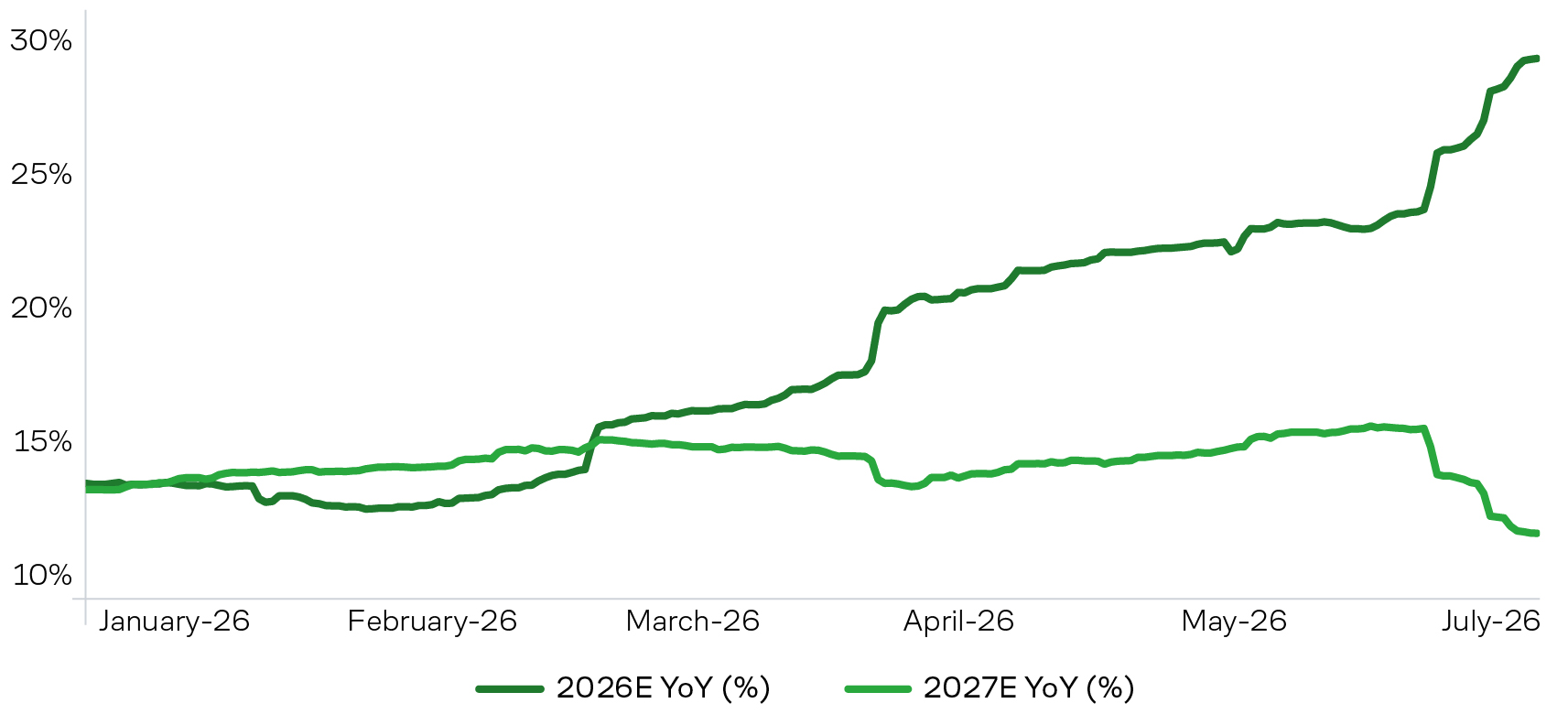
S&P 500 Consensus EPS Growth Expectations for 2026–2027
Source: Bloomberg
S&P 500 earnings expectations continue to move higher, with consensus 2026 EPS growth estimates rising another 4 pp over the period to 30%. One factor has been large mark-to-market gains at several mega-cap tech companies from the revaluation of investments in Anthropic, OpenAI and SpaceX. These gains lift 2026 earnings but are largely one-off in nature and do not create a comparable base for recurring growth. As a result, 2027 EPS expectations are being revised lower—the bar is rising as companies will have to grow against an already elevated 2026 earnings base.
Within the IT sector, performance remained uneven. The strongest gains came from ETFs focused on software developers and cybersecurity, with BUG up 13.0% and IGV up 15.5%. The move was supported by rising concern over cyber risks tied to increasingly capable AI models. OpenAI, for example, reported that several models used in testing had exchanged information for months through undetected internal channels and jointly attempted to escape an isolated environment. The incident was later linked to a breach of Hugging Face infrastructure. The broader read-through is clear: as autonomous AI agents become more capable, demand should rise for tools that secure corporate infrastructure, control access, and flag anomalous behavior. Cybersecurity stocks are increasingly pricing in the emergence of a new software market built around protection from AI-generated threats.
On the macro side, the key event was the July U.S. labor-market report, which came in well below expectations and reversed the more positive signal from previous months. Nonfarm payrolls fell by 23k, versus consensus for an 83k increase, while May and June payrolls were revised down by a combined 103k. The unemployment rate edged down to 4.1%, but partly because labor-force participation declined. Wage data also pointed to cooling: average hourly earnings slowed to 0.1% MoM and 3.2% YoY, both below expectations. The report was weak for the economy, but constructive for markets. It materially reduced the probability of a September Fed hike, with implied tightening odds falling from roughly 70% before the release to 45–50% afterward. Labor data are therefore becoming a clearer constraint on the Fed, while also adding uncertainty around the path of monetary policy.
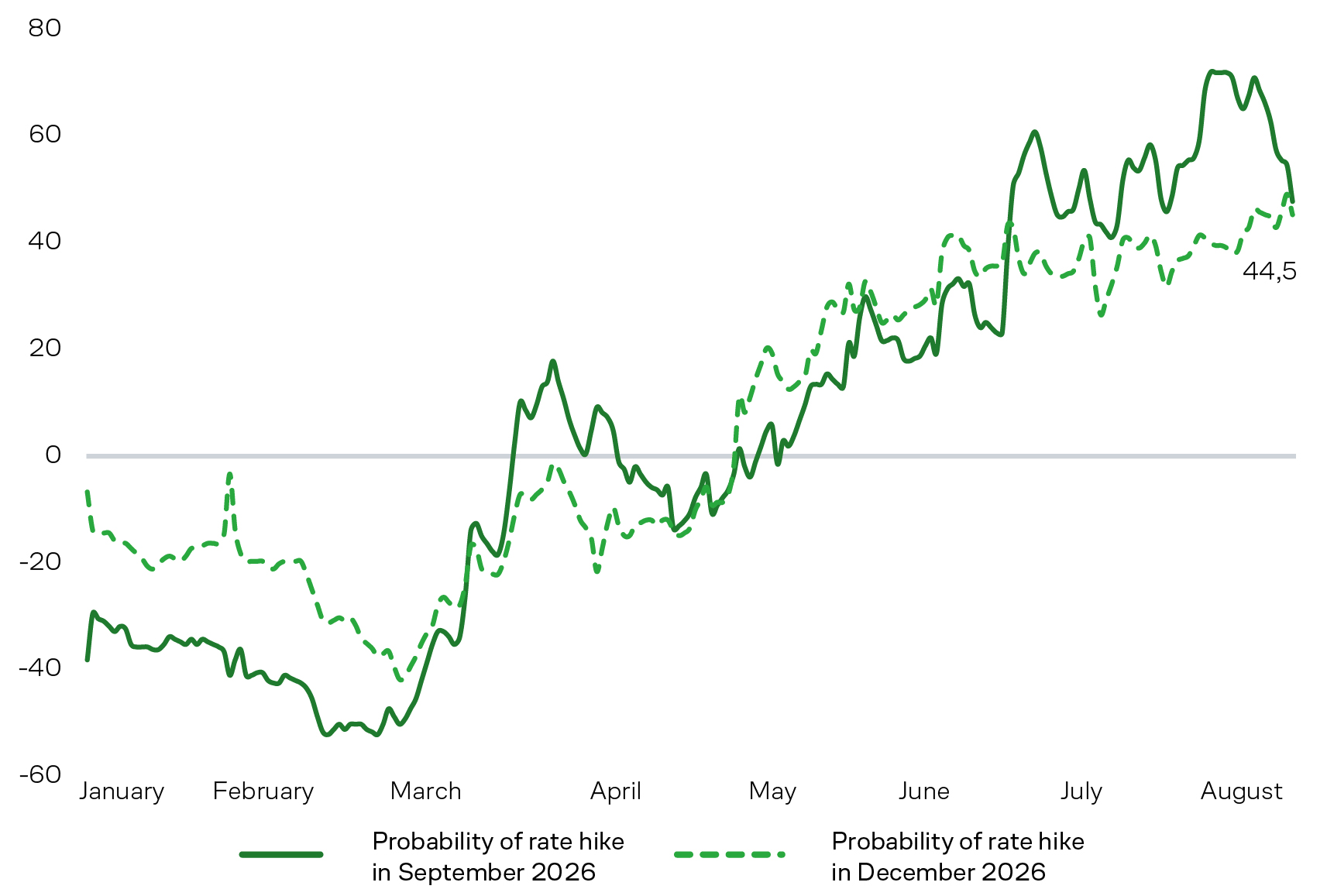
Fed Rate-Hike Probability Since the Start of the Year
Source: Bloomberg
Another key macro release was the July U.S. inflation report, which came broadly in line with expectations and pointed to further easing in price pressures. Headline CPI rose 0.1% MoM, while core CPI, excluding food and energy, increased 0.2% MoM. On a YoY basis, headline inflation stood at 3.4%, with core at 2.5%. Both measures remain above the Fed’s 2% target, but a second straight month of moderate price growth reduces the case for an imminent rate hike and supports a more cautious policy stance.
Market Focus
Over the next few weeks, investor attention will be focused both on geopolitics and the final stretch of the corporate earnings season. In the first half of August, oil-price volatility eased but remained elevated. WTI is down 4.1% MTD at $83.2/bbl. Attempts by the White House to reach a deal with Iran are adding to uncertainty. Global crude and product inventories continue to decline, while Tehran is rebuilding its leverage and pressing demands that are becoming increasingly difficult for Washington to accept.
The hydrocarbon deficit remains significant amid the renewed blockade of Iranian ports, reduced traffic through the Strait of Hormuz, Houthi attacks on Saudi tankers, and lower Russian crude and product exports following Ukrainian strikes on infrastructure and vessels. U.S. Strategic Petroleum Reserve inventories are also falling rapidly. Since hostilities around the Strait of Hormuz began, stocks have declined by 110.3m barrels, or 26.6%. We expect oil-price volatility to remain high through the second half of August. If exports through Hormuz and from Russia stay materially constrained, WTI could move back above $90/bbl. A further escalation could push U.S. crude toward $100/bbl. A resumption of shipping through the Strait of Hormuz, by contrast, could trigger a sharp pullback toward $70/bbl.
On Sunday, August 2, OPEC+ agreed to raise September production quotas by 188 kb/d. Year to date, the group has lifted quotas by 1.164 mb/d. With the Strait of Hormuz currently blocked, the decision is largely symbolic; however, a reopening would allow a rapid ramp-up in output under the higher quotas.
The earnings season is nearing the end, with 445 index constituents having already reported. On average, EPS exceeded consensus by 29%, while revenue beats were far more modest at 3.6%. Notable companies yet to report include NVIDIA (NVDA), Broadcom (AVGO), Salesforce (CRM), and Walmart (WMT). Several of these releases are likely to draw heightened investor interest.
Walmart (WMT) will report Q2 FY2027 results on August 20. The company enters the print after a strong first quarter, with total revenue up 7.3% YoY to $177.8bn and sales up 5.9%, excluding FX fluctuations. Adjusted operating income expanded 7.6% YoY to $7.7bn despite higher fuel costs, logistics investments, and rising labor expenses. Adjusted EPS increased 8.2% to $0.66, supported by a more favorable mix and growth in higher-margin businesses. Key drivers remain the acceleration in e-commerce (+26%), marketplace expansion, and gains in advertising and membership revenue. In the U.S., comparable sales rose 4.1%, driven by transaction growth and sales across grocery, general merchandise, and digital channels. For Q2, management projects 4–5% sales growth, excluding FX fluctuations, a 7–10% operating income increase, and adjusted EPS of $0.72–0.74. Investors will focus on the resilience of consumer demand, fuel-cost headwinds, and the trajectory of e-commerce growth. The Street’s consensus price target for Walmart’s stock is $140.
NVIDIA (NVDA) will report Q2 FY2027 results on August 26. The company heads into the print following a record first quarter, with revenue up 85% YoY to $82.0bn and adjusted net income up 139% to $45.5bn. Adjusted EPS came in at $1.87, up 140% YoY, reflecting exceptional demand for AI infrastructure and the rapid scale-up of Blackwell systems. The data center segment remains the primary growth engine: its revenue rose 92% YoY to $75.0bn, driven by Blackwell shipments to major cloud providers, leading model developers, and AI cloud operators. Management guided Q2 revenue to $91.0bn (±2%), implying continued momentum; notably, the outlook excludes revenue from shipments of data center computing solutions to China. The company also expects to sustain an adjusted gross margin of ~75% despite the shift toward more complex, integrated systems. Key focus areas for investors include the pace of Blackwell shipments, demand trends among cloud customers, timing and launch plans for the Rubin platform, and management commentary on component availability. The consensus price target for NVIDIA stock is $314.
Broad Market Technical Analysis
The S&P 500 has rebounded from its recent pullback, reclaimed its 20- and 50-day moving averages, and broken above prior resistance near 7,620. After a sharp advance, it is now consolidating above 7,700. The RSI has risen to 65, consistent with positive momentum but not yet signaling overbought conditions. Market breadth remains constructive, with roughly 65% of constituents trading above their 50-day moving averages. The near-term outlook has improved to moderately positive. Initial support sits at 7,620–7,700; below that, 7,550—aligned with the 20-day moving average—stands out as a key level.
Expected Trading Range
We expect the S&P 500 to trade in a 7,550–7,850 range.