
Investment Review №356. A Reassessment of Values
Market Review as of October 20
Global Perspective
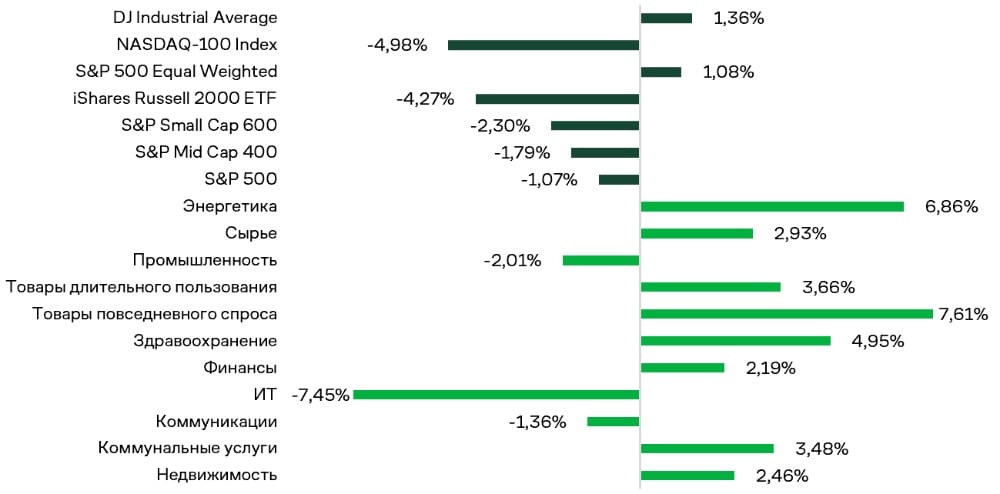
The U.S. equity market saw a rotation out of IT and into traditional sectors over the period under review. The S&P 500 fell 1.07%, while the NASDAQ-100 dropped 4.98%. In contrast, the Dow Jones gained 1.36% and the equal-weighted S&P 500 rose 1.08%. Consumer Staples (+7.61%), Energy (+6.86%), Health Care (+4.95%) and Utilities (+3.48%) led sector performance. The divergence suggests investors were not exiting equities outright, but rather reallocating capital toward traditional and defensive sectors.
Demand for U.S. Treasuries strengthened as investors sought defensive exposure, with the 10Y Treasury yield falling 17bps to ~5.1% from ~5.3%. Meanwhile, the NASDAQ-100 posted its steepest weekly decline since the April 2025 tariff-driven sell-off following Trump’s “Liberation Day” announcement. Similar flight-to-safety dynamics played out in April 2025 and September 2024, when sharp tech sell-offs coincided with inflows into government bonds. Unlike several episodes in 2022, when equities and bonds sold off in tandem, Treasuries are once again providing an effective portfolio hedge.
S&P 500 Information Technology was the period’s worst-performing sector, falling 7.45%. The sell-off centered in part on neoclouds, specialized AI cloud infrastructure providers funding data center expansion largely through debt. CoreWeave bond yields approached 15%, while its credit default swap spreads, a measure of the cost of insuring against default, hit record highs. Elevated funding costs and the risk of further Fed rate hikes are fueling investor concerns over the sustainability of these capital structures. New capacity must not only drive revenue growth but also generate sufficient cash flow to cover substantial debt-servicing costs.
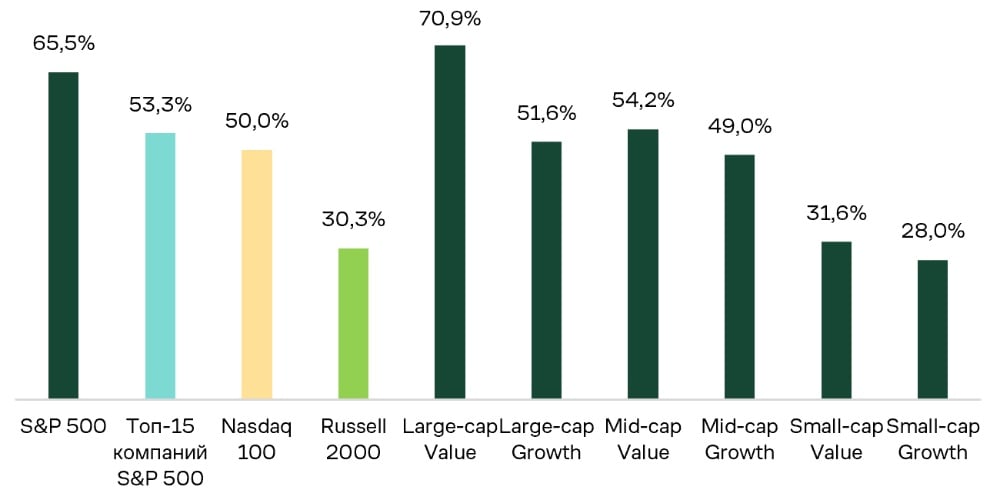
Support from Nvidia CEO Jensen Huang, buying by Cathie Wood’s funds and subsequent analyst upgrades provided only limited support to CoreWeave shares, leaving concerns over its leverage unresolved. Additional attention was drawn by share sales by the company's three co-founders: since the IPO they have sold $3.3bn of stock, of which $2.4bn came in 2026, substantially reducing their equity holdings. CoreWeave has stressed that the transactions were pre-scheduled and do not, in themselves, signal expectations of an impending sell-off. However, the scale of insider selling has added to investor caution.
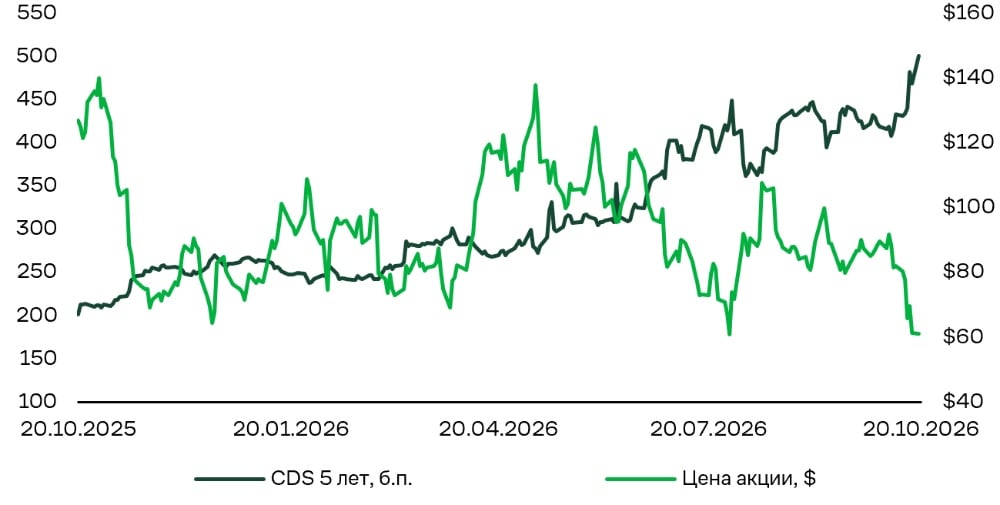
Stress has spread across the broader data center infrastructure chain, with operators’ bonds also falling below par. According to Barclays, $37bn of the $80bn in data center bonds issued in 2026 carried high-yield ratings, up sharply from $8.6bn of $36bn in 2025. The surge in issuance is therefore accompanied by a rising share of riskier debt. Meanwhile, the average yield on U.S. high-yield bonds climbed to 8.41%, its highest level in ~18 months. Against this backdrop, the market’s capacity to absorb new AI-related debt issuance at the pace seen to date is increasingly in question, while further infrastructure buildout may come at a materially higher cost of capital.
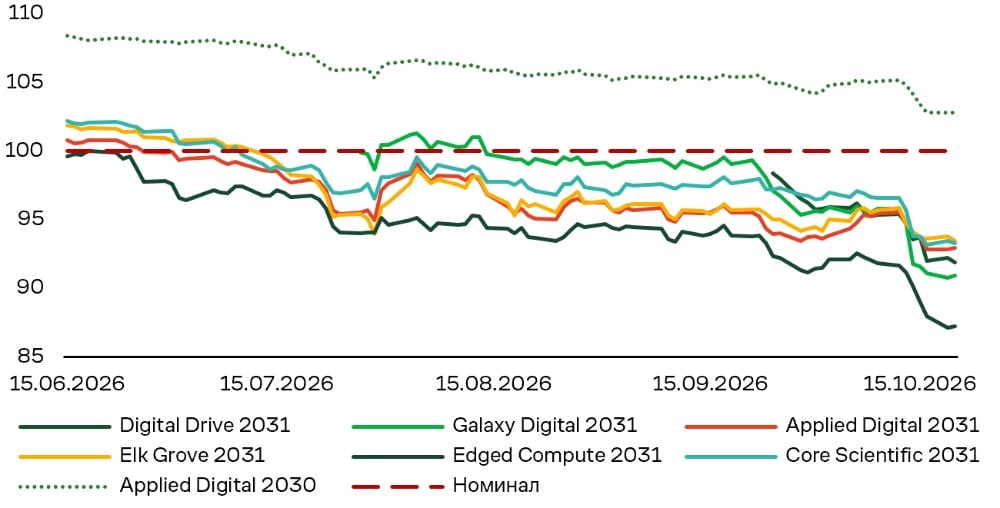
Sentiment was further undermined by a new Gartner report warning that >$3.5tn in AI infrastructure investments could be at risk of impairment by end-2030, as monetization of computing capacity lags the costs of construction and financing.
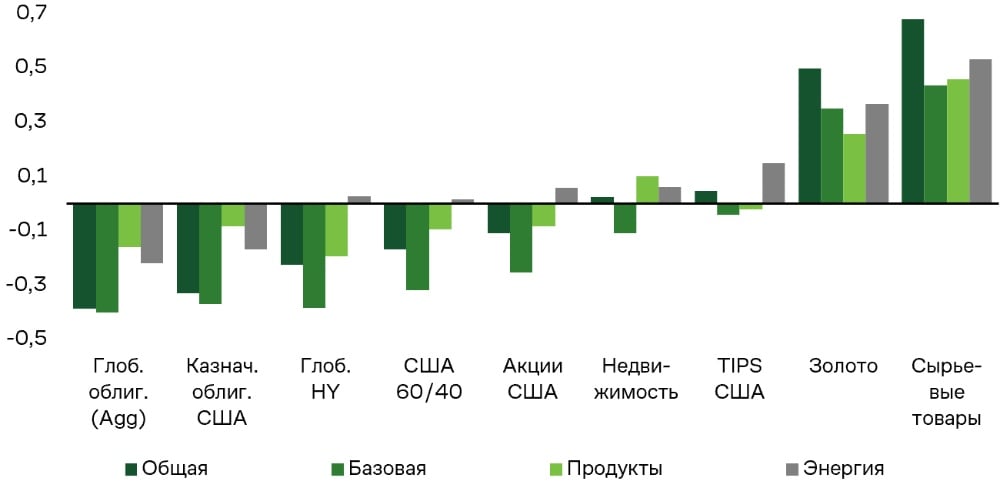
On the macro front, the key event was the release of September U.S. CPI data on October 14. Headline CPI rose 0.65% MoM, above the 0.6% consensus, while core CPI increased 0.33% MoM versus expectations of 0.2%. YoY inflation stood at 3.7% and 2.6%, respectively. Shelter costs rose 0.39% MoM, core goods prices increased 0.25%, and transportation services climbed 0.59%. Beyond shelter, the data point to persistent second-round effects from elevated oil prices, with higher transportation costs feeding through to broader goods and services prices. This adds to inflation uncertainty and keeps the risk of further Fed tightening in play.
The recent rotation into Treasuries should not yet be interpreted as the start of a sustained bond rally. AQR research shows that accelerating inflation has historically weighed on both government and corporate bonds, particularly when core inflation rises, while gold and commodities have exhibited positive sensitivity to inflation. The rotation out of IT and into traditional sectors may persist, but its duration remains uncertain, and the defensive properties of bonds will depend on the nature of the underlying risks. If investor focus shifts back from the tech sell-off to inflationary pressures and further Fed tightening, the bond market could come under renewed pressure.
Market Focus
Escalating hostilities in Yemen continue to be a key driver of oil prices in October. Additional upward pressure on the oil market has come from Iran’s increasingly aggressive attacks on vessels transiting the Strait of Hormuz. As a result, U.S. WTI crude prices have risen by 9% since the beginning of October and are hovering around $100/bbl.
Supply shortages persist amid the blockade of Iranian ports, reduced shipping through the Strait of Hormuz and declining Saudi oil exports via the Red Sea. Global inventories of crude oil and refined petroleum products continue to tighten. Since the outbreak of the conflict, U.S. strategic petroleum reserves have fallen by 132.1 million barrels, representing a decline of 31.8%.
In September, OPEC members, including the UAE, increased oil production by 0.92 mb/d MoM. Output rose for a fourth consecutive month, bringing the cumulative increase since May to 6.1 mb/d (+32.3%), although production remained 12.5% below February levels.
We do not expect the current situation in the Middle East to persist for long. A further escalation of hostilities over the coming weeks could push WTI crude prices above $110/bbl. Conversely, if the United States and Iran reach an agreement to restore safe navigation through the Strait of Hormuz, WTI prices could decline sharply toward the $80/bbl level.
The Q3 earnings season is underway, with 48 index constituents having already reported results. Major U.S. banks delivered mixed earnings, as slower investment banking activity and weaker fixed-income trading were partially offset by higher net interest income and strong performance in equities trading. JPMorgan and Bank of America reported EPS below expectations, while positive surprises from other large banks failed to generate a sustained positive response from investors.
Several upcoming earnings reports are of particular interest.
Alphabet is scheduled to report its Q3 2026 results on October 28. The company enters the reporting period following a strong second quarter, with revenue up 24% YoY to $119.8bn and operating income increasing 30% to $40.8bn. Net income attributable to common shareholders reached $112.1bn, while EPS came in at $9.11. However, investment revaluations contributed $77.1bn to profit, or $6.26 per share, indicating that the strong earnings performance was not driven solely by operational growth. Google Cloud remains the company's primary growth engine. Google Cloud revenue surged 82% to $24.8bn, supported by strong demand for infrastructure and AI-related solutions. Search revenue increased 17%, while video advertising revenue advanced 13%. At the same time, capex totaled $44.9bn, placing additional pressure on cash flow. Investors will focus on cloud growth trends, the pace of AI monetization, and the returns on infrastructure investments. The consensus price target for Alphabet shares is $428.
Intel is set to release its Q3 2026 results on October 29. The company enters earnings season following a robust second quarter, when revenue increased 25% YoY to $16.1bn, marking its fastest growth rate in more than fifteen years. Adjusted net income was $2.2bn, compared with a loss of $441m in the same period last year, while adjusted EPS reached $0.42 versus a loss per share of $0.10 a year earlier. On a GAAP basis, Intel reported a net loss of $11.0bn, primarily reflecting a $12.5bn non-cash revaluation of shares deposited with the U.S. government. Demand for server computing continues to be the key growth driver, with Data Center and AI segment revenue up 59% to $6.3bn. Revenue in the Client Computing segment increased 13% to $8.9bn. For Q3, management expects revenue of $15.8–16.8bn, adjusted EPS of $0.38 and a gross margin of 42%. Investors will closely monitor server demand, progress in the adoption of new manufacturing technologies, and the company’s capital expenditure trajectory as profitability in its core business continues to recover. The consensus price target for Intel shares is $120.
S&P 500 Technical Outlook
The S&P 500 has retreated to 7,690 after reaching a record high near 7,850. The index has fallen below both its 20-day and 50-day moving averages, currently at 7,736 and 7,705, respectively. Meanwhile, the RSI has declined to 47, signaling a loss of short-term momentum. Market breadth has improved notably, with the share of stocks trading above their 50-day moving average rising from 28% to 44%. However, the majority of index constituents remain below this threshold. We maintain a neutral risk outlook for the next two weeks. The S&P 500 is testing key support at 7,680–7,700, reinforced by an ascending trendline. A decisive break below this area would increase the likelihood of a pullback toward 7,510. To regain upward momentum, the index needs to consolidate above its moving averages and the 7,750 level. Such a move would pave the way for a retest of the all-time high at 7,850. A successful breakout above that level would open the door to the psychological milestone at 8,000.
Expected Trading Range
We expect the S&P 500 to trade in a range of 7,510–7,850.