Investment Review №356. A Reassessment of Values
Company News in Focus for Our Analysts
TSMC
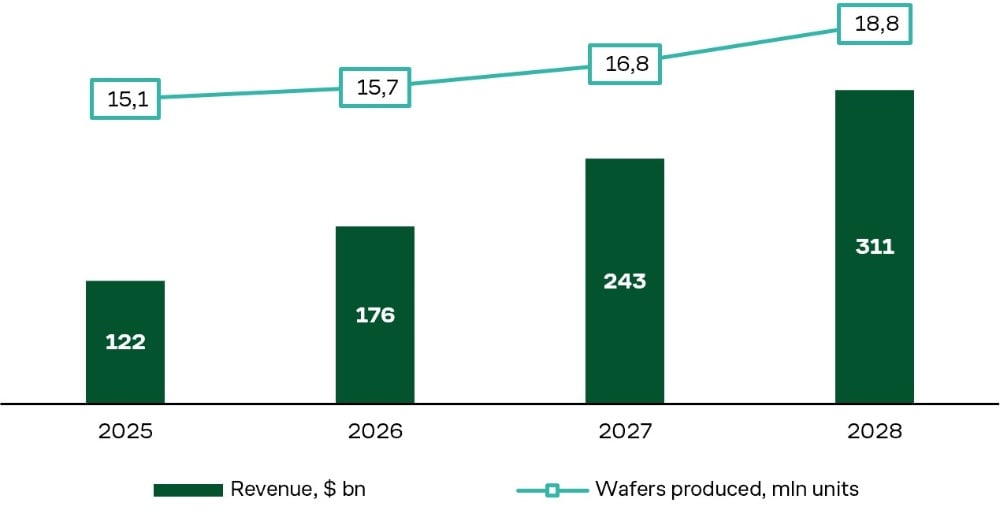
Taiwan Semiconductor Manufacturing Co. (TSM) reported a strong Q3 FY26, with revenue exceeding the high end of guidance, EPS topping consensus, and Q4 FY26 revenue guidance materially ahead of market expectations, implying ~44% full-year revenue growth in U.S. dollar terms. The only notable weak spot was a QoQ gross margin decline, driven by the rapid ramp-up of N2 production rather than any erosion in pricing power; operating margin still beat expectations. Management struck a decidedly bullish tone, highlighting agentic AI as an incremental demand driver beyond accelerators, extending into CPUs and networking, while customers continue to raise demand forecasts and industry demand remains ahead of supply. TSMC is responding with an unprecedented capacity expansion, including an additional N3 fab in Tainan, more than doubling N2 capacity in FY27, and evaluating a new site in Texas. Crucially, revenue continues to outpace CAPEX growth, while management remains disciplined on pricing.
Constellation Energy, Black Hills
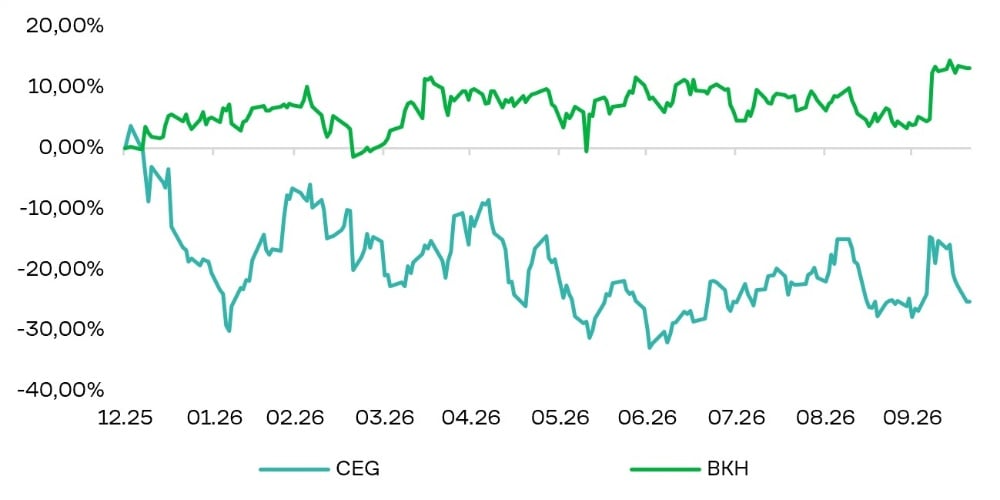
Constellation Energy (CEG) and Black Hills (BKH) announced long-term power agreements with Google on October 6, underpinning significant generation investment. CEG signed a 20-year agreement to supply an incremental 890 MW of nuclear capacity through plant uprates, alongside a 15-year, 2.7 GW power supply agreement within PJM sourced from its existing fleet. The company plans to invest >$4.3bn to upgrade 11 operating nuclear units, with the first incremental capacity expected online in 2028. BKH secured agreements through 2048 to supply up to 590 MW of grid power to Google’s Wyoming data center and manage 2.1 GW of third-party resources through a private microgrid. The company plans to invest $1.8bn in 564 MW of new gas-fired generation through its unregulated subsidiary. Management expects investment returns and microgrid management fees to begin contributing to earnings in 2027, reaching ~$150m in net income by 2030. The agreements establish a long-term earnings growth catalyst for both companies.
Warner Bros. Discovery, Skydance
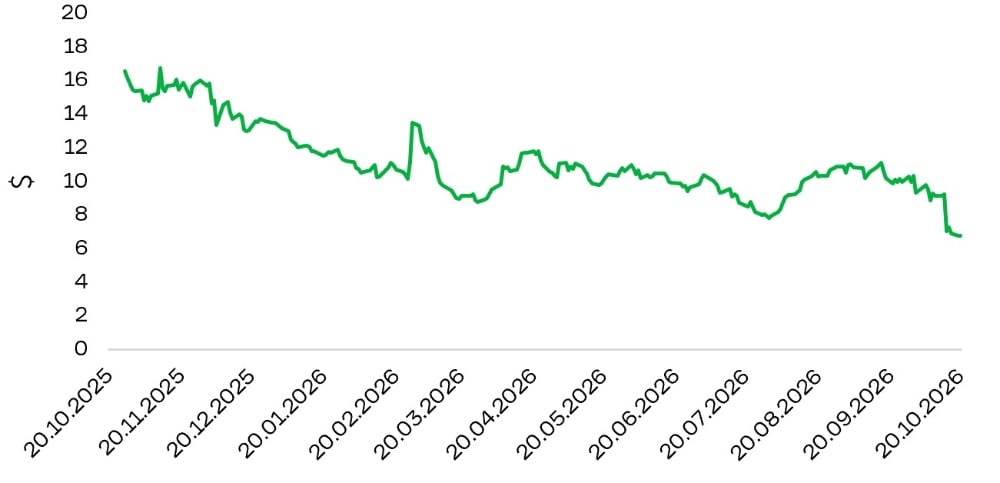
Paramount Skydance completed its acquisition of Warner Bros. Discovery (WBD), with the combined company rebranding as Skydance (SKYD). The transaction valued WBD at ~$111bn, including debt, with $81bn, or $31/share, paid to shareholders. The combination brings together major entertainment franchises, TV series and sports rights, strengthening the group’s competitive position against Netflix and Disney. The combined streaming base exceeds 200m subscriptions, although meaningful overlap between the two services limits the incremental reach. The key challenge is a substantial ~$87bn debt burden amid ongoing structural declines in traditional TV revenue. Management targets net leverage of 3x by 2029, annual FCF of >$10bn by 2030 and investment-grade credit metrics, underpinned by $6bn in annual cost savings within three years. Both studios will remain operational, with a combined theatrical slate of at least 30 films annually over the first two years, rising to 32 films per year over the following three years.
Johnson & Johnson
Johnson & Johnson (JNJ) reported Q3 results ahead of consensus, although the print highlighted persistent weakness in international markets. U.S. sales grew 9.1% YoY to $15.0bn, while international revenue increased just 1.5% to $10.4bn, with international MedTech sales essentially flat YoY. Management attributed the subdued overseas performance primarily to macroeconomic and geopolitical headwinds, raising the risk of a more prolonged slowdown, although it expects conditions to improve in Q4. Innovative Medicine remains resilient, supported by continued uptake of newer drugs. In our view, J&J’s strong competitive positioning across key therapeutic areas and sustained growth from recently launched products should remain the primary near-term earnings drivers, offsetting temporary softness in MedTech. We see no evidence of structural deterioration in the business and reiterate our $280/share price target.
Citigroup, Goldman Sachs, Morgan Stanley, J.P. Morgan Chase, Bank of America, Wells Fargo
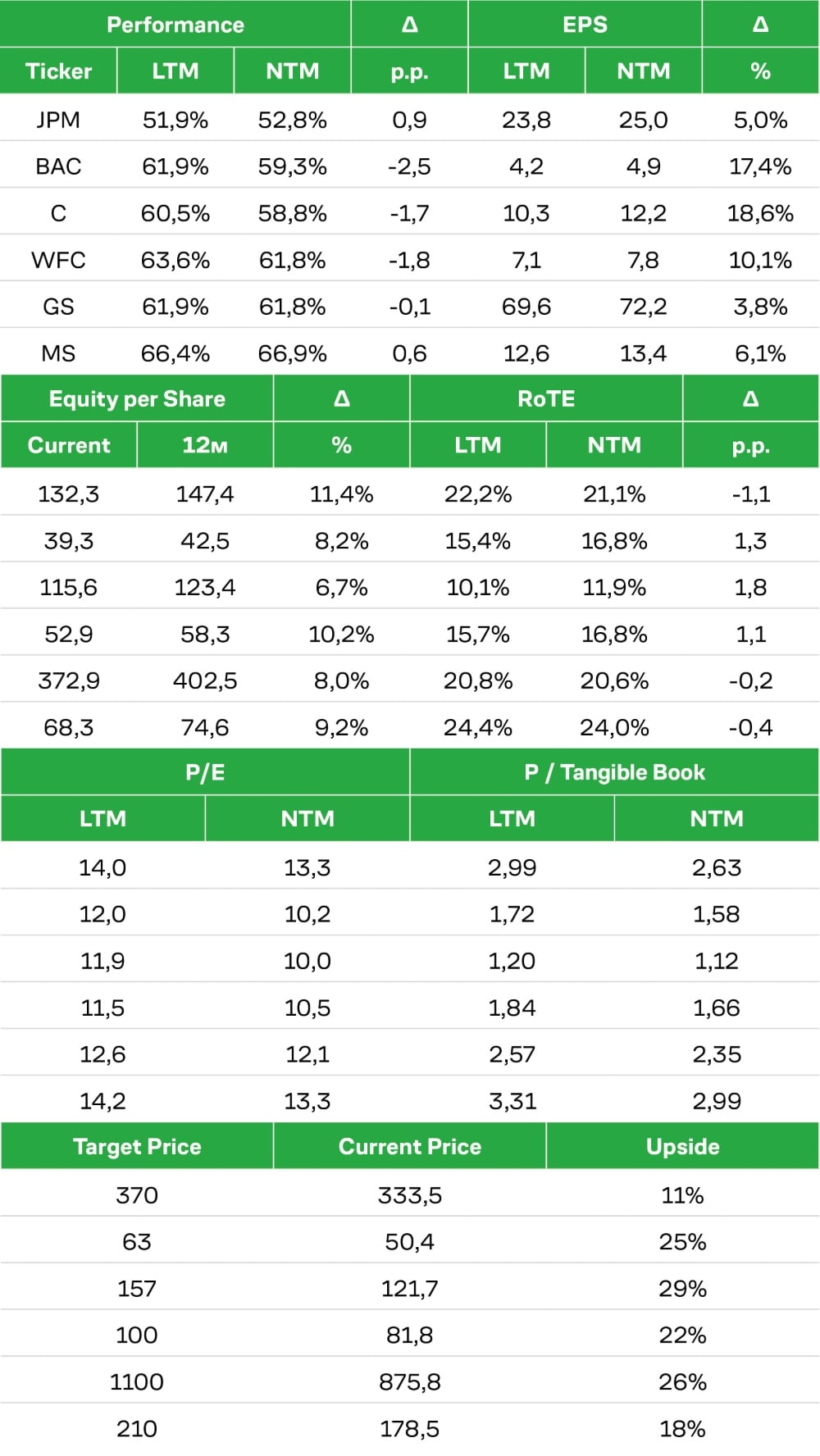
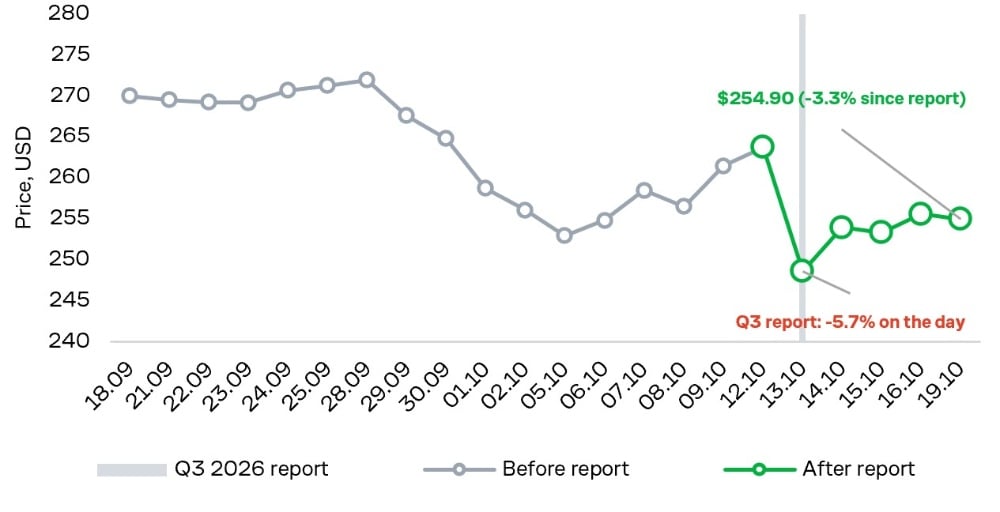
U.S. banks delivered mixed 3Q26 results. Citigroup (C), Goldman Sachs (GS) and Morgan Stanley (MS) beat consensus on both EPS and revenue, while JPMorgan Chase (JPM) and Bank of America (BAC) fell short. Wells Fargo’s (WFC) EPS beat was driven by a one-off tax benefit. Loan growth remained firm, with asset quality holding up. At universal banks, NII provided support, although NIM trends were mixed. JPM and C raised FY26 NII guidance, while BAC and WFC reiterated their outlooks. Funding cost inflation remains a headwind, compounded by a rising mix of interest-bearing deposits. In capital markets, GS and MS stood out on equities trading, with GS also benefiting from strength in investment banking and MS posting a record $232bn in Wealth Management net new assets. Trading revenue at JPM, BAC and WFC came in below expectations.