
Investment Review №334. Customer return
Corporate News In Focus of Our Analysts
Barrick
In 2025, Barrick Gold’s (ABX) Loulo-Gounkoto complex in Mali was at the center of a prolonged conflict with military groups, leading to asset seizures, employee detentions, and a loss of operational control. This created significant uncertainty and weighed on Barrick’s share price throughout the year. An agreement was only reached in November: Barrick regained operational control and secured a 10‑year life-of-mine extension but agreed to pay roughly $430 million and operate under Mali’s more stringent 2023 Mining Code. As part of the settlement, all ongoing ICSID arbitration proceedings were withdrawn. The year-long disruption had a material impact on financial performance. Barrick excluded Loulo-Gounkoto from its guidance despite the mine historically accounting for ~14% of production, wrote down approximately $1 billion in revenue, and reported a net loss of $1.035 billion in Q2. The crisis accelerated Barrick’s focus on more reliable jurisdictions: the Tongon mine was sold, and capital allocation priorities moved to the Reko Diq project and the Lumwana expansion. Before the conflict, Loulo-Gounkoto was a cornerstone asset, producing 723,000 ounces of gold in 2024 and accounting for about 43% of Mali’s industrial gold output.
| Period | Key Development | Impact |
| 2023 | New Mining Code | Mali introduces a new mining code that raises the state’s equity participation and tax burden. Barrick initially pushes back, invoking stability clauses in its existing agreements. |
| Jan-25 | Seizure and Suspension | Tensions escalate into open confrontation. The government blocks gold exports and seizes three tonnes of doré; Barrick suspends operations on January 14. |
| Apr-25 | Office Closure | Authorities close Barrick’s Bamako office and threaten to revoke its mining license over alleged tax arrears. |
| Jun-25 | Loss of Control | A Malian court places the Loulo-Gounkoto complex under “provisional administration,” effectively stripping Barrick of operational control. A former health minister is appointed as the court‑mandated administrator. |
| Jul-25 | Limited Restart | Under government supervision, the mine runs at roughly 25% of capacity, hampered by supply chain disruptions and limited technical expertise. |
| Nov-25 | Settlement | A comprehensive settlement has been eventually reached. Barrick regains operational control, while Mali releases detained employees and drops all related charges. |
Source: Barrick, Freedom Broker
Freeport-McMoRan
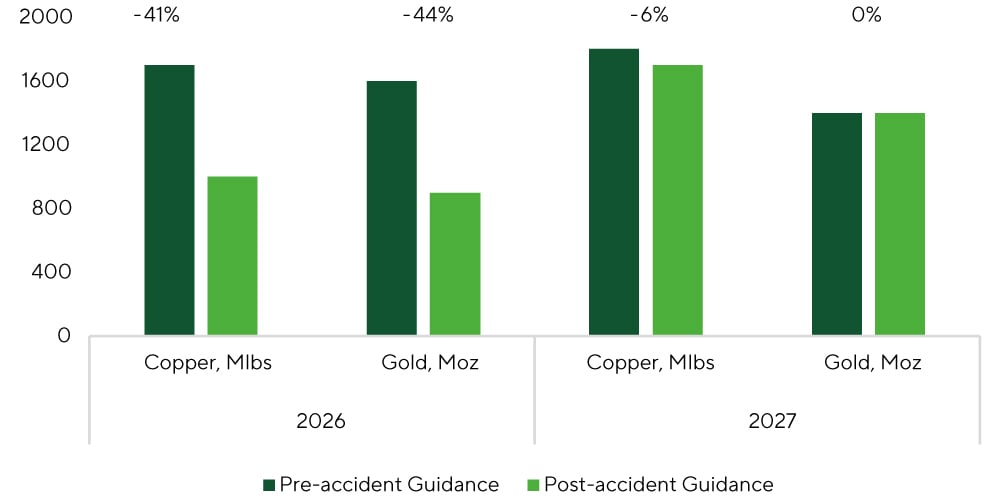
Freeport-McMoRan revised its production guidance following the September 8 landslide at the Grasberg mine, which shut down the underground PB1C block. The company now expects 2026 copper production to be roughly 90 kt below prior plans, adding about 0.3% to the global deficit. Forecasts for 2027–2029 have also been lowered by 40–50 kt per year, reducing cash flow potential. Despite this, FCX shares are up 12% YTD after recovering from a 13% pullback, and now they are facing technical resistance, so the recommendation remains “Hold.”
The landslide was caused by a previously unidentified channel from an old quarry that allowed water and fine material to enter PB1C. The impact was amplified by a geotechnical “soft zone,” leading to subsidence of roughly 800 kt of rock and damage to underground infrastructure. Freeport has since implemented risk‑mitigation measures and has partially maintained output at the Big Gossan and DMLZ mines. Production in
2025 is projected at around 65% of normal capacity, and 2026 volumes are expected to be about 35% below normal. The restart will be staged: PB2 and PB3 are scheduled to come back online from Q2 2026, PB1S will be relaunched in 2027, and PB1C – tentatively by the end of 2027. By 2027–2029, production should be close to normalized levels without an increase in costs, preserving the asset’s high operating leverage, supported by copper and gold prices.
Source: Freeport-McMoRan, Freedom Broker
Alphabet
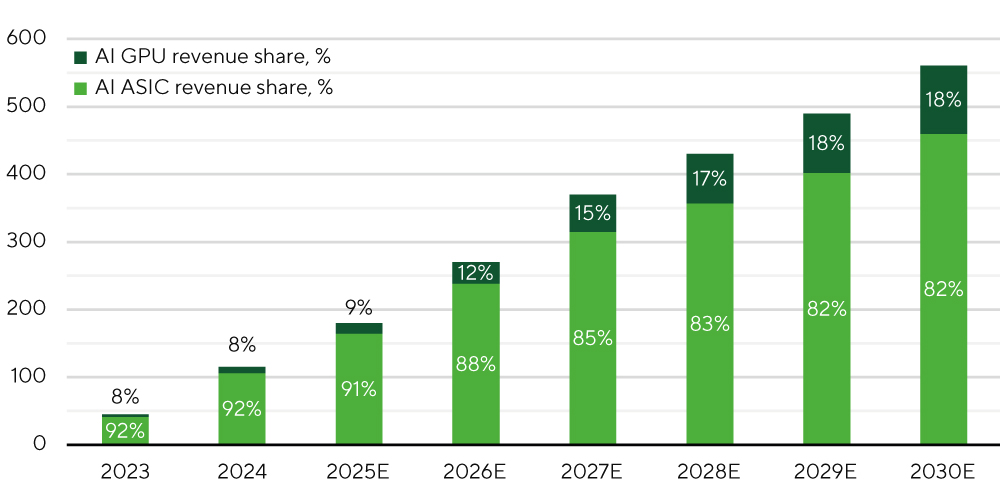
On November 25, Alphabet Inc. (GOOGL) announced plans to begin selling its Tensor Processing Units (TPUs) and is already in talks with Meta Platforms Inc. (META) and several cloud infrastructure providers. Various estimates suggest the new TPUs could deliver 30–40% better compute performance per dollar of total spend (OPEX + CAPEX) than Nvidia chips. While real results will depend on multiple parameters, the emergence of large prospective TPU customers indicates that competitive pressure is becoming meaningful. That said, it is too early to call an end to Nvidia Corp.’s (NVDA) dominance or to write off the growth prospects of AMD Inc. (AMD). TPUs still account for a relatively small share of the overall market, their adoption is constrained by a comparatively weaker ecosystem, and the higher technical complexity of the supporting infrastructure and software stack. Big tech companies are ramping up investment in custom AI chips (ASICs), and by 2030 the ASIC share of the AI chip market may double and exceed 18% of total sales. Google’s TPU announcement came just a week after it unveiled its latest AI model Gemini 3.0 Pro on November 18. Trained on TPUs, it outperformed all rival models across a range of benchmark tests. In the first days and weeks after launch, the model received extensive positive feedback and prompted concern among competitors. Notably, OpenAI CEO Sam Altman sent a letter to employees warning of challenging times ahead for the team. Taken together, these developments have positioned Google as a central protagonist in the current phase of the AI cycle and largely dispelled skepticism about the company’s technological leadership. GOOGL shares gained nearly 16% over the final two weeks of November.
Sales of AI chips for data centers, $ billion.
Source: Bloomberg Intelligence, Freedom Broker
NVIDIA
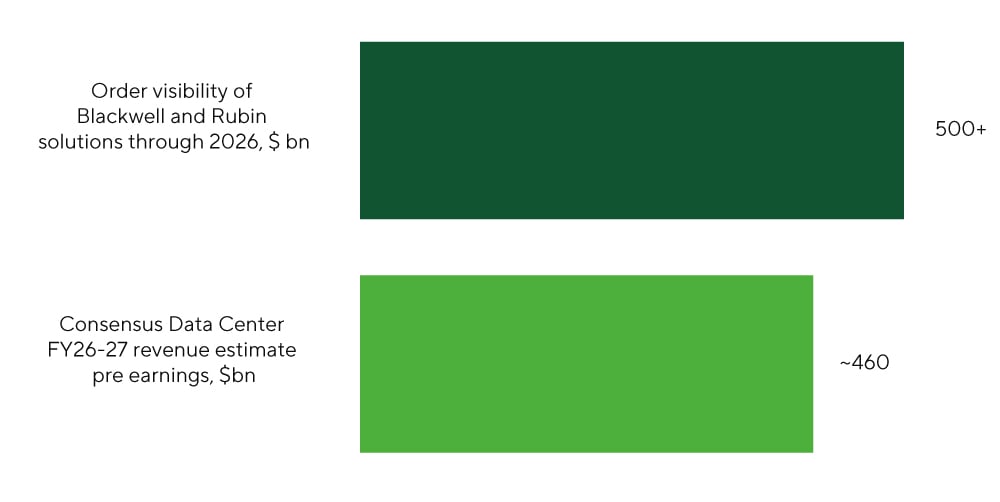
On November 19, Nvidia Corp. (NVDA) reported Q3 FY26 results that exceeded market expectations across all key financial metrics. The positive surprise was driven primarily by record growth in the Data Center segment and particularly strong sales in the Networking sub-segment. Despite concerns about rising component costs and a structural shift toward integrated systems, the company delivered better-than-expected margins at all levels. Nvidia’s Q4 revenue and margin guidance is also well ahead of expectations. Newly announced strategic partnerships with OpenAI and Anthropic, along with expanded alliances with major cloud providers, are creating unprecedented visibility into future demand. Management reiterated their expectation for more than $500 billion in combined revenue from the Blackwell and Rubin architectures through the end of calendar year 2026. Despite the initially positive market reaction, NVDA shares closed down 3.2% on November 20.
Source: Nvidia Corp., FactSet, Freedom Broker
Target и Walmart
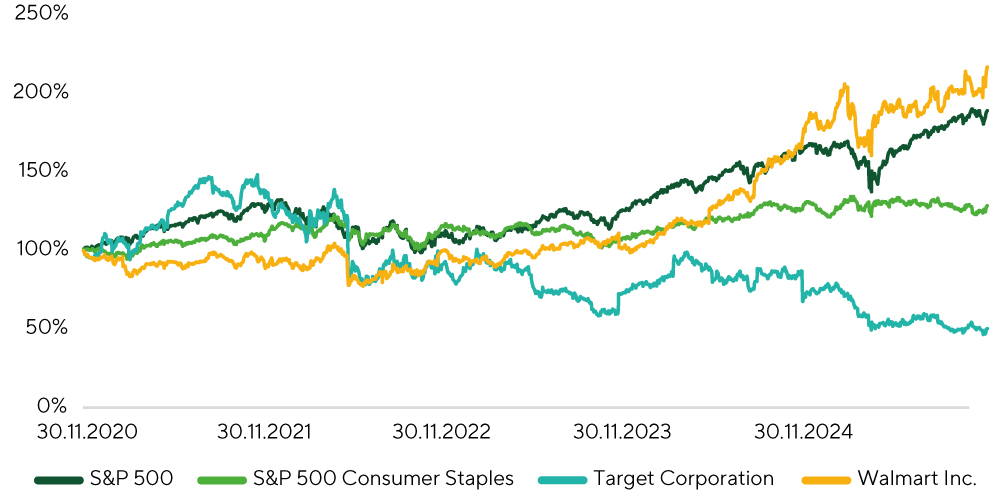
Target’s shares fell to their lowest level since 2019 following the earnings report. The company has lost two-thirds of its market capitalization over the past four years. Revenue has declined for four consecutive quarters, with sales falling across most product categories. In Q3, revenue decreased 1.9% YoY to $24.75 billion, missing consensus forecast, while comparable store sales declined 3.8%. Amid this, profitability also worsened, with the net margin slipping to 2.7%. The online segment, however, was a bright spot – digital sales generated 19.3% of total revenue.
Walmart, by contrast, delivered strong results. Comparable sales in the Walmart U.S. segment rose 4.5% YoY excluding fuel, net sales increased 5.1%. Walmart International sales grew 10.8% YoY. Consolidated revenue reached $179.5 billion (+5.8% YoY), exceeding consensus forecast. Global e-commerce sales growth accelerated to 27% YoY. Management raised its revenue guidance for FY 2026. Walmart has announced that it will transfer the primary listing of its shares and bonds from the NYSE to the Nasdaq, underscoring its strategic focus on technology, automation, and AI adoption. Walmart has also announced a partnership with OpenAI that will enable Walmart and Sam’s Club customers to make purchases directly through ChatGPT.
Источник: FactSet, Freedom Broker