
Investment Review №349. High Hopes
The Focus Is on the Domestic Agenda
A mix of corporate news led to mixed performance among the UAE’s benchmark indices
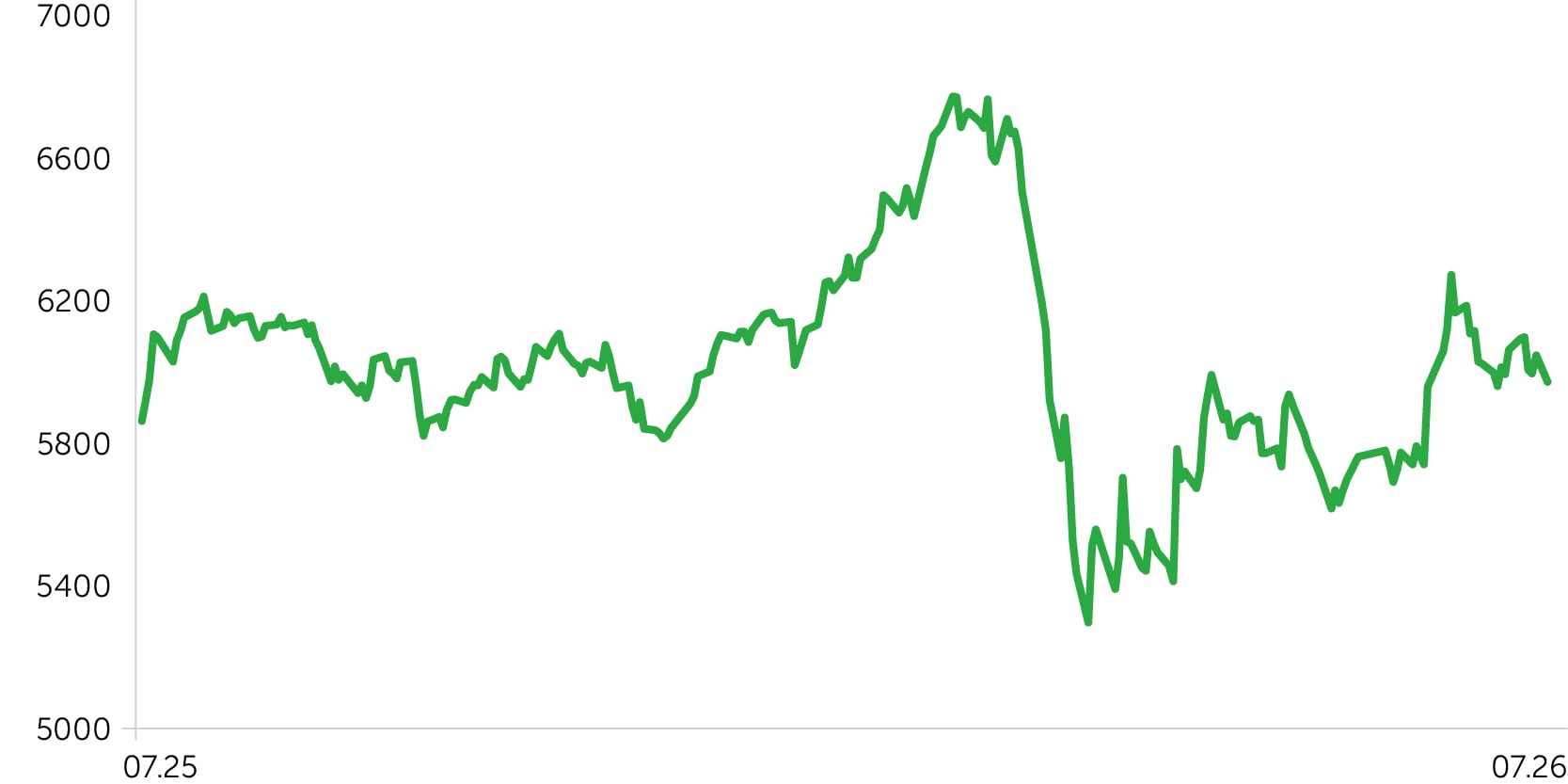
DFM General Index: 1-Year Dynamics
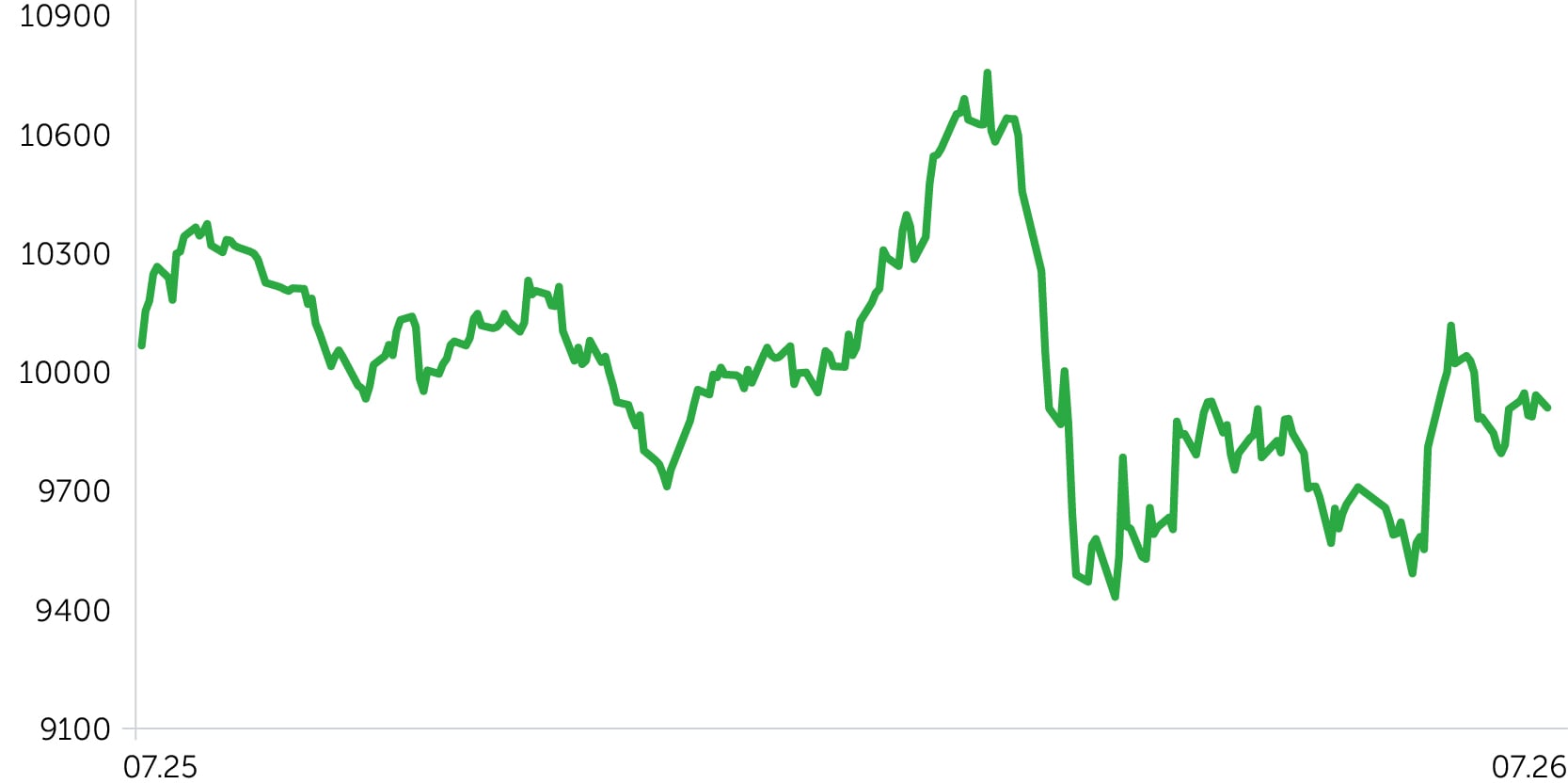
Abu Dhabi Securities Exchange Index: 1-Year Dynamics
Brent Oil, 1-Year Dynamics
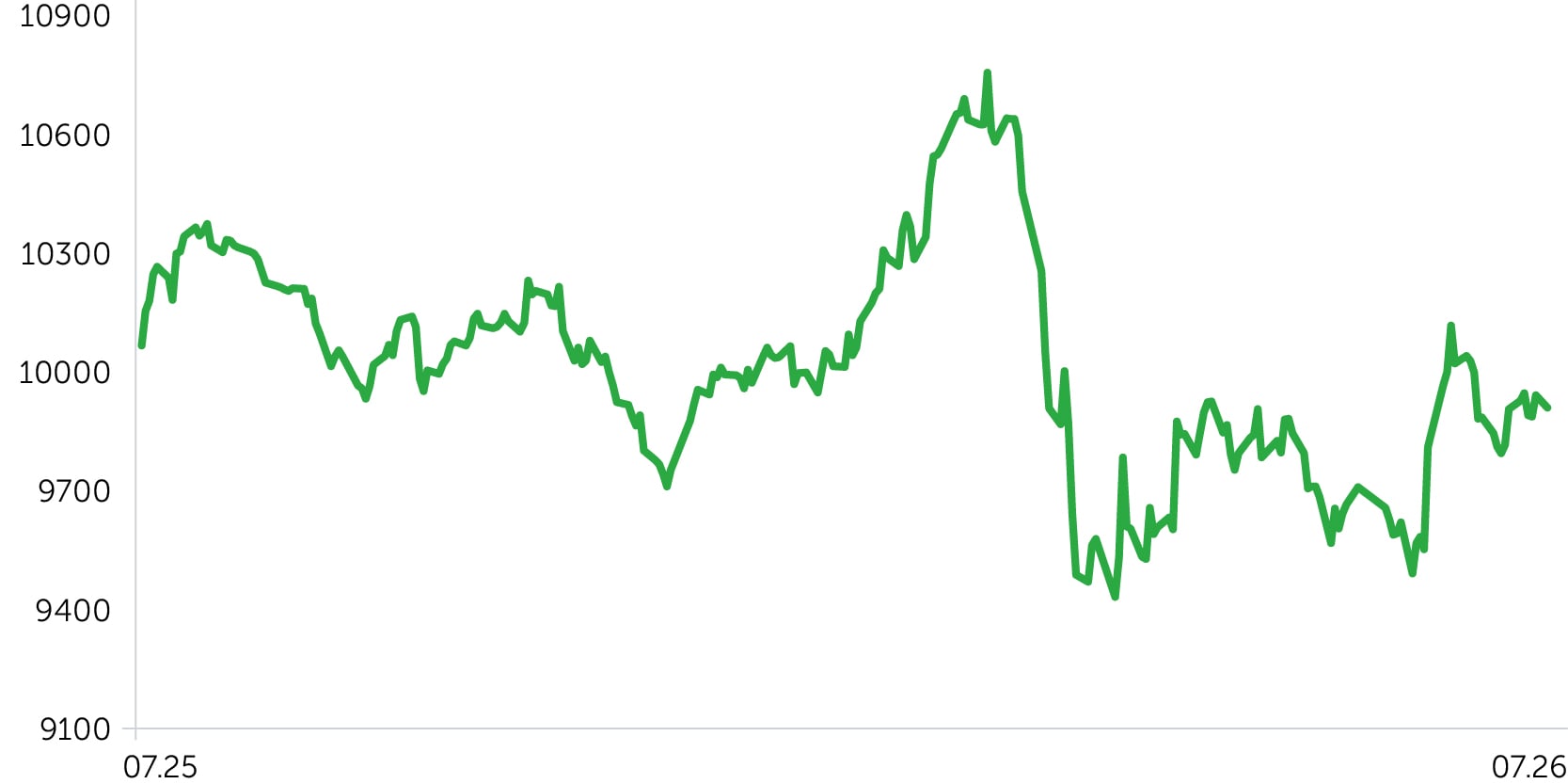
Over the two weeks from June 30 to July 13, 2026, UAE index performance was mixed amid a sharp oil rally and persistent geopolitical risk around the Strait of Hormuz. The Dubai Financial Market General Index (DFMGI) edged down 0.4% to 5,967 (from 5,993), while the Abu Dhabi Securities Exchange General Index (ADXGI) rose 0.7% to 9,904 (from 9,839). By comparison, the U.S. S&P 500 gained about 1.0% over the same period, reflecting a more muted response from global equities to regional risk. Brent crude rose 15.3% to $83/bbl from $72/bbl, supported by military escalation in the region, including heightened U.S.–Iran tensions.
Sector performance in the UAE market was mixed and mostly negative, with five of eight sectors closing lower. Communication Services led (+6.64%), driven by e& (Emirates Telecommunications) (+6.81%), du (Emirates Integrated Telecommunications) (+6.07%), and Sudatel (+6.60%). Real Estate lagged (−2.50%), with Aldar Properties losing 5.67% and Emaar Properties dropping 4.45%. Financials edged up (+0.50%): First Abu Dhabi Bank (+5.14%) and Abu Dhabi Islamic Bank (+5.11%) outperformed, while Phoenix Group fell (−12.27%). Utilities moved slightly higher (+0.68%), supported by TAQA (+1.53%), but DEWA declined (−1.08%). Industrials & Logistics lost 1.37%, with Aramex (−5.62%) and Dubai Taxi (−4.76%) the weakest. Energy was little changed (−0.05%): ADNOC Distribution gained 1.52%, whereas Dana Gas dropped 0.97%. Both Consumer Staples (−1.60%) and Consumer Discretionary (−1.36%) closed lower.
UAE sovereign bond yields edged up to 5.37% from 5.31% (+6 bps) over the period, while 10-year U.S. Treasury yields rose to 4.67% from 4.53% (+14 bps). As a result, the 10-year UAE–UST spread narrowed from ~78 bps to ~70 bps, indicating modest compression in the local risk premium. Local bonds remained relatively stable despite renewed tensions around the Strait of Hormuz: the move in UAE yields was roughly half that of USTs, while the geopolitical risk premium continued to shrink, supported by the successful debut of the first sovereign retail T-Sukuk issuance on Nasdaq Dubai.
Economic Updates
- Non-oil PMI slowed further. The S&P Global UAE PMI decreased to 50.8 in June 2026 (from 52.6 in May), the lowest in over five years. While the index remained above the 50 threshold that separates expansion from contraction, the slowdown was pronounced: overall private-sector activity expanded at its slowest pace in five years amid geopolitical headwinds, muted demand, and fierce competition. Notably, employment declined for the first time in more than four years, the sharpest drop since August 2020. Dubai’s PMI also eased to 50.7 (from 52.0), still in expansionary territory.
- The Central Bank of the UAE cut its 2026 real GDP growth forecast to 1.7% (from 5.6%), citing the temporary drag from regional conflict on trade, shipping, tourism, and private-sector sentiment. The regulator projects a strong rebound to 9.8% in 2027, supported by normalized oil output, continued non-oil growth, government spending, and infrastructure projects. Inflation is forecast at 2.3% in 2026, easing to 1.9% in 2027.
- On July 2, the UAE Ministry of Finance announced the listing on Nasdaq Dubai of the country’s first sovereign retail T-Sukuk. The inaugural AED 50m ($13.6m) two-year tranche, yielding 4.30% per annum, followed a June 24–30 subscription window. With a minimum investment of AED 1,000, the program gives retail investors direct primary-market access to UAE sovereign sukuk for the first time.
- UAE oil exports rebounded in June to 3.94 mb/d—the highest since 2017 and roughly 27% above the 12‑month average (Kpler)—despite ongoing shipping constraints in the Strait of Hormuz. Key enablers were the Habshan–Fujairah pipeline (capacity up to 1.8 million b/d), which bypasses the Strait, and the 42‑million‑barrel Mandous underground storage facility. According to the IEA’s July Oil Market Report, Gulf oil exports rose by about 6.5 million b/d in June to 16.1 million b/d, still well below the pre‑war level of ~24 million b/d. After exiting the OPEC+ agreement in May, the UAE is no longer bound by production quotas.
- Dubai’s real estate market closed H1 with AED 286.4bn ($78bn) in sales across 86k transactions, the second highest on record, though ~12% below the record first half of 2025. The luxury segment set an all-time high: 296 transactions above $10m, totaling $5.1bn (+14% YoY; Knight Frank). In Abu Dhabi, residential sales jumped 174% YoY to AED 84.5bn.
- The UAE ranked as the top global destination for real estate investors. In a Penta Group survey covering 12 countries and ~700 major investors, 56% named the UAE their preferred market—ahead of the U.S. (54%) and the U.K. (41%). Among European respondents, the UAE’s lead was stronger: 63% of French, 60% of German, and 57% of Swiss investors ranked it first.
- Etihad Rail has commenced the first phase of its passenger service. On June 30, 2026, the company launched the first phase of passenger service on the Abu Dhabi–Fujairah route (1h45m travel time). The full network’s official launch is scheduled for September 30, 2026, with stations in Dubai and Al Dhaid opening.
Corporate News
- e& and Aldar have entered into a partnership to connect residential properties. On June 29, 2026, e& UAE and Aldar Properties announced a strategic partnership to provide Aldar residents in Abu Dhabi and Dubai with exclusive home internet offers. Discounted plans include “Ultra Starter,” featuring 500 Mbps fiber (promotional upgrade to 1 Gbps), 180+ TV channels, and an additional 10% discount for Aldar customers.
- On July 6, ADNOC launched a global LNG marketing and trading platform, combining ADNOC Gas and XRG’s marketing functions with ADNOC Trading’s expertise. The platform targets 47 MT p.a. of LNG sales by 2035 (~11% of today’s global market). Existing ADNOC Gas commercial contracts remain unchanged; the initiative is expected to unlock incremental growth, including optimized commercialization of future Ruwais LNG volumes.
- On July 7, ADNOC signed a 15-year SPA with Japan’s Inpex for 1 MT p.a. of LNG from the Ruwais LNG project (start-up in 2028), bringing contracted volumes to 90% of Ruwais’s 9.6 MT p.a. nameplate capacity. On July 8, ADNOC also signed a strategic agreement with South Korea covering the supply of up to 24 million barrels of UAE crude and cooperation on strategic petroleum reserves.
- Also on July 7, ADNOC Distribution entered into a binding agreement to acquire Shell Downstream South Africa (c. 580 service stations) for ~$1bn. Management guides to immediate accretion of 6% to EPS and 13% to EBITDA and signaled further expansion plans in Africa and Southeast Asia.
- Aldar Properties unveiled the AED 6bn Yas Point project. On July 10, 2026, Abu Dhabi’s largest listed developer announced a new waterfront project on the northern shore of Yas Island spanning ~600,000 sqm. The scheme will feature 1,600 branded residences, a five-star resort hotel, an international school, and retail and entertainment facilities, and is designed to house 5,000 residents. The site sits near Sphere Abu Dhabi and Disneyland Abu Dhabi—two anchor attractions to be launched in the coming years and expected to drive significant footfall. In Q1 2026, Aldar’s net profit rose 20% YoY to AED 2.3bn ($626m).
- On July 13, ADNOC set the August OSP for benchmark Murban at $80.01 per barrel, down from $101.48 for July, reflecting the sharp price decline following an interim U.S.–Iran agreement. The company also offered an alternative FOB Fujairah loading option for offshore grades (Umm Lulu, Das, Upper Zakum), bypassing the Strait of Hormuz; since June, more than 70 million barrels have been sold in spot tenders via Fujairah.
- IHC ramped up investment activity. International Holding Company (IHC), one of the largest ADX-listed conglomerates, issued a strategic update on portfolio development ahead of its H1 2026 results. The company previously launched the first tranche of an AED 1.8bn ($490m) share buyback program. Q1 2026 net income nearly doubled year over year.
Two-Week Outlook
Oil remains the primary near-term driver for UAE markets. Last week, WTI rose 0.8% to $71.40 per barrel amid escalating U.S.–Iran tensions. The price outlook remains constructive: the global market still faces a supply shortfall, and total U.S. liquids inventories are at a 23-year low. A renewed U.S. blockade of Iranian ports could lift WTI toward $86 per barrel as soon as July.
In the near term, four factors should drive UAE market performance. First, prices and developments around the Strait of Hormuz: ADNOC has cut Murban’s August OSP to $80.01 (-21.2% from July’s $101.48), signaling market expectations of gradual normalization around the strait; however, a full reopening of the waterway still looks premature. Second, resilience in Q2 2026 earnings: in the coming weeks, the market will watch results from FAB, Emirates NBD, Aldar, and ADNOC Gas; solid prints could help reverse the subdued sentiment following the recent PMI decline. Third, normalization of the geopolitical risk premium in local assets: UAE government bond yields rose 6 bps while UST yields increased 14 bps, compressing the spread from ~78 bps to ~70 bps and underscoring the relative resilience of local bonds. Further compression below 70 bps requires meaningful diplomatic progress toward de-escalation. Fourth, real estate and infrastructure: the rollout of Etihad Rail and a sizable development pipeline (Yas Point, Sphere Abu Dhabi, Disneyland Abu Dhabi) are creating durable demand for both residential and commercial space. In a cautious scenario, a further PMI slide below 50 and a continued lack of progress toward regional de-escalation could trigger a flight to safe-haven assets and keep indices consolidating near current levels in the short term.