
Financier №1 (41) 2026

Tural Aliyev
Junior Analyst, Freedom Broker
The Undervalued Factor
Why Startups with Female Founders Use Capital More Efficiently
There is a significant difference between the performance of companies founded by women and men, and this gap is increasingly confirmed not by isolated success stories but by the analysis of large datasets. For the venture capital market, this represents a fundamentally important shift: if the gender effect is reproducible and persistent over time, it is no longer a coincidence but a factor that determines investor interest.
By the Numbers
Data from Boston Consulting Group, which studied several hundred early‑stage startups, showed that companies with female founders generate more revenue per dollar of capital raised. Under comparable conditions, such teams attracted smaller amounts of funding but demonstrated a higher return on invested capital.
First Round Capital reached similar conclusions: startups with female founders delivered higher aggregate returns and exhibited lower volatility in performance.
Data from the Kauffman Foundation indicates that businesses founded by women reach break‑even faster and are less likely to require urgent additional infusions of capital. In an environment where the venture capital market is increasingly unwilling to tolerate losses, this factor becomes a major advantage for investors.
Slow and Steady Wins the Race: Sustainability Through Prudent Growth
The reasons behind the effect described above are not tied to abstract differences in management style, but to specific decisions made at the early stages of business development. Women, as a rule, spend more time testing the product and the economics of the model before moving to scale up. They perceive capital as a limited resource that requires control, rather than as a way to compensate for strategic mistakes.
For example, Rent the Runway - a subscription‑based designer clothing rental service that combines a digital platform with physical inventory management and logistics - initially operated in a segment even venture capital investors consider risky. Instead of pursuing aggressive growth, Rent the Runway focused on fine‑tuning its internal economics. Scaling was carried out as key parameters were validated: the frequency of item reuse, wear and tear, logistics costs, and real demand. This approach slowed down growth, but helped avoid the accumulation of hidden losses typical of startups that scale too early.
A similar story is happening at Bumble (BMBL), an online dating service in which the right to make the first contact is reserved for women. From a venture capital perspective, this model appeared risky because the company effectively opted out of a segment of male users who wish to message first. However, it was precisely Bumble’s chosen approach that ensured more transparent user behaviour and predictable monetisation. The growth was less intensive, but of higher quality. Ultimately, Bumble went public as a rare example of a technology business where the key asset was not the speed of expansion, but the reliability of the business model.
Venture Conservatism
Despite women’s higher efficiency in using capital, businesswomen’s access to venture financing remains limited. According to PitchBook data, startups founded by women receive significantly less funding than would be expected based on their market share.
This is not so much related to the quality of the projects as to the structure of the venture capital industry itself. Investment decisions are shaped within tight professional networks, where experience and the repeatability of successful cases serve as the main reference points. Founders who resemble those who have already generated substantial profits for the fund are a priori perceived as less risky. This creates a vicious circle: capital is repeatedly directed toward familiar models, while new types of founders remain outside the focus of attention - regardless of their business performance.
The differences become apparent already at the stage of initial meetings with investors. Studies of business communication show that women are more often asked questions about risks and measures to protect against negative scenarios. Men, on the other hand, are invited to discuss market size, growth rates, and plans for aggressive expansion. As a result, impressions of the project - whether positive or not - are formed even before the analysis of its metrics and may influence the outcome of negotiations more than the financial model itself.
The Founders Forum Diversity Report states that the challenges faced by female founders intensify as they scale, creating a "cumulative inequality" effect.
However, the market environment is changing, and these barriers are gradually beginning to fade. The rising cost of capital, declining liquidity, and pressure from investors are forcing venture capital managers to take a closer look at the real economics of businesses. Investors' willingness to buy shares of companies that are not showing profit growth has sharply declined. Under these conditions, the ability to work effectively with limited resources is becoming a powerful competitive advantage. As a result, venture capitalists' priorities are shifting toward teams that demonstrate a high level of discipline and stability.
Focusing on Women – A New Investment Strategy
Amid the persistent gap between business performance and access to capital, a distinct segment of venture capital strategies targeting female founders has emerged. Funds such as Female Founders Fund, BBG Ventures, and Serena Ventures seek out undervalued, early-stage companies. These investors prioritize segments where deal competition is lower than the sector average, valuations are more moderate, and economic parameters and prospects are often higher than current market valuations suggest. This allows them to create portfolios with a more balanced risk-reward profile.
Unlike the largest traditional venture capital players, these funds typically invest smaller amounts, compensating for this with hands-on management. They focus on the financial model, cost structure, and scaling rate. The priority is not rapid growth at any cost, but building a sustainable business capable of surviving several market cycles without constant dependence on new capital.
This investment focus is naturally reflected in the sectoral structure of portfolios. Businesswomen are most successful in areas where a deep understanding of end-consumer needs is essential. It is empathy that enables the ability to build a long-term product economics. This is relevant in healthcare, climate and biotechnology, financial services and education, business software solutions, and the consumer segment.
These sectors share a common thread: robust demand, which was often ignored by the market in the past. In many cases, venture capitalists considered these sectors too complex and incapable of rapid growth and, consequently, capital returns. Today, the “female” spectrum of economic sectors is increasingly being viewed by professional market participants as a way to diversify venture investments and gain access to a reliable and long-term source of income.
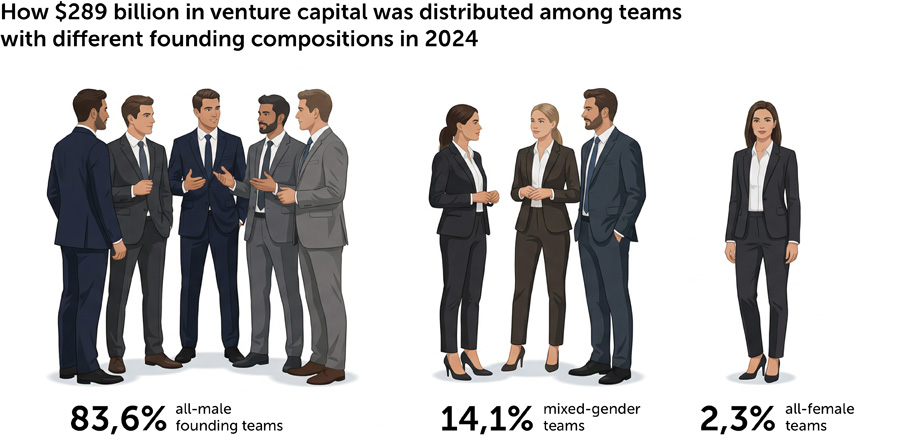
Source: Founder Forum Group