
Financier №1 (41) 2026
Yelena Belyaeva
Investment Mentor, Freedom Finance Global
Rules for Good Returns
How to Build an Investment Portfolio
My name is Yelena Belyaeva, and I’m an investment mentor in the Investor Subscription from Freedom Broker. More than 20 years ago, I discovered investing and turned it into a profession.
I focus specifically on investing, not trading. I teach practical operations with exchange‑traded assets by showing which securities I buy and sell in my own brokerage account. All statistics and trades are open information for all participants of the Investor Subscription from Freedom Broker.
I execute trades twice a month and open long‑term positions - from several months to several years. This approach is ideal for those who don’t want to constantly monitor charts and intend to spend very little personal time on investments. My portfolio delivered a 40 % annual return in 2025. Participants who consistently followed our recommendations achieved the same level. We outperformed the S&P 500 index by more than two times: it grew by only 18 % over the year.
How I Got into Investing
I first became interested in the stock market after watching the 1987 film Wall Street with Michael Douglas. I became curious about stocks, exchanges, and how everything works. My husband, seeing my interest in the topic, gave me Frank J. Fabozzi’s book Investment Management and said: “Learn it - you’ll manage the family savings.” That was in 2003.
For six months, I studied eight hours a day, without days off. I read books, exchange news, analysed stocks, and observed how the market works. In 2004, I opened a brokerage account and started buying stocks.
My first year in the market ended with a zero result; in the second year, I earned 10 %. I’ve followed the “caution first” strategy throughout my career.
Over 23 years in the market, I haven’t lost a single deposit*. For me, it’s always been more important not to lose than to earn. Male colleagues were very surprised by this when I first started working at a brokerage firm. It was unusual for them that a woman could manage a portfolio more effectively than most of them.
*A deposit is money that an investor or trader deposits into their trading account.
The Key to a Successful Investment Portfolio
When selecting stocks, I primarily focus on companies’ fundamental indicators. I include in my portfolio only securities from issuers that demonstrate revenue and profit growth, as well as high expected performance.
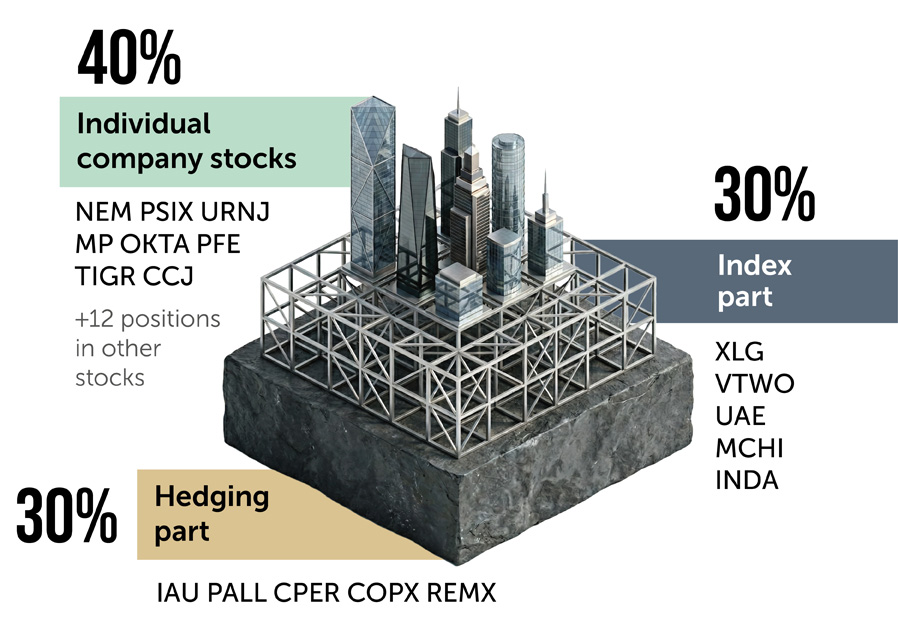
Here’s how I structure my high‑return portfolio in the Investor Subscription:
- 30 % in hedging (protective) instruments. I use exchange‑traded funds (ETFs) for precious metals. In some market situations, bond ETFs can be considered instead. We started building an ETF for physical gold in August 2023. Although gold didn’t rise until spring 2024, I continued to add to the position.
- 30 % in country‑specific, sector‑specific, and industry‑specific ETFs with low volatility. The specific choice depends on current market trends or expectations of their development.
- The remaining 40 % is allocated to individual company stocks. Foreign issuers (e.g., Chinese companies) and small‑cap stocks are considered high‑risk. Their total weight in the portfolio should not exceed 10 %.
Mandatory rule: no single stock should account for more than 5 % of the portfolio. Up to 10 % can be allocated to ETFs. If an asset’s share exceeds the limit after growth, sell a small part of the position to avoid excessive imbalances.
As a rule, we don’t buy the entire position at once. Assets are acquired in parts, and the additional portion’s size cannot exceed the initial amount.
What the Portfolio Looks Like Now
Hedging part. In 2025, exchange exchange‑traded funds for silver and platinum delivered strong returns. We exited them in January 2026 with +156 % and +68 %, respectively. We closed the gold ETF, then reopened it and added a fund for copper (CPER), as well as an ETF for companies mining copper and rare‑earth metals. We hold an ETF for palladium (PALL).
Index part. Here we have ETFs for the Russell 2000 (VTWO), S&P 500 Top 50 (XLG), and country‑specific exchange‑traded funds: for India (INDA), the Emirates (UAE), and China (MCHI).
Individual company stocks. We hold about 20 positions. The largest weights are Newmont (NEM, 5 %), Cameco (CCJ, 2.5 %), and MP Materials (MP, 3.3 %). We add $100 to portfolios at each investment webinar, so we don’t buy stocks priced above this amount. This significantly narrows the selection but allows subscribers with smaller deposits to open positions directly during our webinars. For those with much larger deposits, we offer a separate portfolio called Wealthy Investor.
Source: Yelena Belyaeva's personal portfolio
What I Don’t Do in My Portfolio
I never use leveraged ETFs (funds that use borrowed funds) and don’t consider stocks of unprofitable issuers or companies with a capitalisation below $300 million. Here’s why.
Classic ETFs are formed from specific assets: metals, bonds. Leveraged ETFs don’t build a portfolio of real stocks - they work with futures and options. This is the main problem.
**A futures is an exchange-traded contract that obligates the investor to buy or sell an asset at a predetermined price in the future
***An option is an instrument that provides the right, but not the obligation, to buy or sell a stock at a predetermined price
Regular ETFs for stocks, precious metals, or bonds closely follow their underlying asset’s chart: their prices depend solely on it. The value of leveraged ETFs reflects changes in the prices of options and futures held by the fund, but these prices reflect not the current dynamics of the underlying asset but market expectations of future movements. Moreover, derivative instruments tend to lose value over time. Such assets make sense only for short‑term trading.
I avoid unprofitable issuers because there’s a risk they’ll never turn a profit. If losses continue to grow, there may be a risk of bankruptcy. Then the stock will trend toward zero with no chance of recovery, and you’ll lose money. Trading unprofitable companies’ stocks is about trading, not investing.
Low‑cap issuers suffer from liquidity issues: large funds don’t include them in portfolios. It’s institutional buying that creates upward trends, which ordinary investors like us profit from.
Most Common Mistakes of Beginners
Our subscription offers a service: analysis of participants’ investment strategies. I personally review portfolios sent by subscribers - I’ve done this more than a thousand times. Based on this experience, I’ve identified the most common mistakes of novice investors:
- Beginners don’t view the portfolio as a whole, so they don’t include assets that will keep it afloat during market corrections. In most cases, a novice trader settles for a random combination of scattered positions.
- Many get position ideas from questionable sources, such as blogs, and skip their own analysis. The internet often promotes high‑risk, unprofitable companies, where investing is more like buying a lottery ticket. It’s much safer to buy stocks of large, stable corporations like Apple (AAPL), Amazon (AMZN), or Microsoft (MSFT). In the long term, they’re far more likely to show growth than questionable companies. Buying small biotech stocks is a bad idea for a market novice.
- Beginners quickly close profitable positions, capturing only a small part of potential returns, but hold losing positions for years until they reach −60 to −80 %, when there’s no chance of price recovery to initial levels and they’re forced to realise a loss.
- Diversification rules aren’t followed. Individual positions have too much weight in the portfolio. When prices of these securities correct, the deposit suffers a significant drawdown. If a single stock accounts for 2–5 % of the portfolio, its negative result won’t greatly affect the account size.
If you want to take your first steps in investing or seek new knowledge in this field, I invite you to the Investor Subscription. Here, my colleague Mikhail Brovkin and I show which stocks we buy in our brokerage accounts and help everyone build an investment portfolio.
Since this issue of Finansist is dedicated to women, I'd like to give our readers a gift: a 90% discount on one month of the Investor Subscription. With this discount, you'll have time to attend two investment livestreams, watch my signature investing course, and send me your portfolio for analysis.