
Financier №3 (43) 2026

Daniel Baiseitov
Chief Client Manager, Freedom Finance Global
Money Per Barrel
How a Private Investor Can Profit from the Oil Agenda
The current crisis in the global energy market opens up broad opportunities to profit from “black gold”. In this article, we will look at the most popular exchange‑traded instruments available to market participants even with a modest initial capital. Let’s start with the most accessible asset.
Stocks: The Big Names
Buying shares of oil companies is one of the simplest and most straightforward investment ideas. When the commodity price rises, the producers see their revenues and net profits increase - and this invariably has a positive effect on their stock prices. For example, the S&P Oil & Gas Exploration & Production Select Industry Index, which tracks the performance of key industry players, surged by 37% over the first seven months of 2026, while the S&P 500 rose by just over 8%.
In addition, companies in the oil, gas, and coal sectors typically pay solid dividends. According to estimates by the US investment platform Dividend.com, the current yield stands at 4.34% per annum in these industries. Add to this the gains from rising stock prices, and a bullish bet can deliver a strong return on capital.
In the US, the stars of the oil and gas industry usually include ExxonMobil (XOM), Chevron (CVX), ConocoPhillips (COP), EOG Resources (EOG), and Occidental Petroleum (OXY), as well as players in the oilfield services segment - primarily SLB (SLB), with French roots, and Halliburton (HAL).
Each group follows its own business logic. Vertically integrated giants like ExxonMobil and Chevron combine exploration, refining, trading, and petrochemical production, and they also attract investors with regular dividend payments. Their diversified operations help them weather periods of falling oil prices more easily.
Shares of independent producers such as EOG Resources or ConocoPhillips are more sensitive to volatility and to the dynamics of their own output, so their stocks tend to exhibit wider price swings. Due to the closure of the Strait of Hormuz from February to May 2026, SLB shares rose from $51.07 to almost $59, while Halliburton shares rose from $35.83 to approximately $44. However, both companies had pared some of this gain by the end of July.
Oilfield services companies do not profit from the barrel itself (they do not sell oil) but from the infrastructure that enables its production. The more actively oil and gas corporations drill new wells, develop fields, and maintain operations, the higher the demand for equipment, technology, and services.
ETFs: Buy the Whole Pie Instead of a Single Slice
Often, an investor isn’t ready to spend time and effort researching even the most promising individual stocks. In such cases, Exchange‑Traded Funds (ETFs) – collective investment vehicles - are a good option. They allow investing in entire portfolios of securities, usually replicating the structure of specific indexes, which reduces the risk of picking the wrong company. The entry threshold is minimal: you can buy a single ETF share and become a co‑owner of a tiny stake in a portfolio comprising dozens of corporate stocks.
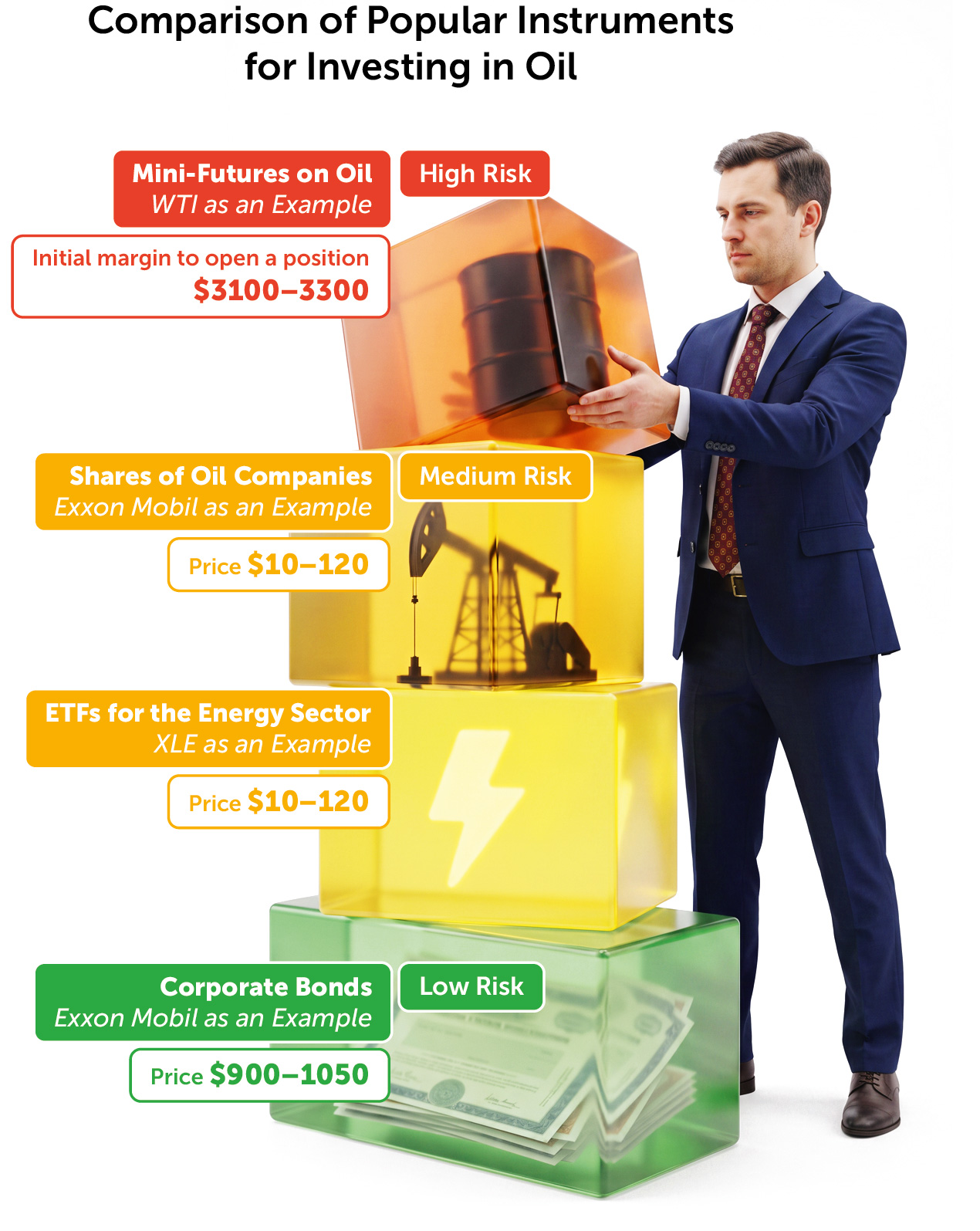
Typically, you need only $50–100 in your account to purchase one ETF share
In the context of the oil market, there are two main types of ETFs: those that invest in a portfolio of oil‑related stocks and those that buy oil futures contracts. In the first case, the investor becomes a co‑owner of a basket of stocks; in the second, they effectively gain exposure to a barrel of oil - not as a physical commodity, but via special exchange contracts (futures). We will discuss futures in more detail later in this article.
Portfolio ETFs suit a “buy‑and‑hold” strategy, while commodity funds are often used for short‑term trades during periods of heightened volatility. The leading fund investing in oil stocks is the Energy Select Sector SPDR Fund (XLE), with about $40 billion in assets. It invests in energy companies from the S&P 500 index and charges an annual fee of just 0.08%.
For short‑term trading, the United States Oil Fund (USO) is a suitable choice; it buys oil futures. As of July 2026, the price of one USO share hovers around $107–109.
Most ETFs track the performance of their underlying assets on a one‑to‑one basis (if the index rises by 1%, the ETF also rises by 1%). However, some funds are designed to deliver amplified returns. For example, the GUSH ETF tracks the S&P Oil & Gas Exploration & Production Select Industry Index with leveraged exposure. Similarly, the UCO fund replicates the performance of WTI crude oil futures but with returns multiplied by two - whether the underlying asset rises or falls.
Futures: Complex but Profitable
Oil is a volatile asset: its price can move by 5–10% in a single trading session, creating ample opportunities for active speculation. In this context, exchange futures are the most suitable instruments. These are special contracts that allow you to buy an asset in the future at a predetermined price. With futures, a market participant can profit both from rising and falling asset prices.
The mechanics of making money on an uptrend are fairly simple. Let's say an investor bought a WTI futures contract at $80 per barrel. If oil prices rise to $81, the profit per contract will be $1.
The most liquid oil futures are Brent, WTI, and Shanghai Crude Oil. Brent serves as the main benchmark for the global market, WTI reflects the price of US crude, and Shanghai Crude Oil is China’s key oil futures contract, denominated in yuan
Generating profits in a downtrend is slightly more complex. When a trader expects an asset to fall, they can open a so‑called short position. To do this, they borrow the asset from a broker and sell it on the exchange. After this trade, the trading app will show a negative position, for example, −5 contracts. To close the position, the trader must buy back five contracts on the market.
For example, a trader shorted five oil futures at $80 per barrel, and after the trade, the asset's price dropped to $77. The trader bought back five contracts at that price on the exchange and earned ($80 – $77) x 5 contracts = $15, excluding fee. The main advantage of futures over stocks and ETFs is the ability to profit in various market conditions. Returns can reach tens or even hundreds of percent on the initial capital.
A classic WTI crude oil futures contract on the CME exchange represents 1,000 barrels of oil. As a result, even small price moves generate large financial outcomes. There are also micro contracts for 100 barrels, which are convenient for retail traders due to lower account requirements. While classic futures require $500–$1,000 in available funds per contract, micro contract trading requires only $50–$100.
The downside of futures trading is increased risk. Therefore, to access them, investors often need to undergo additional testing and a brokerage questionnaire to understand the mechanics of these assets and prove sufficient account funds.
It's important for retail investors to remember that oil stocks, ETFs, and futures are simply tools for achieving a specific financial goal. If trading them brings you closer to achieving that goal, then they've made the right choice.
Source: exchange data