Financier №3 (43) 2026

Tural Aliyev
Junior Analyst, Financial Analysis Department, Freedom Finance Global
The Battery Era
How the Electric Car Market Is Changing - and Reshaping the World around It
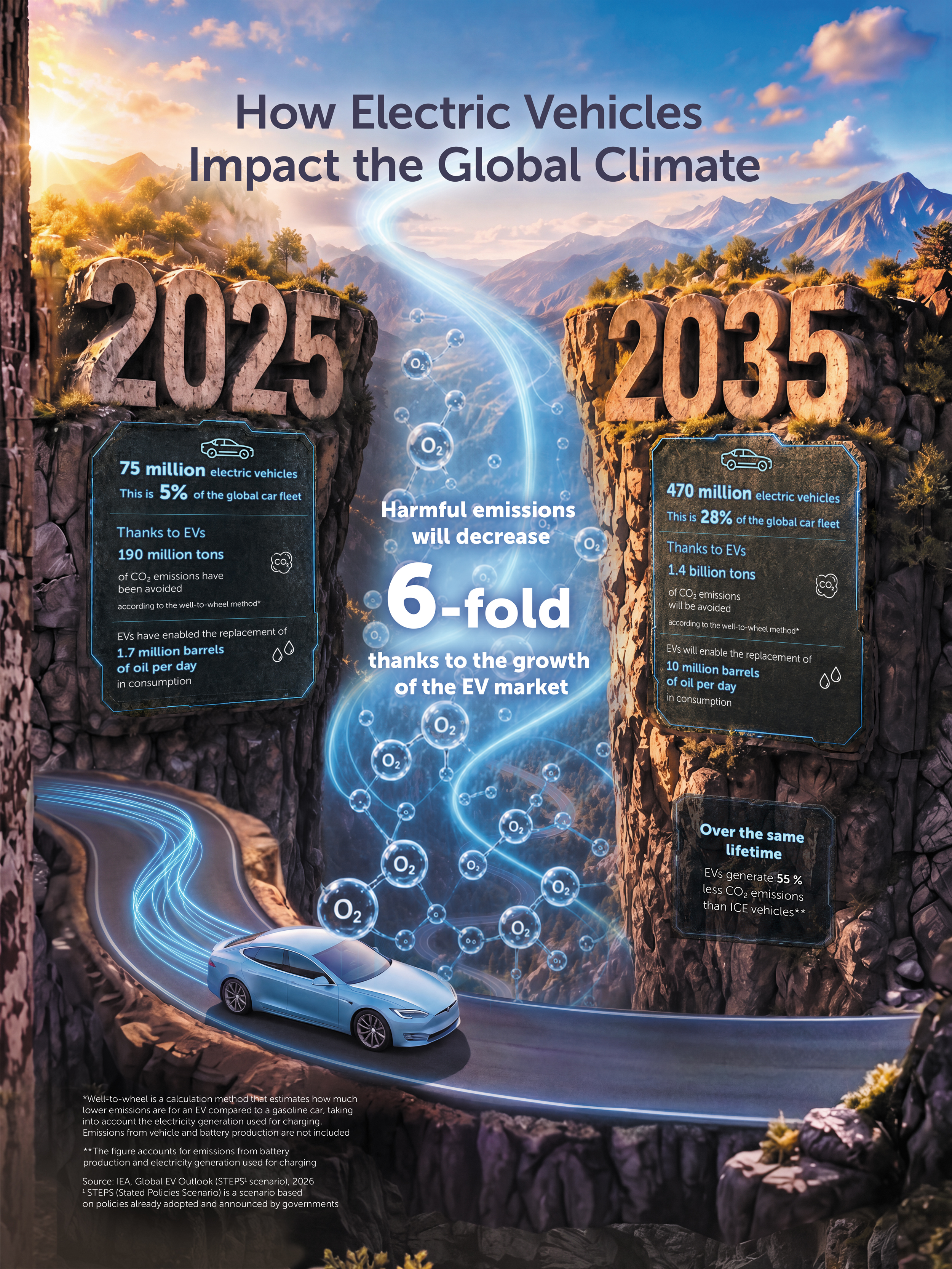
Oil remains an indispensable resource in many sectors, but some industries are already well‑prepared for a gradual phase‑out of this feedstock. The most prominent of these is the automotive sector, where electric vehicles (EVs) have moved beyond the technological experimentation phase and into a period of “maturation”. In 2025 alone, according to the International Energy Agency (IEA), more than 20 million electric passenger cars were sold worldwide - accounting for 25 % of all new car sales. By the end of 2026, the IEA forecasts sales to rise to 23 million units, with their share expanding to 28 %. This growth is supported by stagnation in the internal combustion engine (ICE) vehicle market, the development of EV infrastructure, and a gradual decline in the average price of electric cars.
Electric vehicles have already become a mass‑market phenomenon, and the industry’s main focus has shifted from promoting their adoption to identifying the frontrunners for the next growth phase. So, which players should investors and analysts be watching?
Who is Who
Before the pandemic, EVs were largely represented by US‑based Tesla (TSLA). In recent years, however, Chinese competitors have taken the lead. Elon Musk’s company remained the global sales leader in 2025, thanks to the Model Y. That model held the top spot among EVs and the second position among all passenger cars, with annual sales of 1 million units. Still, more than 60 % of all electric vehicles sold worldwide last year were purchased in China.
Currently, Tesla dominates the production of pure battery electric vehicles (BEVs), but the global market focus has increasingly shifted toward plugin hybrid electric vehicles (PHEVs), commonly known as hybrids. In this segment, Chinese automakers are now leading the way – primarily BYD, with competitors including Geely, Wuling, Leapmotor, and Xpeng (XPEV).
Traditional carmakers haven’t fallen out of the race either. Last year, German electric car Volkswagen overtook Tesla in sales in Europe, demonstrating that even established manufacturers are capable of adapting to the new demand structure.
More than Just Cars
Demand for EV batteries is growing rapidly. In 2025, China produced more than 80 % of all battery cells and controls a significant share of the processing of critical minerals used in battery manufacturing. The PRC restricts mineral exports to strengthen its position in supply chains, creating a risk of component shortages for foreign EV makers - and thus gaining a competitive edge.
More than 60% of buyers consider electric cars too expensive; 56% are dissatisfied with the time required to charge a vehicle; and 54% cite a shortage of charging stations.*
*According to S&P Global Mobility
Industry pain points have also evolved. Previously, most consumers’ main concern was driving range. Today, the key worries are the high upfront cost of EVs outside China, the availability of charging infrastructure, and the reliability of power grids.
Despite these challenges, electric transport continues to reshape cities. In Oslo, around 93 % of new cars were fully electric in 2025. In Shenzhen, China, electrification has extended beyond private vehicles to include public transport. The Los Angeles Department of Transportation plans to replace 2,200 city buses with electric buses by 2030, thereby reducing harmful emissions to zero. EVs have not displaced ICE vehicles, but the direction of the industry’s development is already clear. The key question is no longer whether the shift to electric transport will happen, but how quickly infrastructure, pricing, and technology will allow it to radically transform the automotive market.