Financier №3 (43) 2026

Assel Alibayeva
Senior Client Manager, Freedom Finance Global
The Citizen Barrel
How Oil Quality Affects Its Price - and Where Geopolitics Fits In
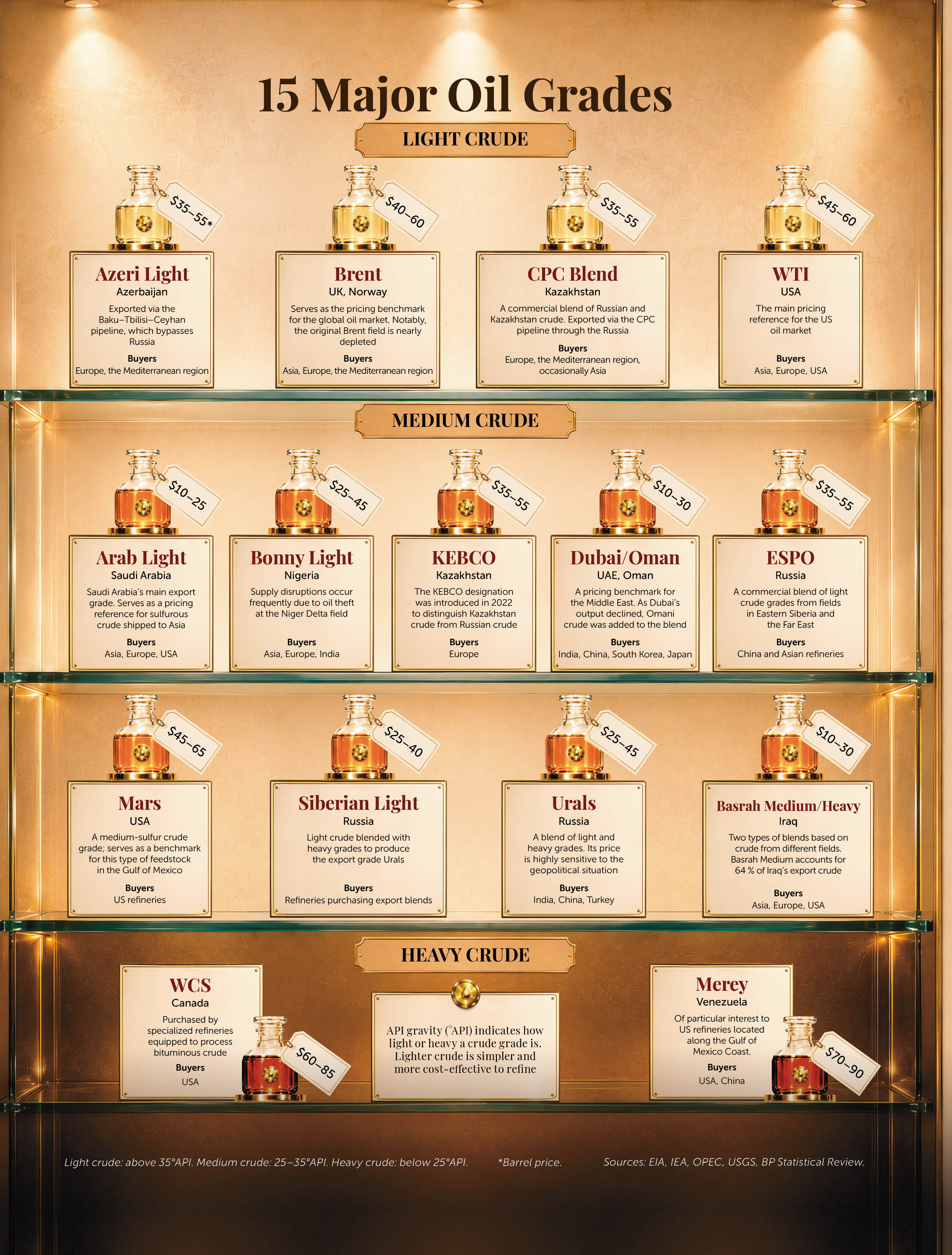
When the media report that oil has risen or fallen in price, they usually mean the benchmark grade - North Sea Brent blend or West Texas Intermediate (WTI). In reality, the global palette of this energy resource is far broader.
Today, over 160 types of oil are produced worldwide, each with different densities and sulfur contents. The characteristics of hydrocarbon feedstock are linked to how it is produced and transported, as well as to the end products that can be derived from it.
In this article, we will examine how different grades of the “black gold” differ from one another, why they are sometimes blended, and how major geopolitical factors come into play.
When Quality Turns into Money
There are several key parameters that define oil grades. The first is density, measured in API gravity degrees. The higher this figure, the lighter the oil; the lower, the heavier and more viscous the feedstock. The second important parameter is sulfur content. Oil with low sulfur content is called “sweet”; high‑sulfur oil is termed “sour.” The terminology may sound odd in translation, but the meaning is simple: sweet crude is easier to refine, while sour crude requires more extensive treatment.
Light, low‑sulfur crude makes it easier to produce high‑quality light products such as gasoline, diesel fuel, or aviation kerosene. Heavy crude is used to produce fuel oil, bitumen, and petroleum coke. Turning these into fuels requires additional deep‑processing units (coking, hydrocracking, hydro treating, etc.), which adds to the cost. That is why light crude is considered higher quality and commands a higher price: it is more convenient to extract, transport, and refine. However, this does not mean that heavy crude is inferior.
Large integrated refineries, particularly those located along the US Coast of Gulf of Mexico, have historically built their business model around processing heavier, more sulfurous grades. These plants buy cheaper feedstock to achieve higher margins on finished products. As a result, the United States is both the largest producer of light shale oil and a continued importer of heavy grades from Canada, Mexico, or Venezuela for processing at its facilities.
Retrofitting US refineries to process domestic light crude is technically feasible but economically unjustified. The US produces a record 13.4 million barrels per day, while the refineries need about 16.5 million barrels per day to operate at full capacity.
Where the Barrel Came From
Oil began to be measured in barrels in the second half of the 19th century, during the first oil rush in the US state of Pennsylvania. At that time, there was no specialized packaging for the new commodity, so producers started using wooden barrels previously used for butter, beer, wine, or fish. Their capacity was 42 gallons (about 159 liters). When full, a barrel weighed 130 kilograms, which allowed two strong workers to load it easily onto a cart.
In 1866, the American Petroleum Producers Association adopted this volume as the basic standard. Since the US eventually became the world’s main oil exporter, the barrel - a unit familiar to Americans - was also adopted by other countries as a universal measurement.
At the United States’ largest field, Prudhoe Bay, vast volumes of associated gas are produced alongside oil. However, most of this gas is not sent to consumers; instead, it is reinjected underground to help push more oil to the surface.
The Mixed Bag
It is not always the case that a single pipeline carries feedstock from a single source. Blending oil is a common practice. Producers and traders mix different streams to obtain a stable grade with predictable characteristics. Buyers want to be sure that the tanker contains oil of the required density and sulfur content, not a random mix with an unpredictable refining yield.
The most well‑known oil grade is Brent, sourced from offshore fields in the North Sea. It is named after the eponymous field discovered by Shell in 1971. By type, it is a “light” and “sweet” crude, suitable for producing high‑quality gasoline and diesel fuel.
Over time, Brent became a global benchmark grade due to a combination of geopolitical, logistical, and economic factors. Its fields were located in a calm and safe region, and the crude was easy to produce and transport to key European refineries. In the 1980s, the London International Petroleum Exchange (now ICE) launched Brent futures trading, providing a convenient tool for hedging risks. This turned the grade into a kind of global “currency” for pricing other oil blends.
Brent’s main competitor is WTI, produced in Texas and transported via pipelines to the US logistics hub in Cushing. Until 2015, this grade was used exclusively for domestic consumption in the United States, but after the export ban was lifted, it began to be sold worldwide.
Today, Brent is not a single specific grade but a blend of several North Sea crudes: Brent, Forties, Oseberg, Ekofisk, and Troll. Since 2023, the calculation of the benchmark price even includes US WTI Midland delivered to Europe. The reason is simple: the Brent field itself no longer produces enough oil to serve as a global reference on its own.
Sometimes, geopolitical factors also come into play when new commercial blends are created. For example, Venezuela is rich in heavy and ultra‑heavy crude, mainly located in the Orinoco River belt. According to the US Geological Survey, about 513 billion barrels of oil could technically be produced from the Orinoco belt, although not all of this volume is considered proven reserves. Transporting such crude via pipeline is inconvenient: heavy hydrocarbons must be diluted with a lighter fraction, such as naphtha or condensate.
One of the most important suppliers of this diluent to Caracas is Tehran. The partners operate under barter swap agreements: Iran supplies Venezuela with ultra‑light crude and gas condensate, while heavy hydrocarbons are exported in the opposite direction. This cooperation helps maintain mutual exports.
Most oil grades do not have their own independent exchange price. Instead, their value is usually calculated relative to one of the benchmarks - for example, Brent, WTI, or Dubai - with a premium or discount. The size of this difference depends primarily on the quality of the feedstock and the costs of delivering it to the buyer. If a certain grade is in short supply or supply routes are disrupted, even a lower‑quality grade can experience a sharp price increase.
A Place for Geopolitics
In Eurasia, the topic of oil grades has long ceased to be purely technical. Russian Urals is a blend of heavier, more sulfurous crude from the Volga and Ural regions with lighter crude from Western Siberia. For decades, Urals has been Russia’s main export benchmark. It is heavier and more sulfurous than Brent, so it usually trades at a discount to benchmark grades, yet it remains a convenient feedstock for many refineries in Europe and Asia.
Kazakhstan’s key export grade is CPC Blend. The main export flow, routed through the Caspian Pipeline Consortium (CPC), goes to the Black Sea. The route passes through Russian territory and uses the port infrastructure in Novorossiysk, but the oil itself is mostly of Kazakh origin.
For the buyer, not only the quality of the feedstock matters but also its origin. In theory, mixing Kazakh and Russian streams could improve the physical properties of individual batches. Lighter crude can make a blend more attractive for refining. However, after 2022, chemistry alone is no longer enough to forecast the demand for a given grade. Documentation, routes, “provenance” issues, and insurance have moved to the forefront. This is why the market for oil grades has become part of geopolitics.
Brent, WTI, Urals, CPC Blend, or Venezuelan Merey are not just different product names. Each grade represents its own production, logistics, refineries, and political constraints. Sometimes the price is determined solely by the quality of the oil; sometimes by the country of origin; but more often, both factors matter.
According to Passport
An oil grade is like a barrel’s identity document. It encodes key information that the seller presents to the buyer: the degree of lightness, sulfur concentration, production cost, suitability for processing at various refineries, and the discount relative to benchmark grades. When the global and exchange environment is relatively calm, these differences appear as technical details. However, when geopolitical factors take center stage, the very name of the grade begins to determine demand and the market price of the offer.