
Financier №4 (40) 2025

Saken Ismailov
analyst at Freedom Finance Global
Nerve of the Digital Economy
Who and How Provides High-Speed Data Transmission in the Modern World
Every time a trader in New York places an order to buy a stock, or an ATM in Abu Dhabi dispenses cash, a transaction signal—like a nerve impulse—travels through hundreds, and sometimes thousands, of kilometers of cable, ranging in thickness from a thread to a garden hose. Most of these backbone networks run along the ocean floor.
How It All Began
The need to transmit information as quickly as possible between the Old and New Worlds has existed since the invention of the electric telegraph. The first transatlantic communications cable was laid in 1858, but engineering flaws meant it was short-lived. According to some estimates, its construction cost approximately $1.5 million—around 2.5% of the annual US federal budget at the time. Using Morse code, the cable could transmit only six words per hour.
After several failed attempts, a stable communication line was finally established across the Atlantic seabed. “Europe and America are united by telegraph communication. Glory to God in the highest; on earth peace, goodwill toward men!” was the first message sent by the board of directors of the Atlantic Telegraph Company in London to their partners in the United States.
One hundred and thirty years later, a fibre-optic cable with a transmission capacity of 280 Mbps was laid along the same route—approximately three billion times faster than the most advanced networks of 1858. Even so, by today’s standards, this speed would be considered extremely low.
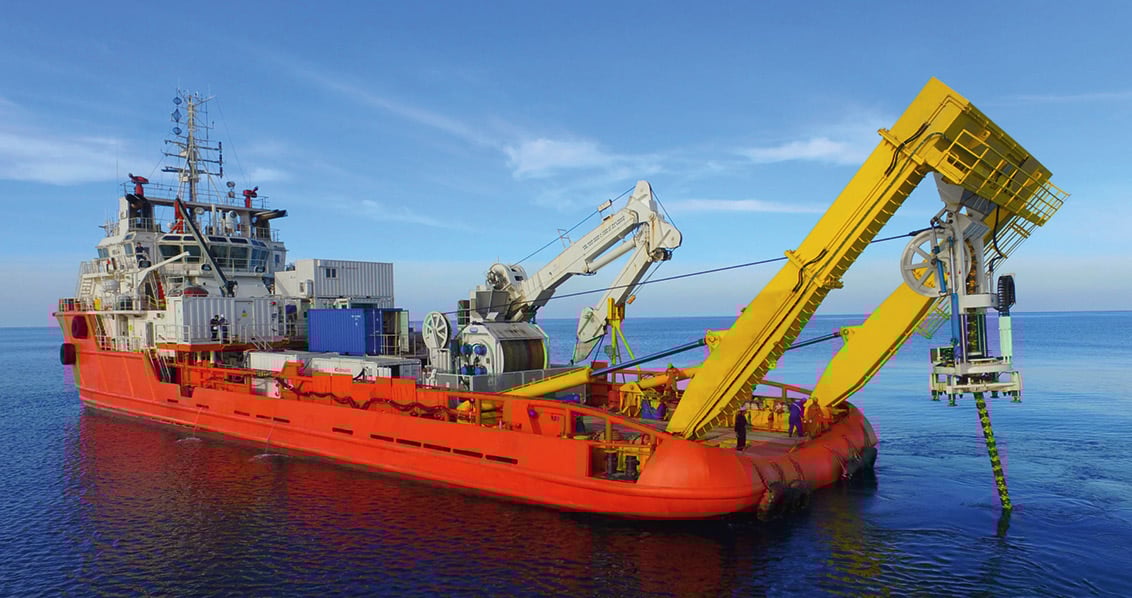
Submarine cable inspection vessel. Photo: open sources
Since 2015, London and New York have been connected by a next-generation fibre-optic link capable of transmitting data at speeds of up to 400 Gbps. In 2025, the construction of an upgraded backbone between the UK and the US with even greater capacity was announced. The existing cable already carries between 160 and 220 Tbps of data per second.
Today, there are approximately 600 submarine cables worldwide, with a combined length of around 1.5 million kilometers Roughly ten new cables are added each year. According to Infra-Analytics, a further 800,000 kilometers of submarine internet cables will be laid by 2030, and 1.6 million kilometers by 2040. The expansion of this infrastructure is driven by rapidly growing demand for bandwidth. Vast volumes of information must be transmitted with minimal delay, and the development of artificial intelligence has made this requirement even more acute. For example, a single request to Midjourney—a neural network that generates images from text prompts—creates around 40 times more traffic than a standard search query. Training large language models is impossible without the near-instantaneous exchange of petabytes* of data across continents.
*A petabyte is approximately one million gigabytes (GB). This volume is sufficient to store around 170–180 million minutes of high-definition video or approximately 500 billion pages of standard printed text.
Power of the Sea
According to Canadian research firm Precedence Research, the global submarine cable market is currently valued at approximately $22.95 billion and is expected to grow to $55 billion by 2034.
Economy Insights estimates that submarine cables carry between 95% and 99% of all global internet traffic. The remainder is transmitted via terrestrial networks and satellites, whose share remains marginal and is largely limited to remote or hard-to-reach regions.
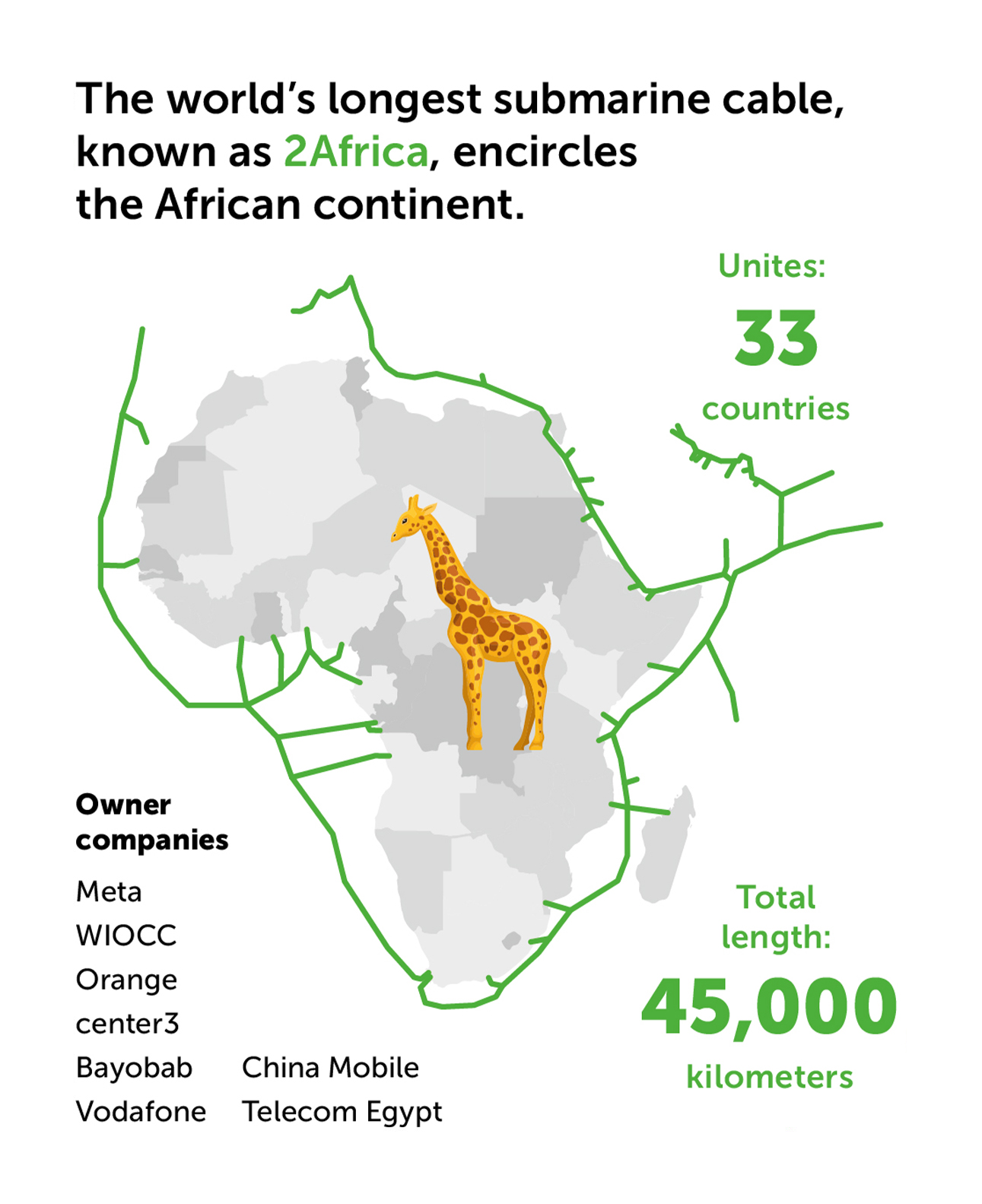
Source: submarinecablemap.com
The primary advantage of submarine cables lies in their data transmission speed. Modern fibre-optic technology allows signals to travel at approximately 200,000 kilometers per second. Historically, cable routes were planned primarily on the basis of economic efficiency—where cables could be laid most cheaply and which traffic hubs they would serve. However, the rise of high-frequency arbitrage* has fundamentally changed this logic. Today, some customers are willing to pay hundreds of millions of dollars to receive information even a millisecond faster.
This demand has accelerated technological innovation, including the development of hollow-core fibre (HCF)—optical fibre with a core filled with air, inert gas, or vacuum, allowing data to travel significantly faster. In laboratory conditions, researchers have achieved speed increases of up to 1.5 times, approaching the speed of light in a vacuum.
**High-frequency arbitrage is a trading strategy that exploits price discrepancies for the same asset across different exchanges.
One drawback of submarine cable infrastructure is its high cost. According to TeleGeography, laying a 1,000-kilometer submarine cable costs between $40 million and $60 million. Maintenance presents further challenges. Around 200 cable-related incidents occur each year, mostly due to human activity in shipping and fishing zones. This figure has remained broadly stable despite the rapid expansion of the global cable network.
Modern cable design allows for repairs without fully lifting damaged sections to the surface. Nevertheless, repair operations require specialized vessels, and the global fleet of such ships is aging. Infra-Analytics estimates that around two-thirds of these vessels will require modernization within the next 15 years, at a cost of approximately $3 billion.
Geopolitics adds another layer of risk. The Europe–Asia corridor running through Egyptian territorial waters and the Red Sea—often referred to as the “digital Suez Canal”—carries roughly 17% of global internet traffic. In the event of disruption, traffic would not cease entirely due to redundancy, but transmission speeds would decline sharply. As noted, even small reductions in speed can have significant consequences, particularly for financial markets.
The Lords of the Underwater World
Today, around 71% of the transcontinental submarine internet cable market is controlled by four major technology corporations, which are responsible for approximately one in five newly laid cables. Over the past decade, the presence of these companies in the sector has increased more than sixfold.
- Meta (META) accounts for around 22% of global mobile internet traffic and 10% of fixed broadband traffic, with its share continuing to grow. Its flagship project, the W-Cable, is a nearly 40,000-kilometer network costing an estimated $10 billion. The W-shaped route will connect the US East Coast to India via South Africa and the West Coast via Australia, effectively circumnavigating the globe. Meta plans to implement the project independently, without partners.
- Alphabet (GOOGL) is involved in 33 submarine cable projects supporting cloud services and data centers worldwide. The company is actively expanding infrastructure in Africa, Asia, and Australia, with plans to build the world’s largest fibre-optic network, exceeding 42,500 kilometers in length.
- Amazon (AMZN) is constructing a submarine cable linking its key digital hub in Ireland to the United States.
- Microsoft (MSFT) is developing international cable routes for its cloud platforms and corporate services. The company owns approximately 5,000 kilometers of fibre, including a link between Ireland and the UK.
Competition in the global internet traffic transmission market has intensified in recent years. China is increasingly challenging US dominance in submarine cable infrastructure. Beginning in the mid-2010s, Huawei Technologies launched its own cable-laying initiatives and is now involved in nearly 100 such projects worldwide. As a result, the balance of power in this strategically important industry may shift significantly in the coming years.