
Investment Review №351. S&P 500 Hits New Highs
Corporate News in Focus of Our Analysts
Apple
On July 30, 2026, Apple Inc. (AAPL) reported results ahead of expectations across all headline metrics, but quality was far from perfect: the bulk of the margin upside and most of the EPS beat stemmed from a nonrecurring tariff refund rather than underlying operations. Demand remains exceptionally strong, with iPhone and Mac sales constrained by chip shortages. That said, gross margin continues to trend lower, pressured by memory costs, which management likened to a “once-in-a-century flood.” Services revenue growth missed expectations and decelerated again sequentially. Near-term guidance was uninspiring relative to the market’s optimistic setup after the stock’s strong pre-earnings run. Consequently, shares fell about 7.4% on the next trading day, July 31, a move that looks more like profit-taking than a deterioration in fundamentals.
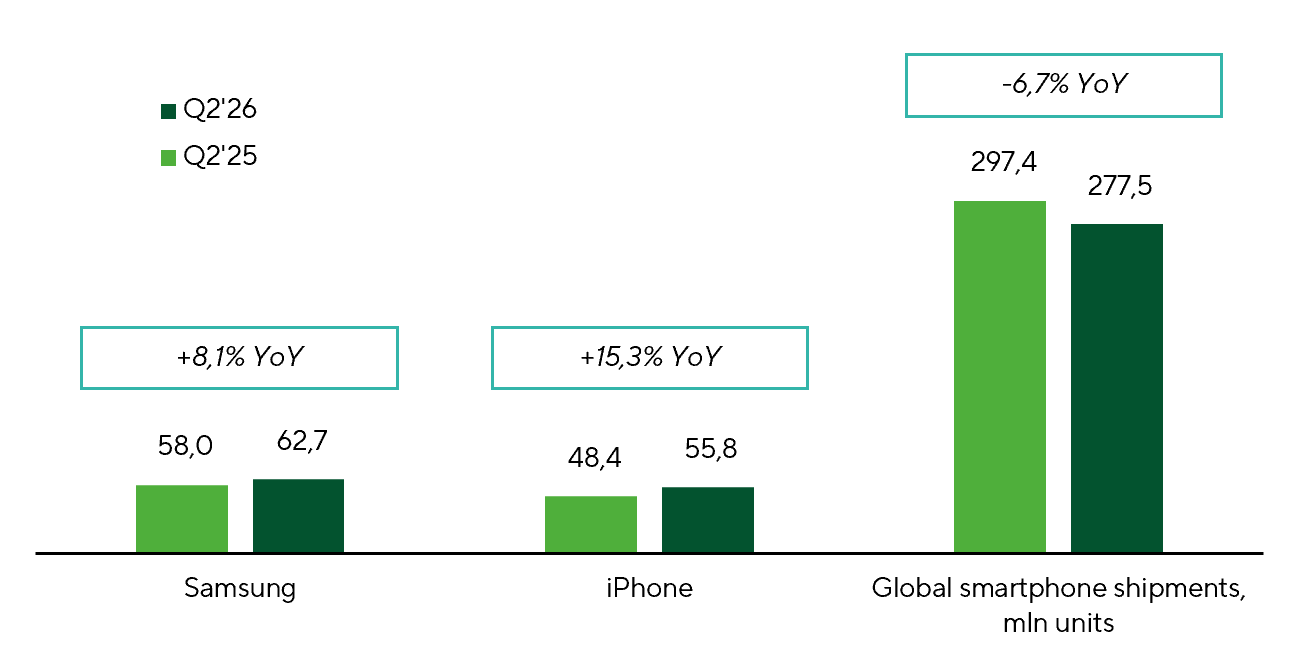
Global smartphone shipments, in millions of units.
Sources: IDC, Freedom Broker analysis
Alphabet, Microsoft, Meta, Amazon
The four hyperscalers again raised their 2026 capex plans, but share-price moves were driven less by budget changes and more by FCF coverage and evidence of monetization. Alphabet (GOOGL) lifted its capex guidance to $195–205bn from $180–190bn and flagged a significant step-up in 2027. Despite Google Cloud growth accelerating to 82% YoY and a $514bn backlog, negative FCF triggered a share-price pullback. Microsoft (MSFT) did not raise capex and technically lowered it through lease reclassification. Azure grew 43% YoY. Strong results and upbeat guidance across segments, combined with YTD underperformance, drove a post-earnings rally. Meta (META) narrowed its capex guidance to $130–145bn from $125–145bn; however, its overall results underwhelmed and failed to convincingly justify the scale of AI spending. Amazon (AMZN) increased its capex guidance most aggressively, to ~$220bn from ~$200bn, following no update last quarter. Management cited rising memory costs as the primary driver. Strength in AWS, where revenue growth accelerated to 36.7% with a 39.4% margin, e-commerce, and advertising more than offset higher investment. Overall, capex expectations rose 6% for 2026 and 14% for 2027. For semiconductor suppliers, a key point is that much of the increase reflects memory-price inflation rather than added capacity.
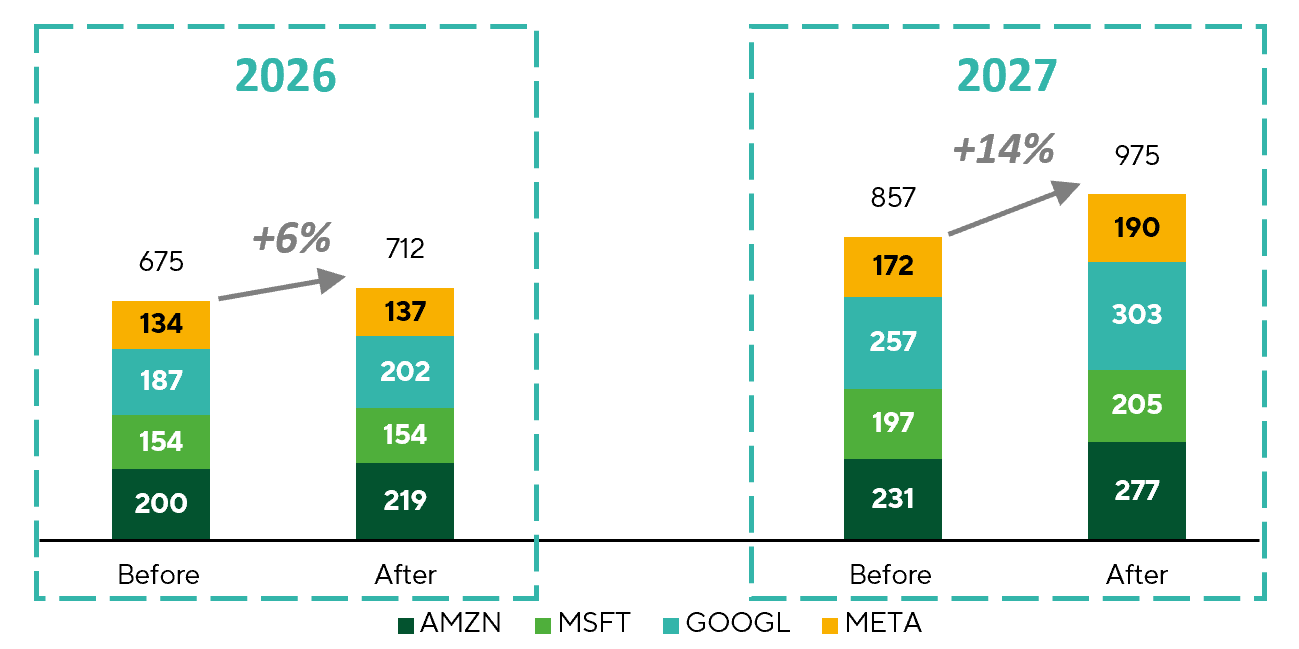
CAPEX Estimates for Big Tech Companies Before and After Earnings Reports, in billions of dollars.
Sources: FactSet, Freedom Broker analysis
Caterpillar
Caterpillar’s (CAT) Q2’26 results, reported on August 4, 2026, underscored strong operating performance, with beats across all major segments and higher full-year sales and margin guidance. The quarter saw broad-based demand growth: Construction Industries benefited from construction activity and equipment leasing; Resource Industries gained support from mining operations and related services; and Power & Energy was backed by strong data-center power needs and demand for oil and gas infrastructure. A solid backlog continues to support revenue visibility into the coming quarters. Tariffs remain a headwind, though their impact has become more predictable. We view CAT as a high-quality beneficiary of long-cycle infrastructure investment, mining capex, and AI data-center power buildouts; however, after a strong share-price move, valuation already reflects much of the upside, and sensitivity to AI-infrastructure sentiment is rising.
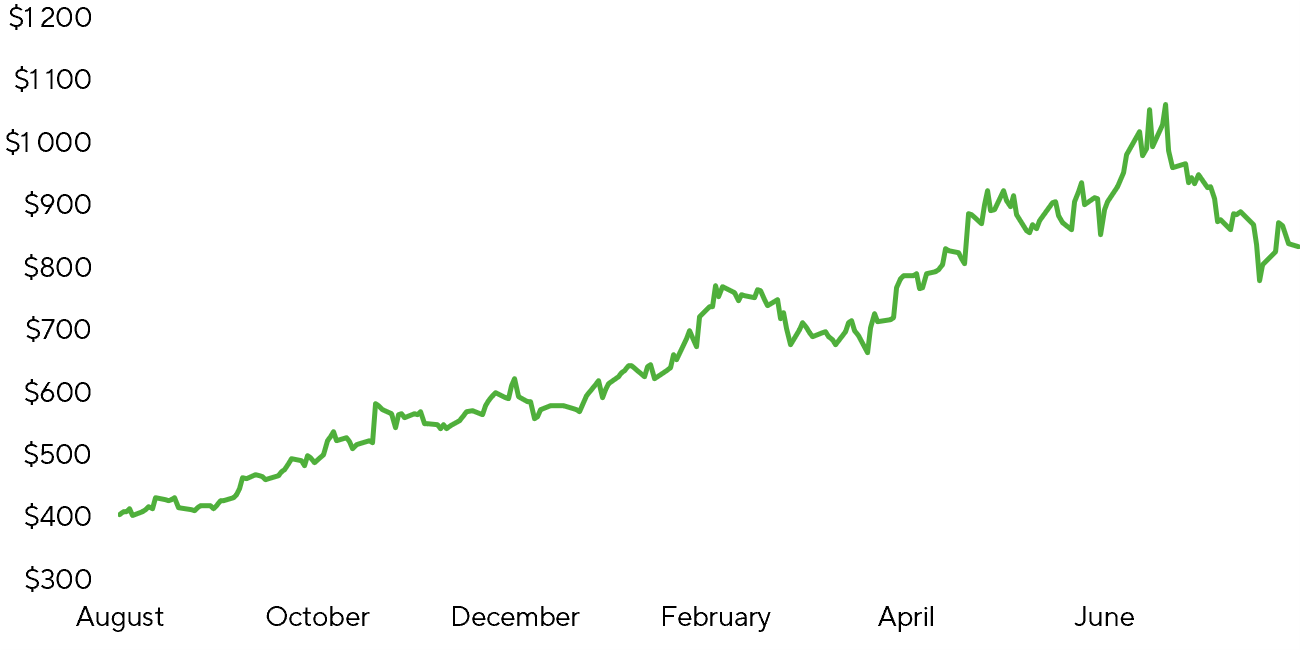
CAT Stock Price, 12 Months.
Sources: FactSet, Freedom Broker analysis
Walt Disney
Walt Disney (DIS) reported moderate top-line growth in Q3 FY26, driven by solid revenue momentum in parks and cruises, as well as streaming subscriptions. Total revenue rose 7% YoY to $25.25bn. This growth was supported by higher theme-park attendance and per-capita spend, cruise fleet expansion, streaming price increases, and subscriber growth. Streaming revenue increased 11% to $5.53bn. Subscription proceeds grew 15% to $4.72bn, while income from advertising was weaker on ad rate cuts and amounted to $851m. Parks and cruises revenue grew 10% to $9.97bn. U.S. theme park attendance rose 3% YoY, per-guest spending increased 4% YoY, and the combined theme park and cruise passenger count was up 4% YoY. The addition of two liners expanded available cruise capacity by about 50%. Consumer Products also benefited from strong Toy Story and Star Wars merchandise sales.
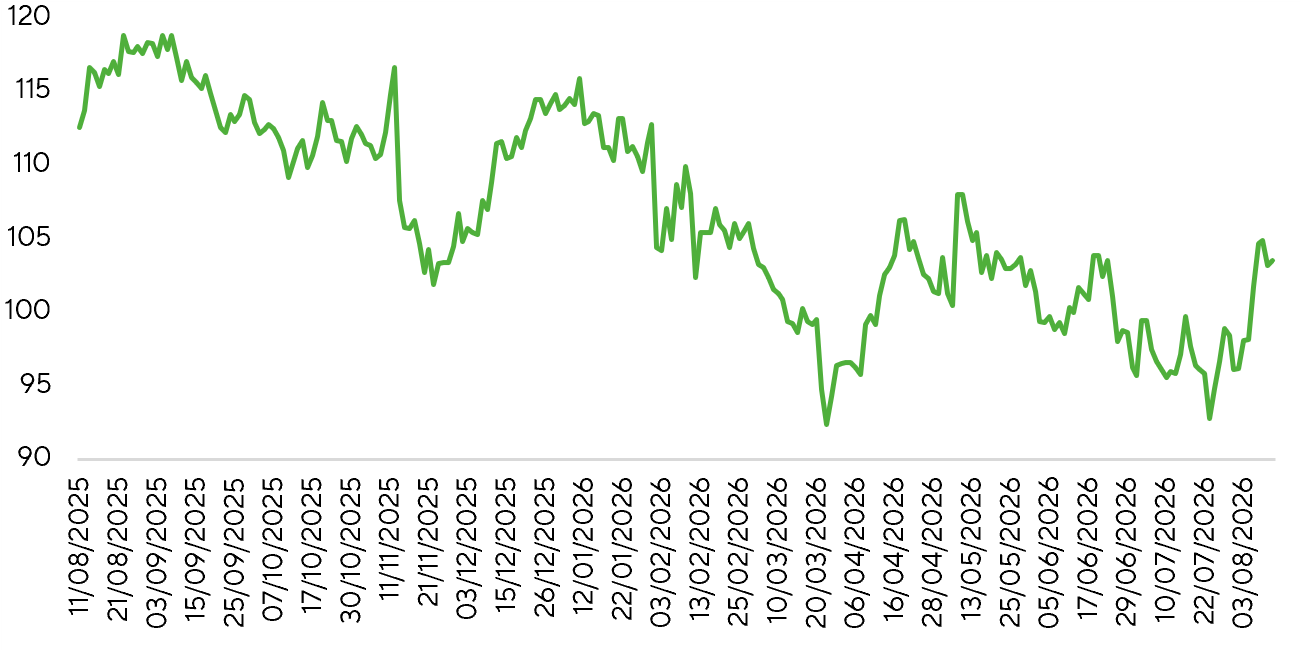
Walt Disney Stock Price Trends.
Source: FactSet
Palantir
Palantir (PLTR) delivered exceptional Q2’26 results, surpassing its own guidance and market consensus across revenue, profitability, bookings, and FCF. The outperformance was driven by a sharp acceleration in the U.S. commercial segment, where revenue surged 149% YoY as customers shifted from pilot projects to large-scale Artificial Intelligence Platform (AIP) deployments in critical processes. The U.S. government segment also maintained strong momentum, supported by expansions of existing defense and civilian programs and new contract awards. The company delivered further gains in operating profitability and record cash flow despite investment in technical talent, products, and the build-out of its sovereign AI division. The material upward revision to Q3 and FY26 guidance is clearly positive, signaling that robust demand should persist into the second half of the year. Growth remains driven by scaling AIP in the U.S. commercial segment, expanding government deployments, and rising customer demand for governed AI use that preserves control over data, models, and business logic.
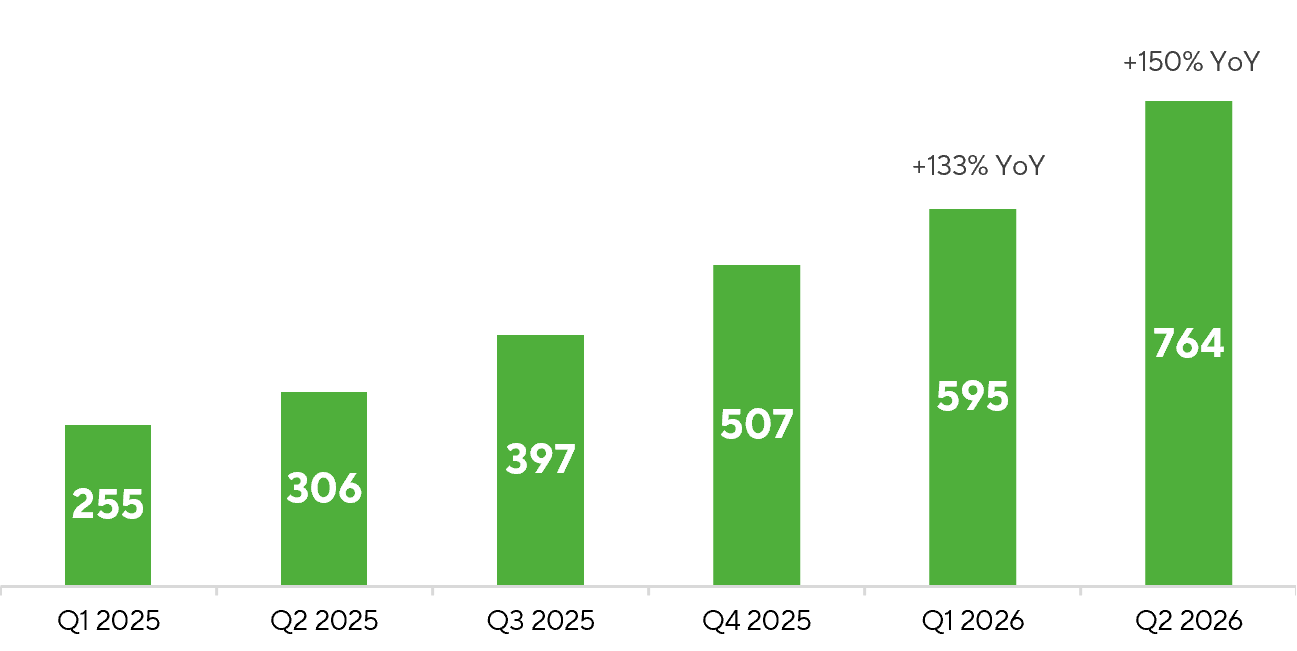
Revenue Trends in the U.S. Commercial Sector.
Source: PLTR IR presentation