
Investment Review №350. A Shift in Priorities
Geopolitics Is Back in the Picture
Stock indices in the Emirates experienced a moderate correction due to a new round of tensions in the region
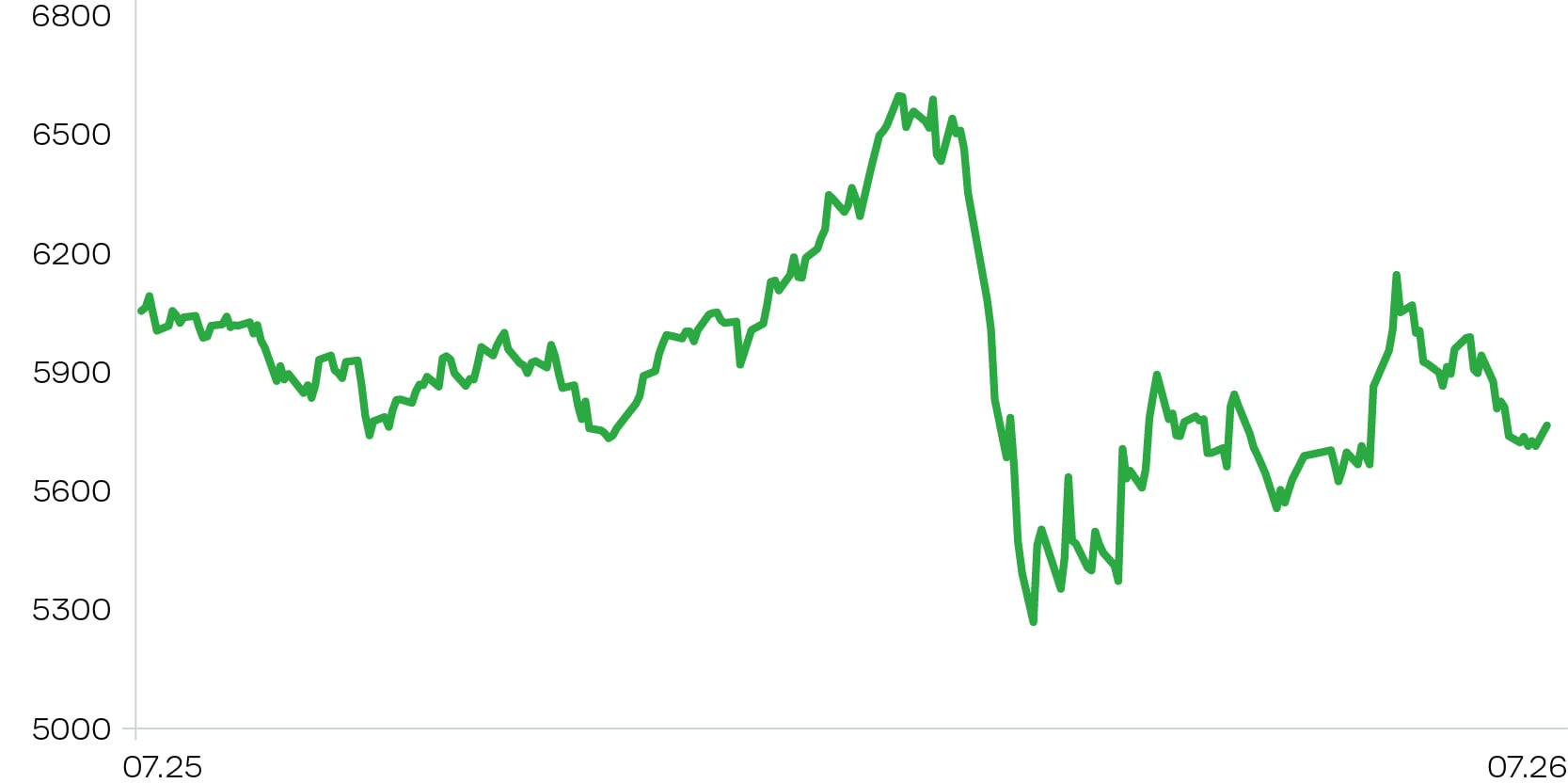
DFM General Index: 1-Year Dynamics
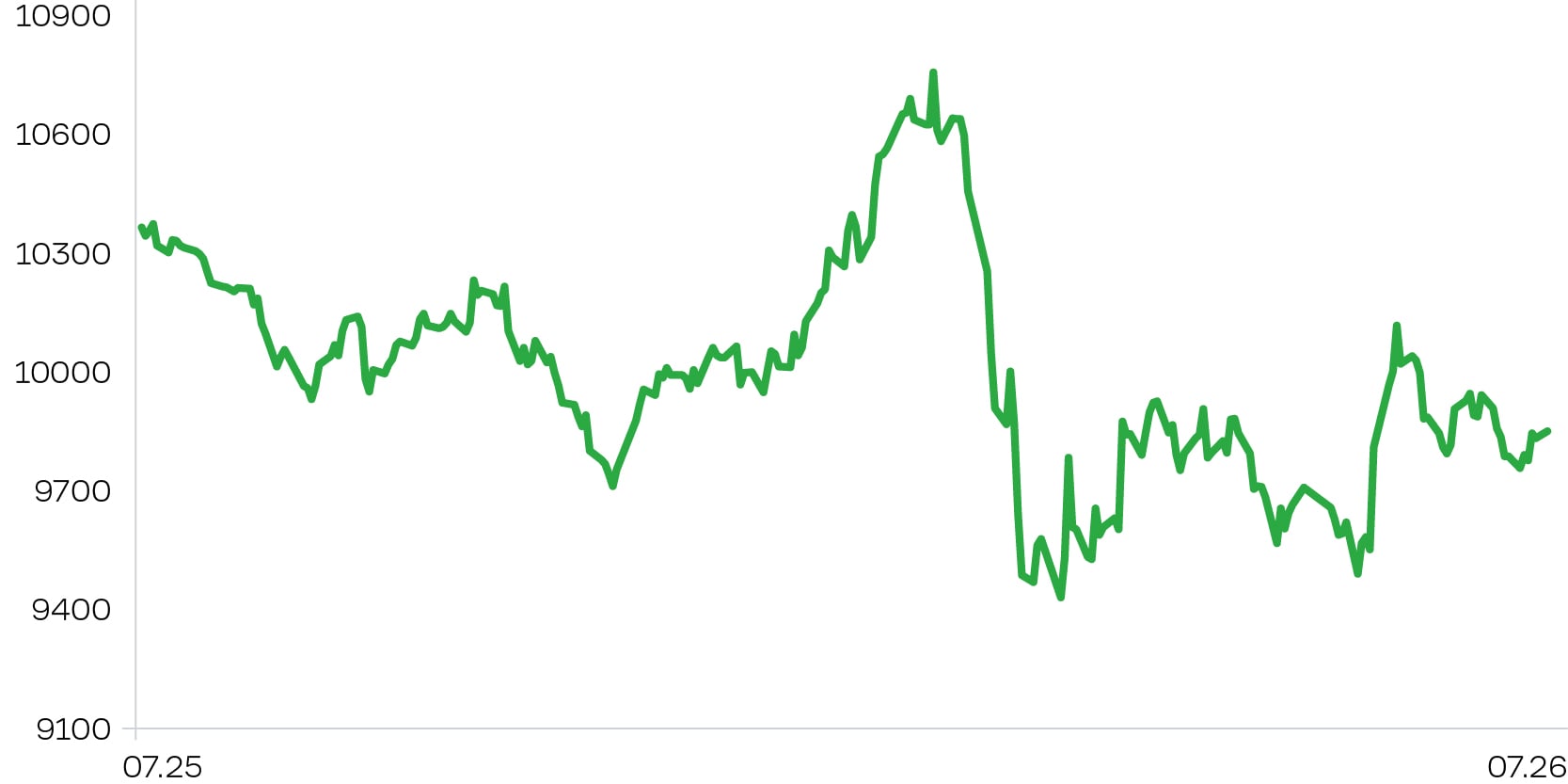
Abu Dhabi Securities Exchange Index: 1-Year Dynamics
Brent Oil, 1-Year Dynamics
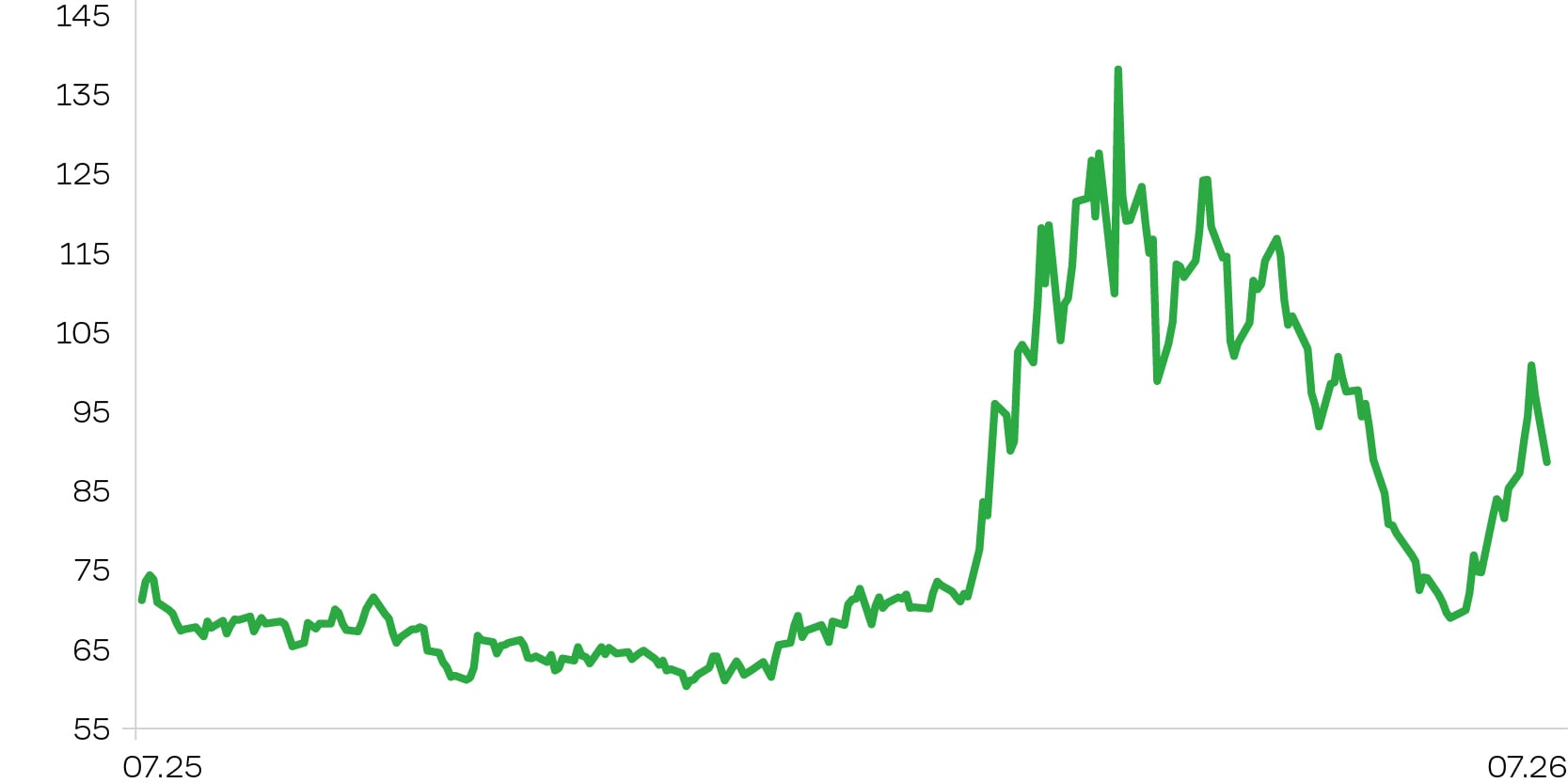
- UAE equities came under pressure over the two weeks from July 13 to July 27, 2026, as renewed U.S.-Iran escalation around the Strait of Hormuz and a sharp oil rally hit risk appetite. Dubai underperformed. The Dubai Financial Market General Index (DFMGI) fell 2.1%, from 5,967 to 5,844, while the Abu Dhabi Securities Exchange General Index (ADXGI) slipped just 0.6%, from 9,904 to 9,845, showing clear relative resilience. The move was not isolated. Over the same period, the S&P 500 lost 1.4%, falling from 7,515 to 7,413, underscoring the broader global risk-off tone. Oil moved the other way, rising 8.3% from about $82 to $88/bbl, as renewed U.S.-Iran fighting and concerns over passage through the Strait of Hormuz lifted the geopolitical premium. Brent rose to its highest level since June 15 by mid-July, while by July 20 the U.S. had reinstated a naval blockade of Iranian ports.
- Sector performance was broadly negative. Seven of the eight sectors finished lower, with only financials holding near flat at +0.1%. Financials were helped by strong bank earnings, with First Abu Dhabi Bank up 3.67% and Abu Dhabi Commercial Bank up 1.94%. But gains were almost fully offset by sharp losses in Phoenix Group (-17.31%), Waha Capital (-6.84%) and Amlak Finance (-6.40%). DFM itself fell 3.40%. Consumer staples were the weakest sector, down 4.73%, dragged by Agthia (-6.16%) and Spinneys (-3.88%). Real estate lost 4.13%, with Alpha Dhabi (-8.18%), Union Properties (-7.93%), Deyaar (-5.22%), Aldar (-4.01%) and Emaar Properties (-2.59%) all lower. The reversal in communication services was especially telling. After leading the market two weeks earlier, the sector fell 3.39%, with e& down 4.35% and Sudatel down 10.03%. Industrials and logistics dropped 3.06%, led lower by Air Arabia (-9.09%), Dubai Taxi (-4.09%) and Multiply (-3.26%). Abu Dhabi Aviation (+1.15%) and Aramex (+0.60%) were among the few gainers. Energy slipped 0.81%, as ADNOC Drilling (+1.04%) was outweighed by declines in ADNOC Distribution (-0.50%), ADNOC Gas (-1.46%) and Dana Gas (-3.92%). Utilities fell 0.98%, while consumer discretionary lost 0.72%.
- UAE Treasury-proxy yields rose 8.8 bps, to 5.46% from 5.37%, while the 10-year UST yield barely moved, rising just 2 bps to 4.69%. That pushed the spread between local UAE bonds and 10-year USTs wider, to roughly 77 bps from about 70 bps, reversing the tightening seen in the previous period. The message is clear: geopolitical tension around the Strait of Hormuz is putting risk premium back into local assets, and UAE yields are reacting more sharply than benchmark USTs.
Economic Updates
- Dubai real estate stayed resilient despite the seasonal slowdown. According to Dubai Land Department, total real estate transactions reached about $114.3bn in 1H26 across 112,850 deals, including more than $78.0bn in sales. Off-plan office sales hit a record $3.57bn, topping the sector’s total sales over the previous seven years. Secondary-market data published on July 15 also showed the strongest monthly increase in ready-home sales in three years, pointing to a recovery in demand in a segment that had lagged the primary market.
- DEWA is accelerating investment in Dubai’s power grid. On July 21, Dubai Electricity and Water Authority said total investment in transmission projects had exceeded $2.72bn. In 1H26, the company commissioned eight 132 kV substations with combined capacity of 1,200 MVA, worth ~$264m, as well as a 400/132 kV substation at the Mohammed bin Rashid Solar Park. Over the next three years, DEWA plans to tender more than 30 additional 132 kV substations and lay 340 km of underground cables. The program supports the Dubai Economic Agenda D33 as electricity demand continues to climb.
Corporate News
- Emirates NBD posted record earnings and closed the RBL Bank deal. 1H26 profit before tax reached a record $4.41bn, up 5% YoY, while total income rose 16% to $7.60bn. Net profit after tax increased 3% to $3.51bn. The acquisition of India’s RBL Bank added $20.2bn in assets. Cost of risk stood at 42 bps, the NPL ratio was 2.1%, and group NIM for the half year was 3.25%.
- First Abu Dhabi Bank delivered a record quarter. 1H26 operating income rose 7% to $5.31bn, while profit before tax increased 3% to $3.59bn. In 2Q, profit before tax rose 16% QoQ and 6% YoY to $1.93bn. First-half net profit increased 1% to $2.92bn, RoTE reached 18.5%, and the NPL ratio improved to 2.2%. Quarterly net profit rose 4% YoY to $1.56bn, ahead of expectations.
- Abu Dhabi Commercial Bank set a record and delivered its 20th consecutive quarter of growth. 2Q profit before tax rose 26% YoY to a record $1.04bn. For 1H26, profit before tax increased 28% to $2.07bn, while net profit after tax rose 34% to $1.84bn. 2Q net profit climbed 31% YoY to $926m, assets increased 16% to $226.8bn, and the NPL ratio fell to a record-low 1.71%. The cost-to-income ratio improved to 26.8%, while net loans rose $11.4bn, or 10%, in the first half.
- Aldar launched the $27.2bn Marsa Al Saadiyat megaproject. On July 22, Abu Dhabi Crown Prince Sheikh Khaled bin Mohamed bin Zayed launched Marsa Al Saadiyat, the final phase of the Saadiyat Island masterplan, spanning 6.4m sq. m with 8 km of waterfront. The project is designed for more than 58,000 residents and includes Abu Dhabi’s largest marina, with 350 berths. First sales are expected in 2H26, with enabling and infrastructure works set to begin in 3Q. The project will include an underground station on the Etihad Rail high-speed network, improving Abu Dhabi’s connectivity with other emirates.
- ADNOC is stepping up its global expansion through XRG. XRG, ADNOC’s international investment arm, is expanding in the U.S. and Latin America. The head of XRG Americas described the U.S. as central to the company’s plan to build a global energy and industrial platform. The move follows early-July deals, including a larger stake in Rio Grande LNG and a strategic agreement with Mitsui, strengthening ADNOC’s position in key export markets.
Two-Week Outlook
Oil remains the key swing factor for UAE markets. According to weekly U.S. Energy Department data as of July 27, WTI rose 9.2% last week to $89.3/bbl as the U.S.-Iran conflict escalated. Reports of a possible new round of talks, however, pulled prices lower on Friday.
Four near-term factors matter. First, the TACO principle. A halt to reciprocal U.S.-Iran strikes could put pressure on oil, but the market is still tight, and a deal between Washington and the IRGC looks unlikely. With uncertainty still high, profit-taking may remain the cleaner trade for conservative investors.
Second, earnings resilience. Strong results from Emirates NBD, FAB and ADCB have set a constructive tone. The market will now look to ADNOC Gas, Aldar, Emaar and other developers for proof that earnings can hold up despite softer PMI data.
Third, the geopolitical risk premium. The UAE-UST spread widened to roughly 77 bps from about 70 bps, showing that local assets have become more sensitive to developments around the Strait of Hormuz. The next leg depends on whether de-escalation actually sticks.
Fourth, structural support from real estate and infrastructure. Marsa Al Saadiyat, record office sales and DEWA’s large-scale investment program continue to support long-term demand.
In a cautious scenario, continued fighting around the Strait and further weakness in business activity could keep indexes consolidating near current levels and push flows toward defensive assets.