
Investment Review №357. A Change of Leadership
Market Review as of November 2
Global Perspective
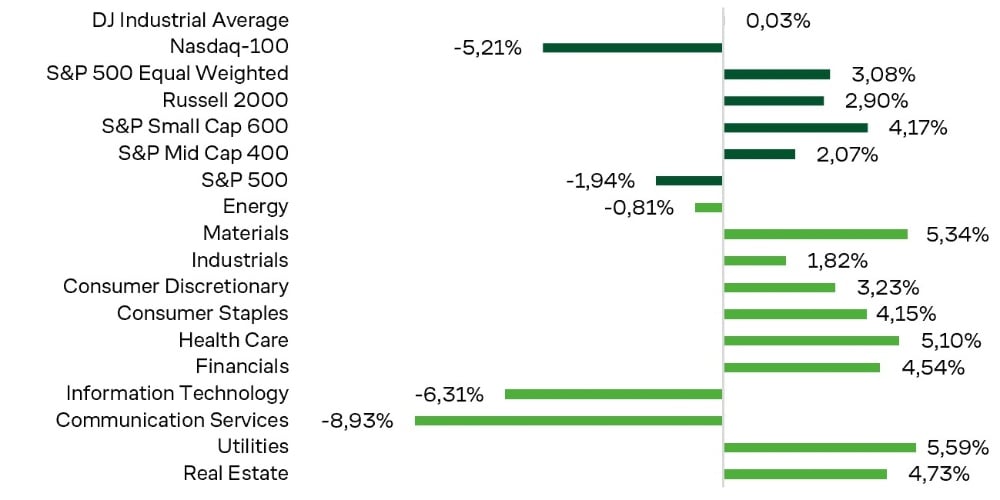
Over the period under review, U.S. equities continued to rotate out of megacap Growth and into more traditional and defensive sectors. The S&P 500 fell 1.94% and the Nasdaq-100 dropped 5.21%, while the equal-weight S&P 500 gained 3.08%. The 5.02pp outperformance of the equal-weight index underscores how heavily the largest constituents weighed on the headline benchmark. In other words, the index declined even as most of its constituents advanced, pointing to an internal rotation rather than a broad-based retreat from equities.
Investors have also favored dividend strategies and low-volatility stocks, while former momentum leaders have lagged. The leadership shift therefore extends beyond individual sectors to investment styles, with investors moving away from momentum and toward more defensive portfolio characteristics. At the sector level, Utilities gained 5.59%, Healthcare rose 5.10%, and Consumer Staples advanced 4.15%. At the same time, gains of 5.34% in Materials and 4.54% in Financials show that the rotation was not confined to defensives.
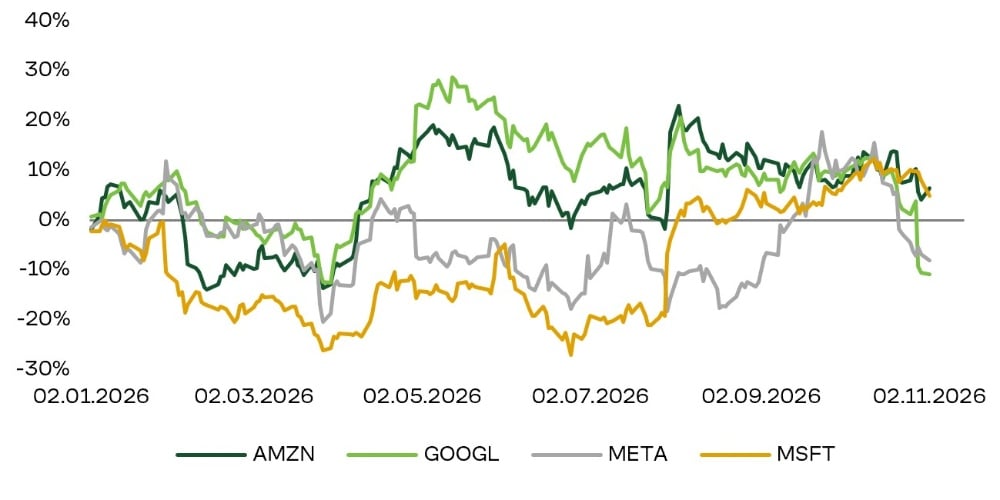
Communication Services and Information Technology were the biggest laggards, falling 8.93% and 6.31%, respectively. Earnings from Technology heavyweights added to the pressure, as elevated AI spending is already weighing heavily on free cash flow. Alphabet (GOOGL) maintained its 2026 capex guidance of $195–205bn but warned of a significant increase in spending in 2027. The prospect of further capex growth amid already negative quarterly free cash flow was a key driver of the selloff.
Meta Platforms (META) quarterly free cash flow turned negative for the first time, reaching −$2.12bn despite 26% revenue growth. The company also raised the low end of its capex guidance to $135bn, while leaving the upper end unchanged at $145bn. Against this backdrop, S&P revised the outlook on Meta’s AA- credit rating from stable to negative, citing uncertainty around the timing of returns on AI investment. Amazon (AMZN) trailing-12-month free cash flow fell to −$42.4bn, while quarterly capex reached $77.3bn, with full-year guidance unchanged at $220bn. Even highly profitable companies are increasingly spending more on infrastructure than they generate in free cash flow.
Microsoft (MSFT) proved more resilient in this environment, with revenue and earnings beating expectations and Azure growth reaching 48%. However, free cash flow fell 27% to $18.63bn, while capex, including finance leases, reached $45.2bn. Big Tech earnings have therefore been far from uniformly weak. Demand for cloud and AI services remains strong, but investors are increasingly focused on the cost of sustaining that growth and when returns will justify the scale of investment.
Semiconductor stocks also came under pressure despite being among the main beneficiaries of rising AI infrastructure capex. The SOXX ETF fell nearly 10%, while Intel (INTC) lost more than a third of its market value. Weak guidance against a slowing PC market was the main drag on Intel, although the selloff also reflected the broader repricing of AI-related stocks. Marvell (MRVL) shares plunged 28% as its announced all-stock acquisition of Lumentum, valued at approximately $11.5bn, added to investor concerns. The deal expands Marvell’s exposure to optical interconnects for AI data centers but also increases its dependence on the continuation of the infrastructure boom. Amid growing doubts over returns on AI investment, investors focused on the size of the deal and whether future earnings can justify the valuation. Even direct suppliers to AI infrastructure were not spared. The prospect of growing order books is increasingly overshadowed by concerns over the sustainability of the broader AI investment cycle.
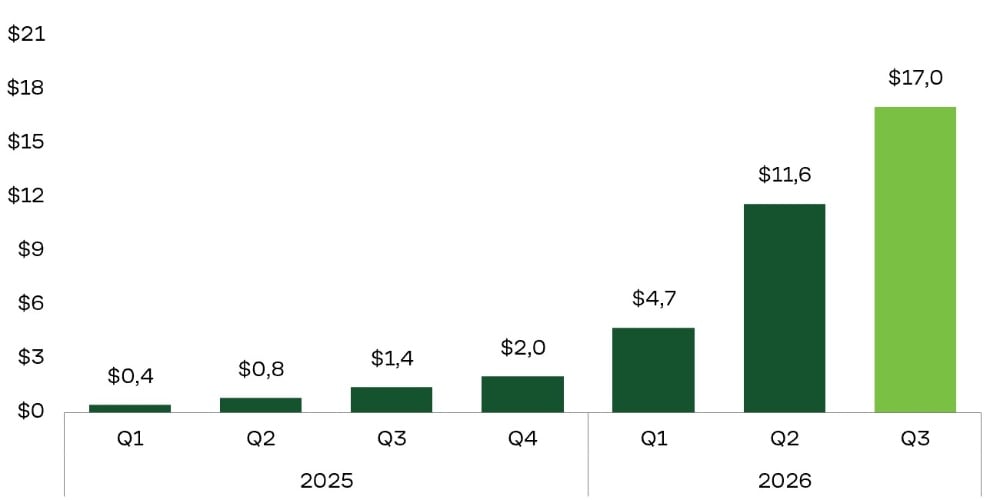
Anthropic is preparing for an IPO at a particularly challenging time. Its initial prospectus highlighted the scale of the company's growth, with Q2 revenue reaching $11.6bn, roughly 14 times the year-earlier level. Updated financials, however, have shifted the focus back to the cost of that expansion. In Q3, revenue rose to $16.96bn, but sequential growth slowed to 47% from 144% in the previous quarter, while operating income swung from a $974m profit to a $567m loss.
Anthropic’s $895.4bn in purchase and lease commitments drew particular attention, with nearly all of those obligations tied to compute capacity and infrastructure. The company warned that some suppliers rely on third-party financing. If that funding becomes more expensive or unavailable, it could lead to delays, higher costs or shortfalls in capacity delivery. The disclosure highlighted not only rapid AI revenue growth but also its dependence on the financial health of infrastructure partners. The balance between monetization, compute costs and future commitments is emerging as the central question for both Anthropic’s IPO valuation and the broader AI sector.
On the macro front, the key event was the October 27–28 FOMC meeting, at which the Fed left the policy rate unchanged at 3.75–4.00%, as widely expected. However, two Committee members dissented in favor of a rate hike, underscoring persistent inflation concerns. At the press conference, Kevin Warsh reaffirmed the Fed’s commitment to restoring price stability, framing the October hold as a necessary pause to assess the impact of September’s rate increase and the evolving economic backdrop. Notably, he stopped short of characterizing financial conditions as restrictive, preserving optionality for further policy action. The pause should therefore not be taken as a signal that the tightening cycle has ended, with investors still focused on how long the Fed might remain on hold.
A further policy signal came from September PCE data, released on October 30. Headline PCE rose 0.49% MoM, broadly in line with the 0.5% consensus, while core PCE increased 0.32% MoM, slightly above the 0.3% forecast. YoY, headline and core PCE stood at 3.6% and 3.1%, respectively. A 9.2% MoM surge in fuel prices was the main source of inflationary pressure, with higher energy costs also feeding through to transportation services and selected goods. This composition points more to cost pass-through than to broad-based demand overheating, although the risk of second-round inflationary effects remains. At the same time, subdued growth in household income and consumer credit should limit further cost pass-through, supporting expectations for core PCE MoM growth to moderate to 0.20–0.22%.
Market Focus
Oil prices in late October were primarily driven by expectations of a potential resumption of U.S. and Israeli military operations against Iran following the November 3 U.S. midterm elections. The hydrocarbon supply deficit persists amid reduced exports from Persian Gulf countries, making the current regional status quo increasingly difficult to sustain. A further escalation in November could send WTI above $110/bbl. Conversely, a U.S.-Iran agreement restoring unrestricted navigation through the Strait of Hormuz could trigger a sharp correction toward $80/bbl. In our view, however, reaching an agreement with Iran’s current leadership on terms acceptable to Washington remains highly unlikely.
The earnings season remains in full swing, with 319 S&P 500 companies having reported so far. Analysts are flagging several upcoming releases likely to attract heightened investor attention.
On November 10, CoreWeave is scheduled to report its Q3 2026 results. In 2Q26, revenue surged 112% YoY to $2.58bn. However, adjusted net loss widened to $567m from $130m a year earlier, while adjusted operating income declined to $128m from $200m. Higher interest expense and infrastructure costs continue to weigh on earnings, delaying the transition to sustainable profitability. AI cloud computing demand remains the key growth engine, with contracted future revenue reaching $104bn. For Q3 2026, management guided to revenue of $3.45–3.60bn and adjusted operating income of $200–260m. Investors will focus on capacity deployment, contract execution, capex and funding costs, particularly given the company's elevated leverage. The consensus price target for CRWV stands at $131.
On November 19, Palo Alto Networks is scheduled to report its fiscal Q1 2027 results. In 4QFY26, revenue grew 34% YoY to $3.41bn, while adjusted net income rose 27% to $853m. Growth continues to be driven by strong demand for integrated cybersecurity platforms and AI infrastructure protection. Next-generation security annual recurring revenue increased 63% YoY to $9.1bn, while remaining performance obligations grew 34% to $21.2bn, highlighting strong forward revenue visibility. For fiscal Q1 2027, management guided to revenue of $3.30–3.31bn, implying 33–34% YoY growth, and adjusted EPS of $0.96–0.98. Investors will focus on platformization momentum, acquisition integration, new contract wins and margin resilience. The consensus price target for PANW stands at $405.
Technical Setup
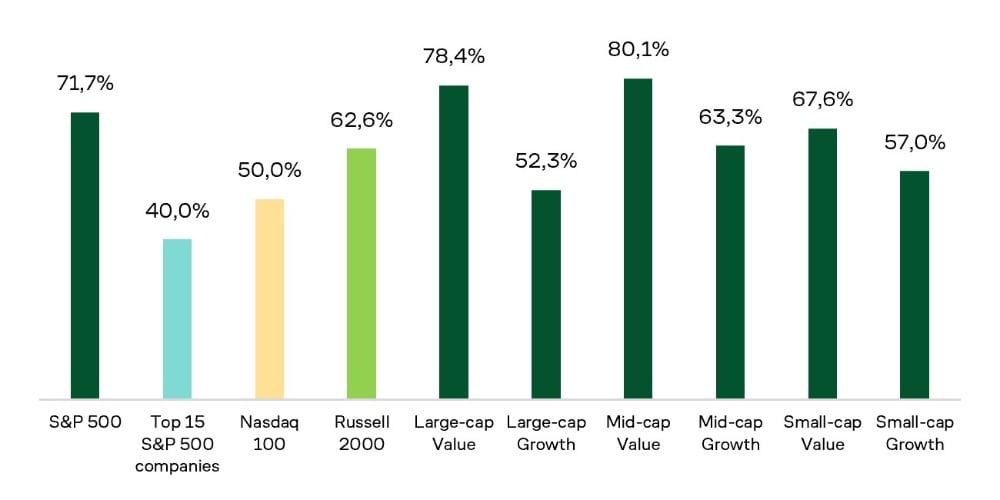
The S&P 500 declined to 7,541, falling below both its 20- and 50-day moving averages, currently clustered around 7,694–7,718. RSI dropped to 38, signaling weakening momentum but remaining above oversold territory. Market breadth, however, has improved, with ~67% of index constituents trading above their respective 50-day moving averages. This divergence from the index's price action tempers the bearish signal but does not, in itself, confirm an upside reversal. We maintain a neutral view on the risk-reward balance over the next two weeks. Immediate support stands at ~7,508. A break below this level would increase the likelihood of a deeper correction toward 7,313–7,316, where the 200-day moving average is located, followed by 7,238. Conversely, a sustained move back above the 7,694–7,718 range would improve the technical setup and open the way for a retest of resistance at 7,850.
Expected Trading Range
We expect the S&P 500 to trade within a 7,320–7,750 range.