
Investment Review №357. A Change of Leadership
Eyes on Hormuz
Persistent geopolitical uncertainty extended the correction on UAE exchanges
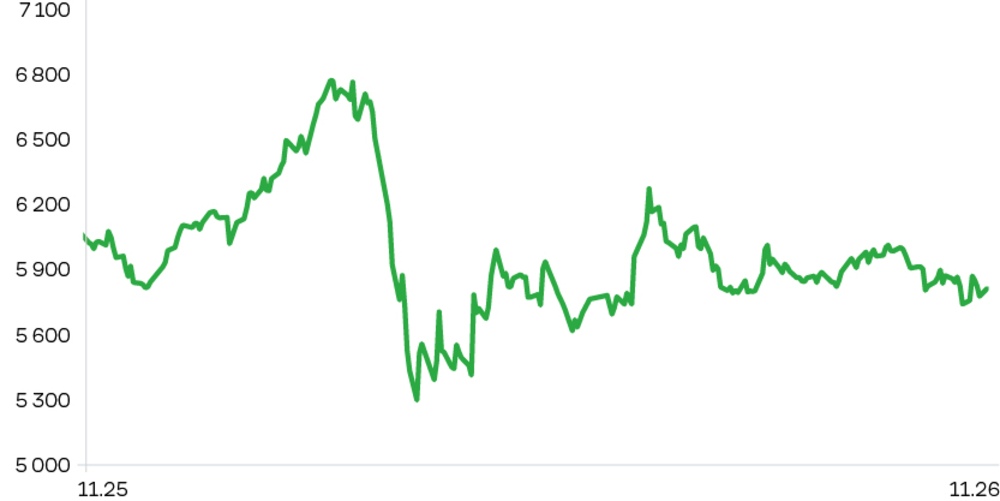
DFM General Index: 1-Year Performance
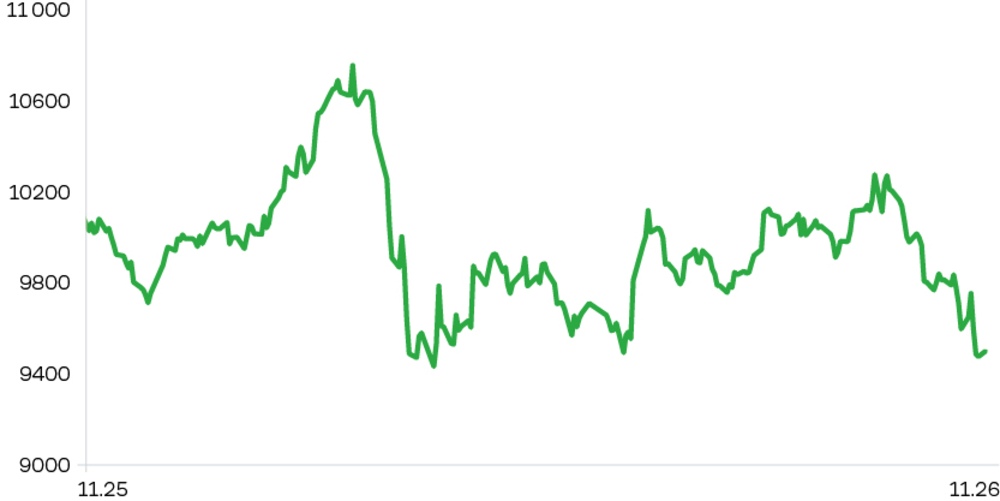
Abu Dhabi Securities Exchange Index: 1-Year Performance
Brent Oil: 1-Year Performance
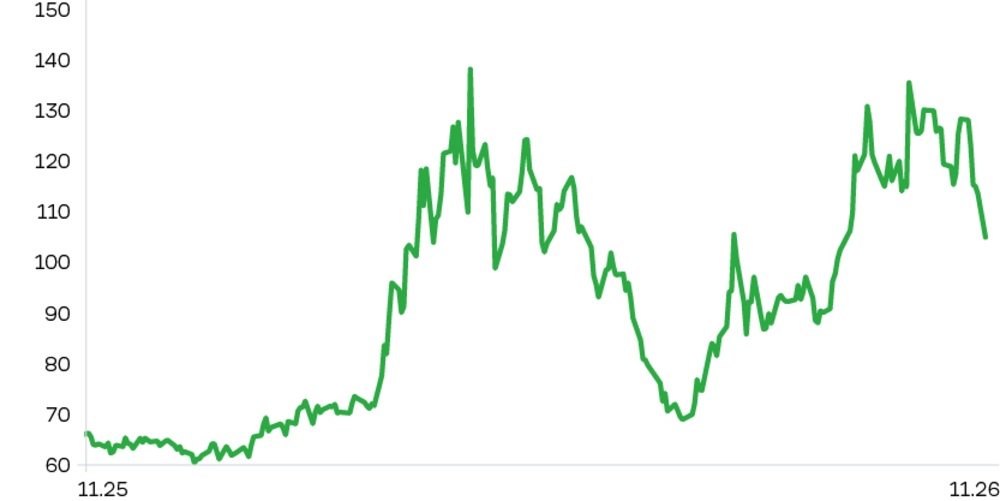
Between October 19 and November 2, UAE equities declined amid attacks on ships in the Strait of Hormuz, while oil sold off late in the period on headlines of renewed U.S.-Iran talks. The DFMGI slipped to 5,808 from 5,851 (−0.7%), the ADXGI fell to 9,491 from 9,783 (−3.0%), and the S&P 500 dropped to 7,541 from 7,691 (−1.9%). Brent crude was down to $104.8 from $118.8 per barrel (−11.8%).
Telecommunications (+0.20%), Utilities (−0.30%), and Consumer Discretionary (−0.48%) outperformed the broader market. Energy (−1.74%), Consumer Staples (−2.43%), Real Estate (−2.71%), Industrials (−3.23%), and Financials (−3.90%) lagged.
Top gainers were Air Arabia (+7.53%), ADNOC Drilling (+6.18%), and Parkin (+4.04%); notable decliners included ADIB (−13.12%), SHUAA Capital (−10.83%), and Gulf Navigation (−9.80%).
UAE sovereign proxy bond yields fell to 5.73% from 6.06% (−32.5bps); U.S. Treasury yields decreased to 5.03% from 5.27% (−24.5bps), narrowing the spread to 70 from 78. Fixed income appears to have priced the drop in the geopolitical premium faster than equities.
Economic Updates
The IMF expects the UAE economy to contract in 2026 and rebound strongly in 2027. It projects a 3.9% decline in real GDP in 2026 (previously +3.1%), followed by 7.7% growth in 2027. The recovery hinges on the resumption of commercial shipping through the Strait of Hormuz.
The Central Bank of the UAE left its policy rate unchanged at 3.9%, tracking the Fed, while fuel prices fell in November for the first time in three months. Super 98 slipped to $1.13 per liter from $1.20 (−5.5%). Elevated rates are underpinning banks’ margins, but cheaper fuel should lower carriers’ costs.
Corporate News
ADIB was the market’s largest decliner after a soft third quarter. Net income amounted to $443.8m, flat YoY but down 7% QoQ. The loan book expanded 25% to $59.36bn. Besides, the bank is raising $476.5m via a rights offering to existing shareholders, priced at $4.48 per share. Estimated dilution is minor at about 0.6%, suggesting the share-price weakness was driven largely by the earnings slowdown.
ADNOC Drilling gained 6.18% on sustainable results and higher dividends. Quarterly net income eased 0.8% to $365.4m, while nine-month revenue hit a record $3.7bn. With a $350m quarterly dividend approved, 2026 distributions could rise 22.5% to $1.225bn. Long-term cost-plus contracts make the name one of the sector’s most defensive.
DIP Holding is launching the UAE’s first IPO of 2026. Dubai Investments is selling 20% of the company at $0.300–0.313 per share, implying a $2.60–2.72bn market cap. Bloomberg indicates pricing will likely land mid-range, raising about $529m for Dubai Investments. A projected 2027 dividend of $197.4m implies a 7.3–7.6% yield. Trading on the DFM is expected around November 11.
Two-Week Outlook
Following the U.S. mid-term elections, the U.S.–Iran standoff remains the key near-term driver. Over the past week, WTI crude rose 0.8% to $104.1/bbl amid a tanker attack in the Strait of Hormuz and strikes on Saudi infrastructure. DOE data were broadly neutral: U.S. crude production increased to 13.99 mb/d, while commercial crude inventories fell by 1.9 mb to 410.6 mb.
Renewed strikes on Iran would likely push oil prices higher, whereas sustained economic pressure to secure a deal could trigger a sharp pullback. In this setup, companies with long-term contract coverage, such as ADNOC Drilling and du, appear more defensive. Escalation would pressure airlines, while de-escalation would weigh on shipping names that have benefited from elevated freight rates.