Financier №3 (43) 2026

Yerlan Abdikarimov
Director, Financial Analysis Department, Freedom Finance Global
Oil: A Great Spill of Straits
How the Strait of Hormuz Crisis Is Affecting the Global Economy
Since the start of the US and Israeli military operation against Iran, the Strait of Hormuz has been systematically blocked in its entirety, and merchant vessels transiting the strait have come under armed attack. Each such incident has invariably triggered turmoil in the oil market. Let’s examine why this waterway is critically important to the global economy.
Getting a Grip on the Chokepoint
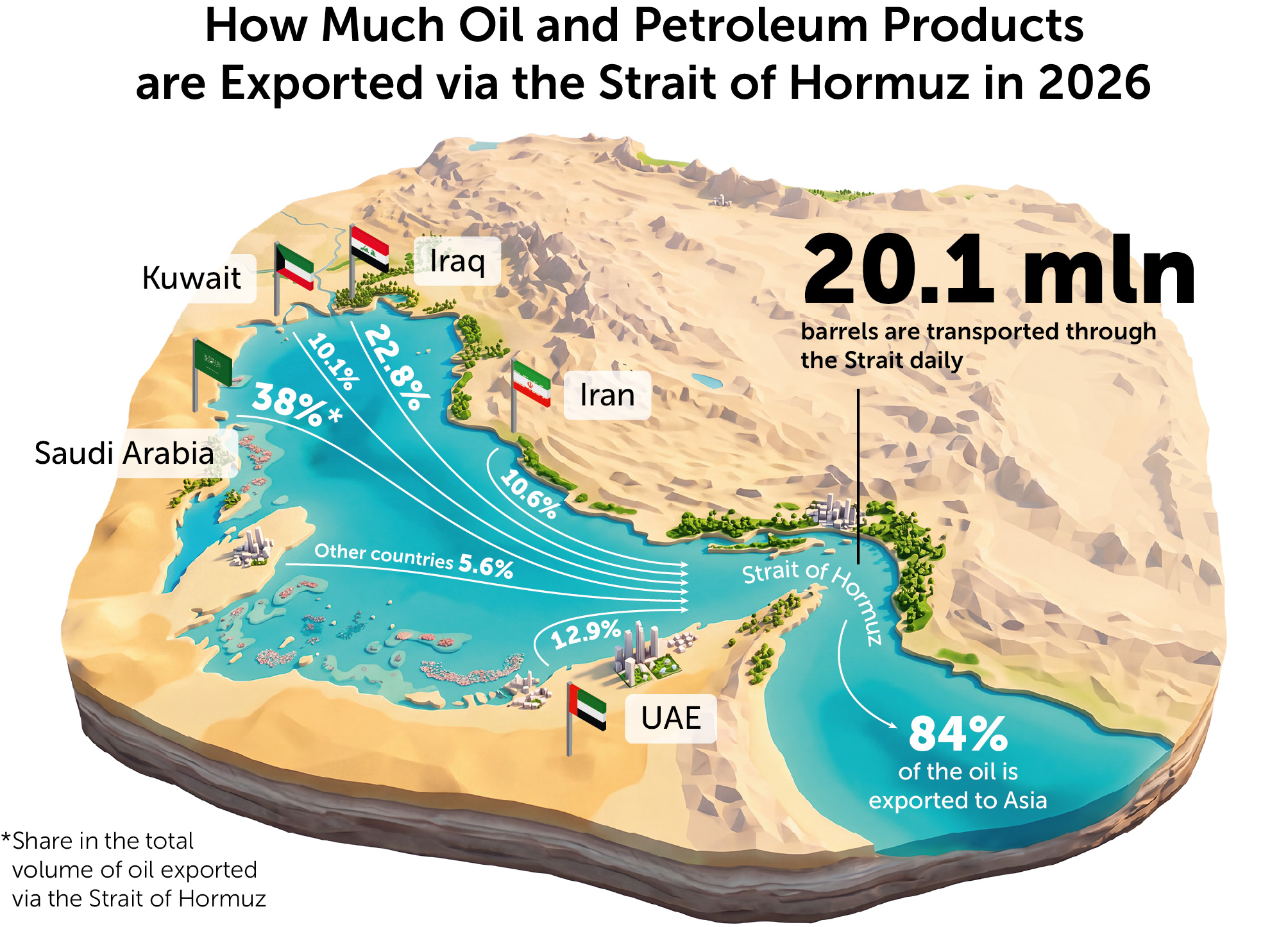
Let’s start with geography. The Strait of Hormuz separates the Arabian Peninsula from Iran and connects the Persian Gulf with the Gulf of Oman and the Arabian Sea. At its narrowest point, the distance from shore to shore in the Strait of Hormuz does not exceed 29 nautical miles (54 km). According to the International Energy Agency (IEA), up to 21 million barrels of crude oil and petroleum products were transported daily via this route in 2025 - accounting for around 26% of total global exports of these commodities.
Saudi Arabia and the United Arab Emirates have alternative supply routes. For Iraq, Kuwait, Qatar, Bahrain, and Iran, the Strait of Hormuz is the main export channel. The primary flows go through it to China, India, Japan, and South Korea - which are therefore the first to feel the impact of conflicts in the Gulf region.
Who Stands to Gain?
As a result of the Strait of Hormuz blockade, global oil supplies fell by more than 14 million barrels per day, according to IEA estimates. Due to the inability to export raw materials, oil‑producing countries in the region lost over $15.1 billion in export revenues in the first few weeks of the conflict alone. Oil production in Kuwait, the UAE, and Iran itself declined several‑fold.
The closure of the Strait also had significant consequences for global gas trade, as it is a key route for exports of liquefied natural gas (LNG) from Qatar and the UAE, which together account for nearly 20% of the global supply of this energy resource.
The US and European countries faced rising fuel prices in this situation. In the United States, the average price of gasoline rose from $2.7-2.8 per gallon at the beginning of the year to $4.50 in May, putting additional strain on household budgets.
The closure of the Strait of Hormuz indirectly intensified pressure on the market for critical minerals. Although the Gulf countries are not key producers of neodymium and dysprosium*, disruptions in sulfur supplies and rising costs of sulfuric acid increased the costs of processing a number of metals, including rare‑earth elements. Automakers, including Tesla (TSLA) and BYD (BYD), have postponed the launch of new models due to supply difficulties. Toyota’s (TM) sales fell by 5.8% YoY in March.
*Rare‑earth metals used in the production of magnets, including those for electric vehicles, wind turbines, and electronics
Bloomberg, a US news agency, and Nikkei, a Japanese analytical resource, directly linked this to the blockade of the Strait of Hormuz. Developing economies, including Turkey and Pakistan, are seeing increased inflationary pressure and depreciation of their national currencies. The closure of the Strait had the most severe impact on key Asian economies, which critically depend on oil supplies from the Persian Gulf.
According to some experts, the US military operation is primarily aimed in the context of broader geopolitics at weakening the Chinese economy. Due to the closure of major maritime transport corridors, China faces both the same challenges as other Southeast Asian countries - namely, disruptions in energy supplies - and problems in export of goods to Europe and other regions by sea.
The Strait of Hormuz crisis led to a 40% reduction in China’s oil imports: from February to May, supplies fell by 4.6 million barrels per day, according to the IEA.
What Lies Ahead?
According to Freedom analysts, oil prices could rise above $100 per barrel again if the Hormuz blockade continues, attacks on ships persist, and insurance and freight costs** rise. If the crisis drags on, prices will reach $120 per barrel or higher. If a sustainable ceasefire is achieved and transit is restored through Hormuz, oil prices will adjust to $65-80 per barrel, but will remain higher than they were before the US military operation against Iran due to a geopolitical premium of $10-15.
**The cost of transporting oil by tanker from seller to buyer
Against this backdrop, the UAE has stepped up the use of the Abu Dhabi Crude Oil Pipeline (ADCOP), a strategically important 360‑km pipeline linking the Habshan field with the Fujairah port on the Gulf of Oman. The UAE exports approximately 1.1 million barrels of oil per day via this route, mainly to Asia, and retains the capacity to handle additional volumes.
Saudi Arabia has its own pipeline connecting the Abqaiq field with the Yanbu al‑Bahr port on the Red Sea, from where the crude is shipped to Europe, the Mediterranean, and Asia. The system consists of two lines with a total design capacity of 5 million barrels per day. Before the 2026 crisis, the pipeline was operating well below its maximum capacity, as most of Saudi exports went through the Strait of Hormuz. After the conflict began, Saudi oil company Aramco increased throughput to 7 million barrels per day within eight days. Iran also has alternative routes.
In the Bushehr province, a pipeline to the Jask export terminal on the Gulf of Oman was officially launched in 2021; it was primarily used to ship oil to China. The transport artery’s capacity is 1 million barrels per day, but it cannot be operated at present because the port infrastructure is not yet complete and hostilities continue in the region.
On a Global Scale
The closure of the Strait of Hormuz affects not only the oil market, but the entire global economy: rising energy prices will increase business costs, accelerate inflation, and weaken consumer demand. The longer the blockade lasts, the more pronounced this effect becomes.
The World Bank has already lowered its forecast for global GDP growth in 2026 from 2.6% to 2.5%. At first glance, the difference is small, but on a global scale, it means hundreds of billions of dollars in lost output and weaker growth in incomes, investment, and employment. According to the Organisation for Economic Co‑operation and Development, if supply disruptions persist, global GDP growth could slow to 2.1% in 2026 and to 1.8% in 2027. In other words, economic growth would nearly stall: companies would invest less, consumers would spend more cautiously, and the risk of recession*** in individual countries would rise markedly.
***An economic downturn when companies produce and sell less, investment declines, and unemployment typically rises
Source: IEA analysis based on Kpler data