Financier №3 (43) 2026

Yeldar Shakenov
Analyst, Financial Analysis Department, Freedom Finance Global
Oil: Busting the Myths, Embracing the Reality
Separating Fact from Fiction with Objective Statistics
Oil myths are born from individual ideas that, in the public consciousness, begin to determine the prospects of the entire market. Over the past century, oil has been declared “about to run out” several times. In the early 1900s, the USA was particularly concerned about a potential shortage. In 2008, the price of a barrel climbed to nearly $150, and the idea of “peak oil” - the point at which production can no longer be increased - became a widespread fear. In April 2020, amid pandemic‑driven uncertainty, prices at one point dipped below zero. In this article, we will debunk the most common misconceptions surrounding this energy resource.
Myth 1. Oil Will Run Out Soon
It sounds convincing: oil is a finite resource, old fields are depleting, and demand is rising. So, one day the world will face empty wells. Indeed, once any given oil field reaches its peak output, its productivity declines. However, that does not mean the ability to increase production elsewhere is exhausted.
In the last century, the “black gold” repeatedly set new production records. In 1919, the US Geological Survey estimated that the country’s domestic oil reserves would last about 10 years; yet by the late 1920s, US production had more than doubled. In 1956, geologist Marion King Hubbert predicted that US production capacity would peak between 1965 and 1970. For conventional extraction methods, this forecast proved fairly accurate. In the 2000s, fears of an imminent production ceiling returned as oil prices hit new historical highs. However, in the 2020s the focus has shifted to a potential deficit of demand rather than a lack of supply.
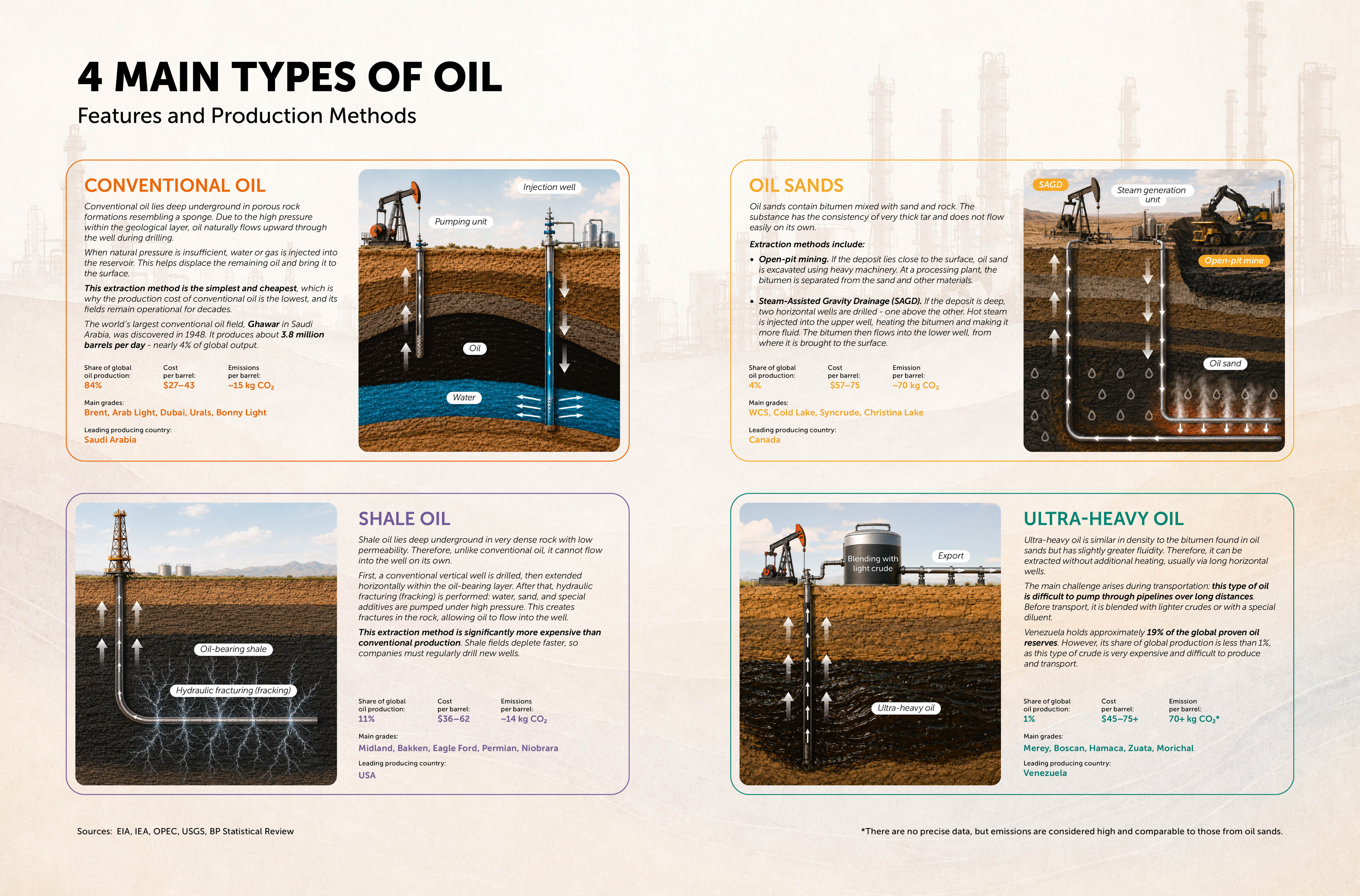
Trying to predict the next production milestone is largely pointless. Estimates of oil reserves evolve with prices, technology, further exploration, and infrastructure. After the production peak in 1970, US output declined for decades. The turning point came after 2008, when the development of shale production triggered a new growth phase. By 2023, the country reached approximately 12.9 million barrels per day - a new global high. A year later, shale formations accounted for about 60% of the country’s proven oil reserves.
So, it’s not that oil is running out - it’s that the mechanics of its production are changing.
One popular myth holds that oil comes from dinosaur remains. In fact, it formed from ancient plankton, algae, and other microscopic organic matter that accumulated on the ocean floor.
Myth 2. Someone Controls the Oil Market
When hydrocarbons rise in price, the media look for someone who “turned off the tap.” OPEC, Saudi Arabia, the USA, Russia, or multinational oil companies are often cast as the culprits. If oil becomes cheaper, it must mean someone “opened the valve” or launched a price war.
This stereotype has historical roots. In 1973–1974, the price of oil soared from $2.90 to $11.65 per barrel amid armed conflicts in the Middle East and OPEC actions. The world took note: oil can serve as a lever of influence in major geopolitical games.
But “influence” does not mean “total control.” As of end‑2024, OPEC countries held 79% of the global proven crude oil reserves but accounted for only 35% of global production. The real impact of OPEC agreements on the market is constrained by spare production capacity, which allows for a relatively quick increase in supply. In February 2025, such spare capacity was estimated at roughly 5.3 million barrels per day (about 5% of global demand), of which 3.1 million came from Saudi Arabia.
In April 2020, energy prices were driven not by geopolitics but by derivatives market dynamics and storage utilization. Futures contracts* for WTI crude fell below zero. Due to uncertainty linked to the spread of COVID‑19, demand collapsed, coinciding with contract expirations, while storage facilities in Cushing, Oklahoma - one of the world’s largest oil hubs - were 76% full. This shows that sometimes the price of oil depends not on OPEC’s will, but on the last available tank into which it can be pumped.
*An exchange‑traded contract granting the right to buy or sell an asset in the future at a predetermined price
Is oil always black? Not at all. It can be transparent, emerald green, amber, yellow, or even bright red. The colour depends on its chemical composition - the amount of resins, metal impurities, and sulfur.
Myth 3. High Prices Always Benefit Exporters
At first glance, it seems obvious: the higher the price per barrel, the more sellers earn. For Saudi Arabia, Russia, Iraq, or Kazakhstan, a rise in the Brent price means greater foreign exchange earnings, additional mineral extraction taxes, and, consequently, more revenue for the state budget. According to the World Monetary Fund, Saudi Arabia would need an average annual price of $92.3 per barrel in 2025 and $86.6 per barrel in 2026 to achieve fiscal balance.
At the same time, an exporter does not need the highest possible price - they need a price that buyers are willing to pay. Between 1979 and 1982, global oil consumption fell by about 10%, and demand for OPEC’s output dropped from 30 million barrels per day to below 20 million. In an effort to defend high prices, Saudi Arabia cut production from over 10 million barrels per day in 1980 to less than 2.5–3 million in 1985–1986, yet oil prices still collapsed.
The same logic played out in the 2010s: high oil prices spurred rapid development of US shale technologies and boosted investment in the industry, its infrastructure, and exploration. This increased supply and was one of the factors behind the 2014–2016 price crash.
Each oil super-cycle and the economic decisions made during it ultimately lead to its own undoing. Expensive oil brings exporters revenue today, but it also grows their competitors and creates problems for tomorrow.
Myth 4. Electric Vehicles Will End the Oil Era
Transport accounts for about 60% of global energy resource consumption, so rising EV sales appear to many as a direct threat to the oil industry. The logic seems clear: the more cars switch to electric power, the less gasoline and diesel will be needed. There is some truth to this.
According to the International Energy Agency (IEA), the global EV fleet in 2025 already helped avoid the consumption of about 1.7 million barrels of oil per day. EV sales continue to grow: in 2026, they may reach 23 million units, or roughly 28% of the global new passenger car market. Electrification is advancing especially fast in China, where the share of fully electric vehicles and plug‑in hybrids could approach 60% in new sales by year‑end.
However, electric vehicles are currently slowing the growth of oil demand rather than reducing it outright. The IEA estimates that global oil consumption continued to grow in 2025 by roughly 680–740 thousand barrels per day, and demand may rise in 2026 by another 700–760 thousand barrels. While advanced economies reduce fuel consumption, developing markets are expanding their vehicle fleets, freight volumes, and industrial output, offsetting much of this effect.
Moreover, oil is not just fuel for passenger cars. A significant share of demand comes from aviation, maritime shipping, freight transport, petrochemicals, plastics, fertilizers, and other chemical products. In many of these sectors, a full alternative to hydrocarbons either does not exist or remains prohibitively expensive.
Notably, even forecasts differ. The IEA expects demand growth to gradually slow as electric transport spreads, while OPEC forecasts global oil consumption to rise to about 120 million barrels per day by 2050, citing population growth, economic expansion, and rising energy use.
Thus, electric vehicles do not eliminate oil - they change how it is used. Like many earlier technological shifts, the energy transition does not instantly destroy the market; it forces it to adapt gradually. Therefore, talk of an imminent “end of the oil era” seems more like an exaggeration than a reflection of current global trends.
Myth 5. The History of the Oil Market Is Linear
The biggest myth about the hydrocarbon market is that it follows simple logic. In the 1970s, it seemed that hydrocarbon producers had taken control of the world. In 2008, it was believed that production had hit a geological limit. Between 2014 and 2016, many thought that “shale” had killed the traditional industry. In the 2020s, a common view emerged that the energy transition would either quickly “bury” oil or fail.
However, the real history of oil is non‑linear. Its core principle is adaptation - through new fields, technologies, routes, forms of demand, political risks, and the industry’s drive to keep pace with, or even slightly outpace, the times.
Oil should not be mythologized as either an eternal curse, an endless source of wealth, or a relic on its way out. The black gold market has been and remains a complex and flexible system capable of reshaping itself to meet new economic, technological, and political conditions.