
Financier №4 (40) 2025

Aliyar Akymgaliyev
Analyst Freedom Broker
Each According to Their Needs
Key Trends in Mobile App Development
According to the StatCounter analytics platform, in July 2025, mobile devices accounted for 60.5% of global internet traffic, while desktop devices accounted for 39.5%. This trend began in 2016 and has been growing slowly but steadily. Super apps—mobile services that combine messaging, marketplace services, and financial management functions—play a key role in this process.
Definition of Concepts
The “super app” concept was coined in 2010 by Michalis Lazaridis, founder of the Canadian company BlackBerry. Currently, according to Accenture, there are more than 30 platform companies worldwide whose products can be characterized as super apps (or are striving to become so). Deloitte experts, one of the world’s largest audit firms, have identified four key characteristics of super apps. These include a large number of diverse services, a shared platform for multiple needs, a convenient transaction method, and data exchange between services.
According to Gartner, the 15 most popular super apps worldwide have been downloaded more than 4.6 billion times, and the number of their monthly active users exceeded 2.7 billion by the end of 2024. Future Market Insights estimates that the global super app market will reach $887 billion by 2033.
At launch, a super app typically has one basic function, but the number of functions gradually increases as the user base expands. New opportunities often emerge through the involvement of partner services: a financial company can partner with a marketplace or taxi service and begin selling its services on the partner’s platform. The main source of income comes from fees earned from third-party partners.
Platform Leaders
There are numerous examples of super apps in the modern world. These are services created at different times, with different goals, and for different markets, but united by their versatility.
- Launched by Tencent (TCEHY) in 2011, WeChat began as a messaging app and has since grown into China’s largest digital ecosystem, with 1.3 billion users, connecting individuals with government services and businesses. The integrated WeChat Pay wallet has significantly simplified money transfers, microloans, and purchase payments, including the use of QR codes. A large number of mini-apps have made WeChat an integral part of the digital economy. Users can make purchases, pay taxes, order taxis, schedule medical appointments, trade on the stock market, and more. Today, over 90% of mobile transactions in China are processed through WeChat Pay. The company has more than 3 million partners, and their payments are processed subject to fees of up to 3%.
- The M-Pesa platform, created by Kenyan operator Safaricom, ushered in a financial revolution in Africa. Launched in 2007 as an SMS-based money transfer service, it paved the way for electronic payments for millions of people without bank accounts. For many African users, the mobile phone became their first banking product, and the M-Pesa agent network became the first equivalent of a bank branch. Currently, tens of billions of US dollars in transactions are processed annually, and the share of cashless payments exceeds 80% in the region. The service has since been expanded to include banking and insurance products. It generates a third of Safaricom’s revenue. An ecosystem of financial startups has formed around the platform, making M-Pesa not only a payment solution, but also a driver of social and economic development in East Africa.
- Kazakhstan’s Freedom SuperApp was launched in early 2024. It integrates banking, brokerage, insurance, and proprietary telecom infrastructure. Customers can open accounts, apply for loans, invest, pay for services, and even connect to the internet. Everything is online and integrated with government databases. Thanks to automated processes, mortgage approval takes 24 hours, and car loan processing takes no more than 12 hours. By October 2025, the number of the SuperApp’s Monthly Active Users (MAUs) approached 1.6 million, and its audience is growing at a double-digit rate.
- The Indonesian platform Gojek launched in 2015 as a motorcycle taxi booking service and now operates its proprietary payment system, offers food delivery and a variety of other services.
- Singapore-based Grab expanded from a ride-hailing platform that initially focused on scooter and bicycle rentals. Subsequently, it added hotel booking and insurance features. Today, Grab controls a significant share of the food delivery market in Southeast Asia.
- The South Korean platform Kakao emerged in 2010 as a messaging app and social network. Today, the platform offers a wide range of services, including financial ones, and its user base is estimated at 87% of South Korea’s adult population.
Transferable World
Financial services have become a common feature of all super apps.
Today, 80% of online payments in Asia are processed through mobile wallets. Africa is quickly catching up in this regard: the mobile money market there has grown to $1.6 trillion, and the number of users has exceeded 500 million. In Europe, only about 40% of total online transactions are processed through mobile wallets.
The key drivers behind the growing popularity of smartphone payments include the transition to cashless transactions, the widespread adoption of QR and NFC payments, the development of open APIs, and the integration of financial functions into social networks, marketplaces, and, of course, super apps.
According to estimates by the GSM Association (GSMA) and Worldpay, by 2030 the volume of transactions through digital wallets will more than double compared with 2024 levels and exceed $33 trillion. The share of wallets will grow to 50% in e-commerce and to 30% in offline purchases. At the same time, risks for super apps are increasing: regulators are requiring owners of mobile financial services to comply with bank-grade standards for compliance and data protection.
Telecom Transformation
Traditional telecoms have entered a maturity phase: communication revenues are growing slowly, and competition for customers is intensifying. The development of super apps will drive further growth in mobile traffic.
According to Deloitte, a dominant super app similar to WeChat will not emerge in the West. Instead, the market will be divided among several players, each of whom will have to compete for users. Services focused on specific niche areas, such as car maintenance or home care, are likely to be in demand.
Cryptocurrency will be another important factor in the development of super apps. Demand for cryptocurrency and related services is growing, so the first platform to offer stable crypto transactions will certainly attract strong user interest.
Mobile operators are capable of becoming active players in the super app market, as demonstrated by M-Pesa. Typically, a mobile operator has thousands of points of sale and partner offices through which payments and transfers are processed. Telecom companies are already actively collaborating with banks and FinTech startups, creating shared ecosystems and joining forces to develop digital wallets, insurance products, and online lending. The convergence of financial and communications services could become a strong foundation for the development of new super apps, providing the combined sectors with additional growth drivers.
However, even if mobile operators do not enter this market en masse, competition will still intensify, guaranteeing further growth in mobile internet traffic.
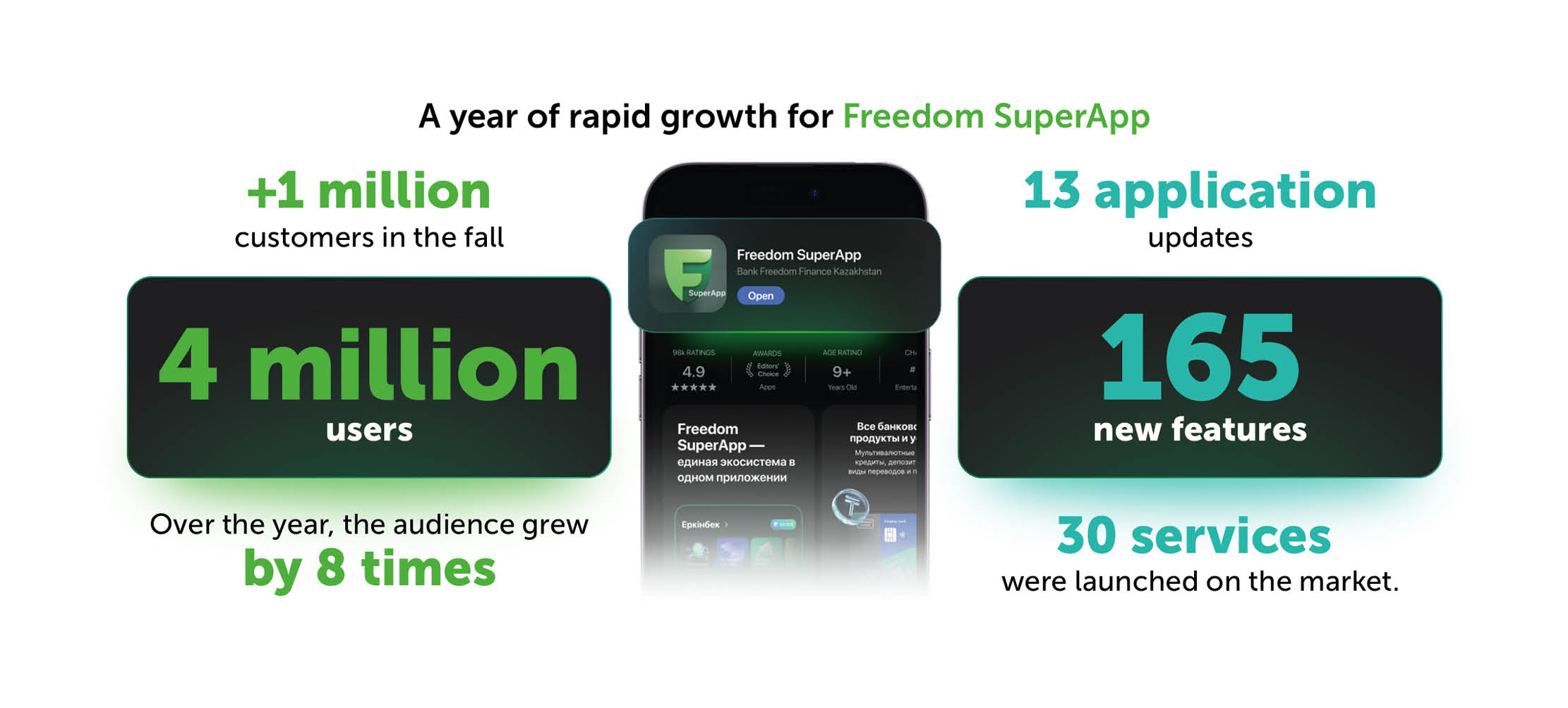
Source: Freedom Bank