
Financier №4 (40) 2025

Alexander Sadchikov
senior personal manager, Freedom Broker
Payment upon Delivery
How Dividend Policy Works in the Communications Industry
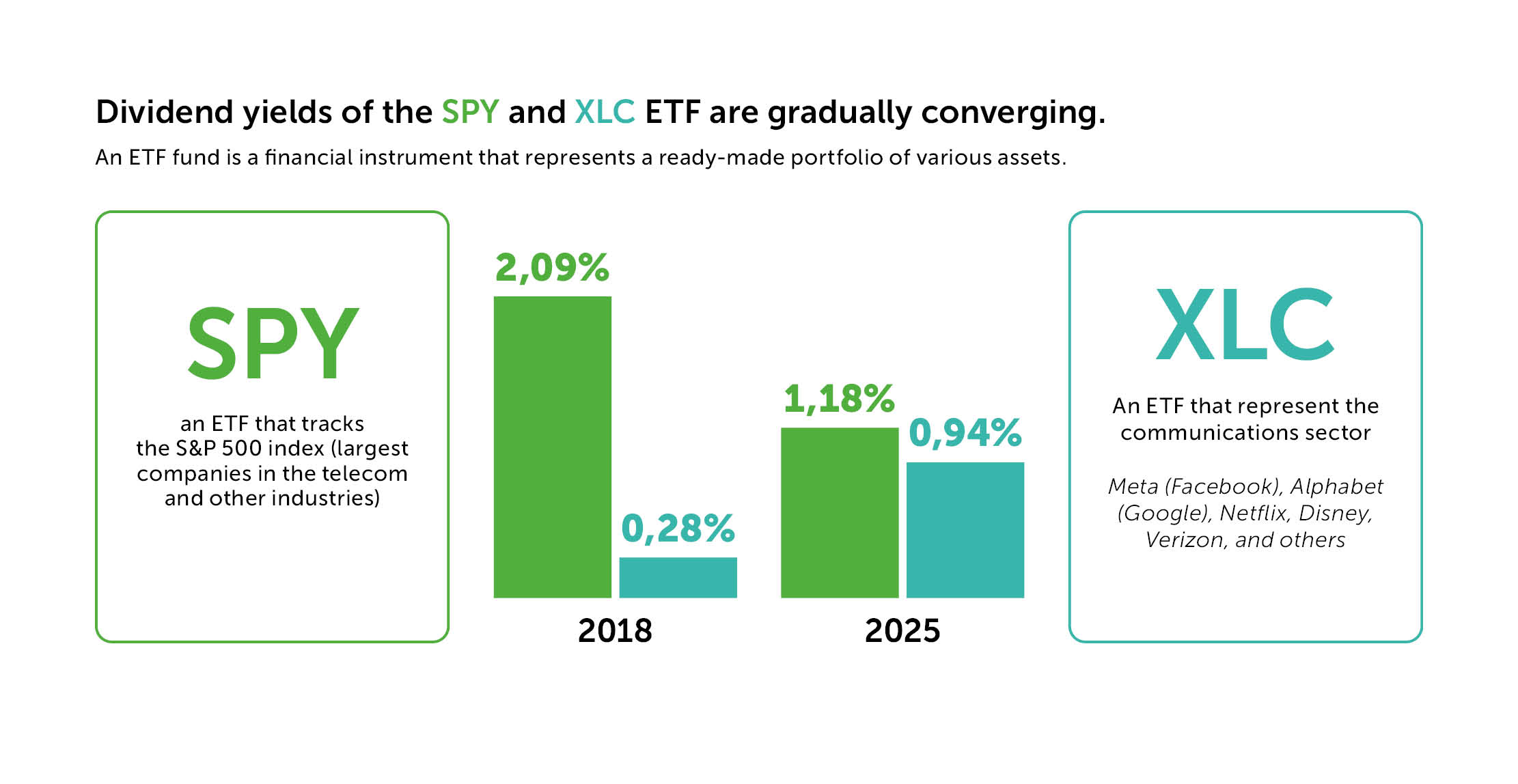
The Communications Services Select Sector Index, which includes all the leading US telecommunications stocks, has risen by 20% since the start of 2025. However, in terms of profit distribution, the sector appears significantly weaker than most others. So what is stopping telecom companies from allocating more funds to dividends, and which companies, despite this, maintain high payouts?
The US telecommunications market will be worth $530.6 billion in 2029
Innovation versus Dividends
Communications technologies quickly become obsolete and require regular upgrades. What was considered cutting-edge yesterday may be irrelevant today and completely obsolete tomorrow. To stay afloat, telecommunications companies must continually invest a significant portion of their profits in development.
Over the past 25 years, the share of capital expenditures in the revenue of Verizon (VZ), one of the world’s largest telecom companies, has never fallen below 13%. By comparison, in retail and FMCG, development expenses account for 3–4% of revenue.
However, the return timelines for investments in the industry are quite long. According to estimates by research firm FarrPoint, investments in 4G communication networks in 2008–2012 paid off over 7–9 years. Current investments in 5G networks will not be recouped for at least eight to ten years due to rising equipment costs. Meanwhile, global spending on deploying fifth-generation networks is projected to reach $1.1 trillion by 2025.
The introduction of new communication standards is not leading to a sharp increase in provider revenue. This is because consumers are not willing to pay significantly more for slightly higher speeds. A study by consulting firm IDC showed that telecom operators’ Average Revenue Per User (ARPU) grew by only 2% in 2024, reaching approximately $28 per month.
According to IDC analysts, companies in the sector are facing a difficult choice between investing significant amounts in equipment upgrades and delivering strong results to shareholders. As a result, investors increasingly view shares in this industry as a conservative way to preserve capital. Meanwhile, only the leaders in the sector, including AT&T (T), Verizon (VZ), Comcast (CMCSA), and Vodafone (VOD), offer the high dividend yields typically associated with defensive assets. These companies distributed over 35% of their net profit to shareholders in 2024.
5G networks are available in 68% of the United States, making it one of the global leaders in this area
Vodafone: Hope of Tomorrow
The European company Vodafone distributes dividends to its shareholders twice a year. In 2025, the company is projected to pay $0.55 per ADR (American Depositary Receipts), representing a yield of 4.8% per annum.
The company currently lacks the ability to significantly increase dividend payments. Its priorities include business development and reducing its debt burden, which reached €53 billion at the end of the last financial year. At the same time, Vodafone’s revenue has declined by 25% over the past nine years, averaging €37.45 billion annually. The company has exited some European markets, and investments in expansion in Africa and Turkey have not yet offset the losses.
Despite these difficulties, investor interest in the company’s shares remains strong. Since the beginning of the year, its share price has risen by 30%, returning to its highest level since mid-2023. Nevertheless, the issuer still appears undervalued: the P/B multiple (market capitalization to net asset value ratio) is 0.5. This means the company is trading at almost half the value of its equity. The introduction of new communication formats and the development of telecoms in Africa raise hopes for an increase in Vodafone’s dividend in the coming years.
AT&T: Expecting Profits
AT&T shares were among the most attractive dividend stocks for investors who bought them in the summer of 2023. At that time, the stock yielded almost 8% annually. Now, they are no longer as attractive: the share price has nearly doubled, and the dividend yield has fallen to around 4.3% annually.
The company distributes 58% of its total profits to investors on a quarterly basis. However, the payments have not been increased for a long time: their total annual amount has remained unchanged at $0.2775 per share since 2022. A dividend increase will not be possible until the telecom operator recovers from the aftermath of its failed attempt to launch its own streaming service, WarnerMedia, which was ultimately transferred to Warner Bros. Discovery (WBD). AT&T’s Board of Directors plans to distribute $1.11 per share annually to shareholders; however, to do so, the company must achieve significant and consistent growth in net income.
Verizon: In the Interests of Shareholders
Verizon Communications allocates over 60% of its net profit to dividend payments to shareholders. Over the past five years, the company’s dividend has grown by 12% to $0.69 per share, equivalent to a 6.8% annual return. Verizon’s stock price has fluctuated widely between $38 and $46 since 2023. The company faces a common telecom industry problem: its debt exceeded $144 billion at the end of 2024, and annual interest payments amounted to over $6.5 billion. Moreover, the company allocated over $11 billion to dividend payments based on last year’s results.
In November 2025, Verizon announced an agreement with Amazon Web Services (AWS) to develop next-generation AI technology aimed at rebuilding its network infrastructure and significantly reducing costs. Analysts at audit firm McKinsey believe that Verizon’s focus on advanced technology will allow it to maintain high profitability and ensure stable dividend payments.
Small Record-Breakers
There are companies offering returns approaching double-digit levels in the telecommunications industry, including ATN International (ATNI) and Cogent Communications Holdings (CCOI). However, these are relatively small players with weak financial results, making the sustainability of their dividend policies highly questionable.
Internet service provider Cogent has annual revenue of approximately $1 billion, debt of $1.7 billion, and a dividend yield of 10.6% per annum. The company’s stock price has fallen nearly threefold over the past year. The market reaction was particularly sharp following the issuer’s Q3 2025 report, in which results deteriorated significantly due to a declining subscriber base.
The situation is no better for ATN, a highly diversified company operating in the US, Caribbean, and Bermuda markets. This year, its dividend yield approached 8% per annum due to a decline in market capitalization. The company’s revenue has been falling since 2023, while expenses continue to rise. Total debt stands at $600 million, and 85% of annual revenue is spent on interest payments alone.
A high dividend yield in telecoms should not be viewed as a clear signal to immediately buy a stock. Rather, it is a reason to explore why a company is bucking the industry trend.
Source: multpl.com