
Investment Review №350. A Shift in Priorities
Corporate News in Focus of Our Analysts
Alphabet
Alphabet (GOOGL) reported strong results for Q2 2026, driven by a sharp acceleration in Google Cloud’s growth. Segment revenue surged 82% YoY to $24.8bn, while operating income more than tripled to $8.8bn. The margin increased from 20.7% to 35.6%, and the backlog reached $514bn. Growth was driven by strong demand for enterprise AI solutions and infrastructure, as well as the start of TPU system shipments to customers. However, investments in computing capacity ramp-up offset the positive factors: CAPEX nearly doubled to $44.9bn, causing FCF to decline from a positive $5.3bn to a negative $5.9bn. Moreover, Alphabet raised its 2026 CAPEX guidance to $195–205bn and warned of further significant cost increases in 2027. Thus, the robust acceleration in the Cloud business is currently being offset by massive AI infrastructure expenditures.
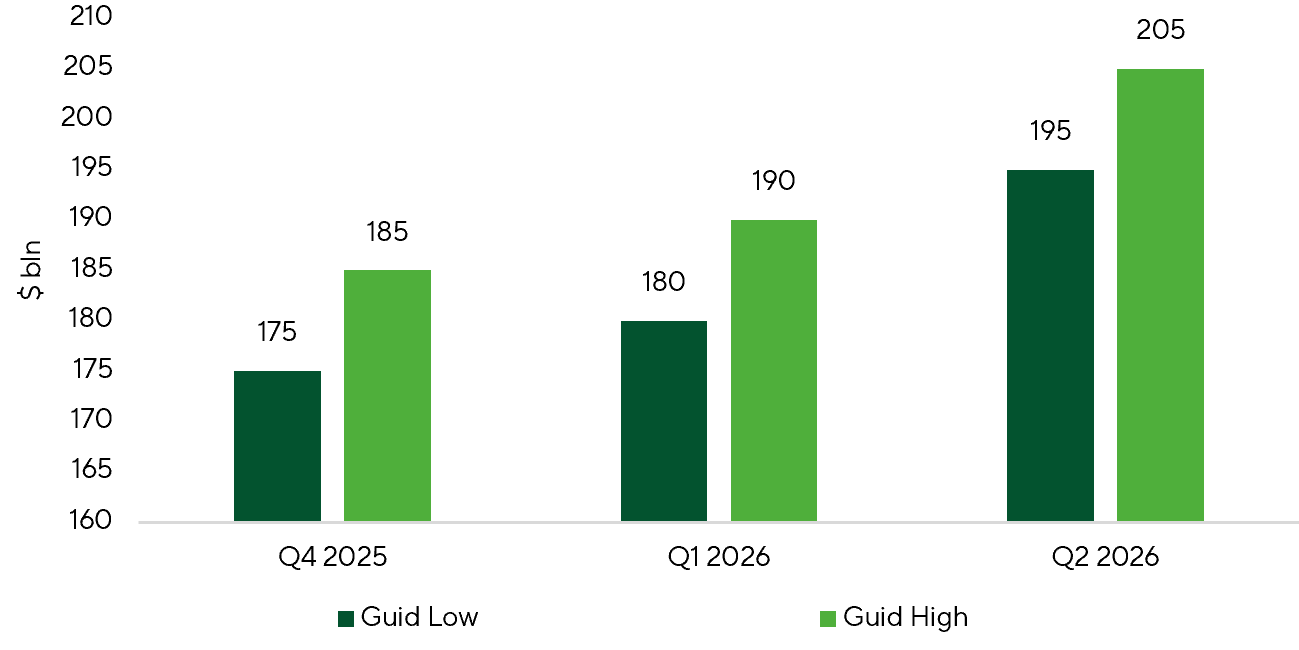
Management's Forecast for Capital Expenditures for 2026
Source: FactSet
Lockheed Martin
Lockheed Martin (LMT) reported strong Q2 2026 results, delivering top-line and bottom-line beats and raising its full-year outlook. Revenue rose 11% YoY to $20.1bn, and adjusted EPS came in at $7.9. The improvement is partly driven by a low base following significant write-downs a year earlier. The main positive was a record influx of orders. The company secured approximately $65bn in new contracts, and its order backlog expanded to $230.4bn, strengthening visibility into future revenue. The main inputs were made by THAAD, PAC-3, and the Precision Strike Missile. The Missiles and Fire Control division was the best performer, with revenue up 19% and operating income rising 24%. Meanwhile, the Aeronautics segment remains a weak point: F-35 deliveries fell to 19 aircraft, down from 50 a year earlier, and the risk of further adjustments persists. The upward forecast revision confirms sustained demand, but further growth will depend on whether F-35 deliveries rebound and if the record order backlog converts into revenue and cash flow. We expect LMT shares to rise to $628 and assign a “Buy” rating.
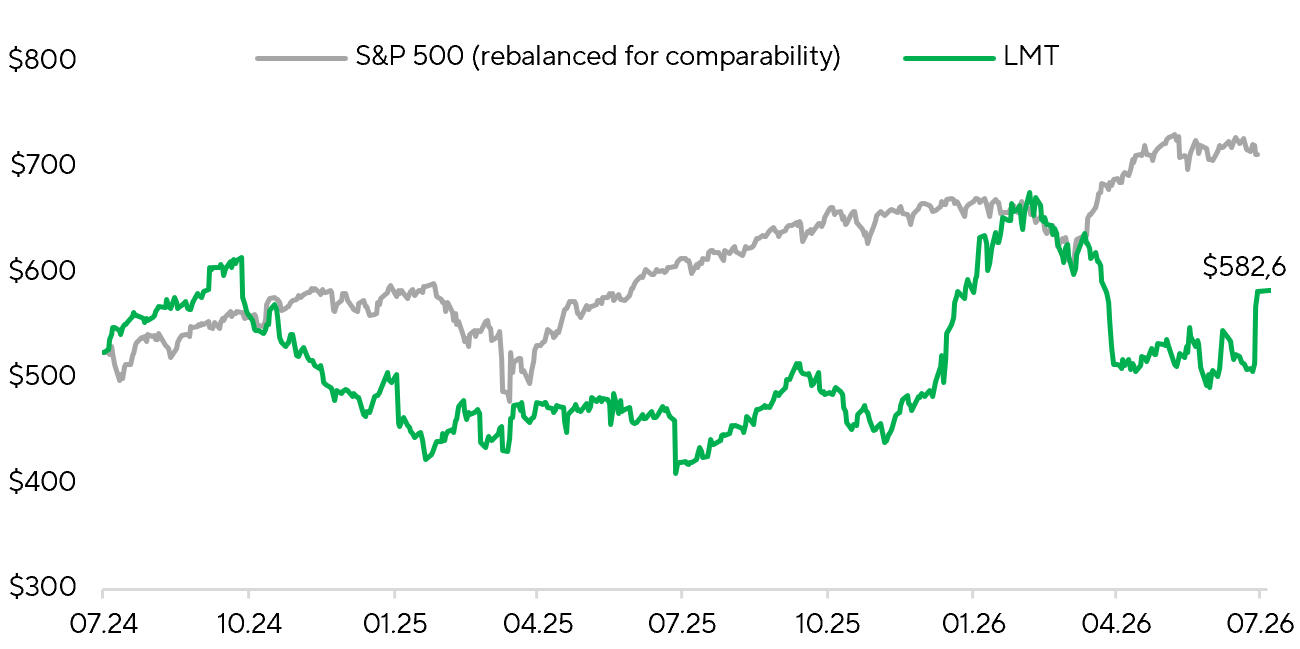
Stock Performance: Lockheed Martin vs. S&P 500
Source: FactSet
American Express
American Express (AXP) reported Q2 2026 results generally in line with expectations. Provisions surprised to the upside and supported the results, while a tax increase limited EPS growth. Management moderately raised its 2026 revenue guidance, regardless of the pressure exerted by the sale of the co-branded card portfolio but kept its EPS outlook unchanged. This reflects plans to increase investment in technology, marketing, and international expansion to drive customer base growth and experience improvements. To achieve this, the company may admit short-term EPS pressures. In the long term, management continues to target revenue growth of over 10% and EPS expansion of around 15% per year. The development of deposit products could serve as an incremental growth driver, as only about 10% of U.S. cardholders have deposit accounts. The market reacted negatively to the report: shares lost more than 4%, likely due to the company maintaining its EPS forecast amid rising investment costs. The forward P/E fell to 17.5x from 21x at the beginning of the year.
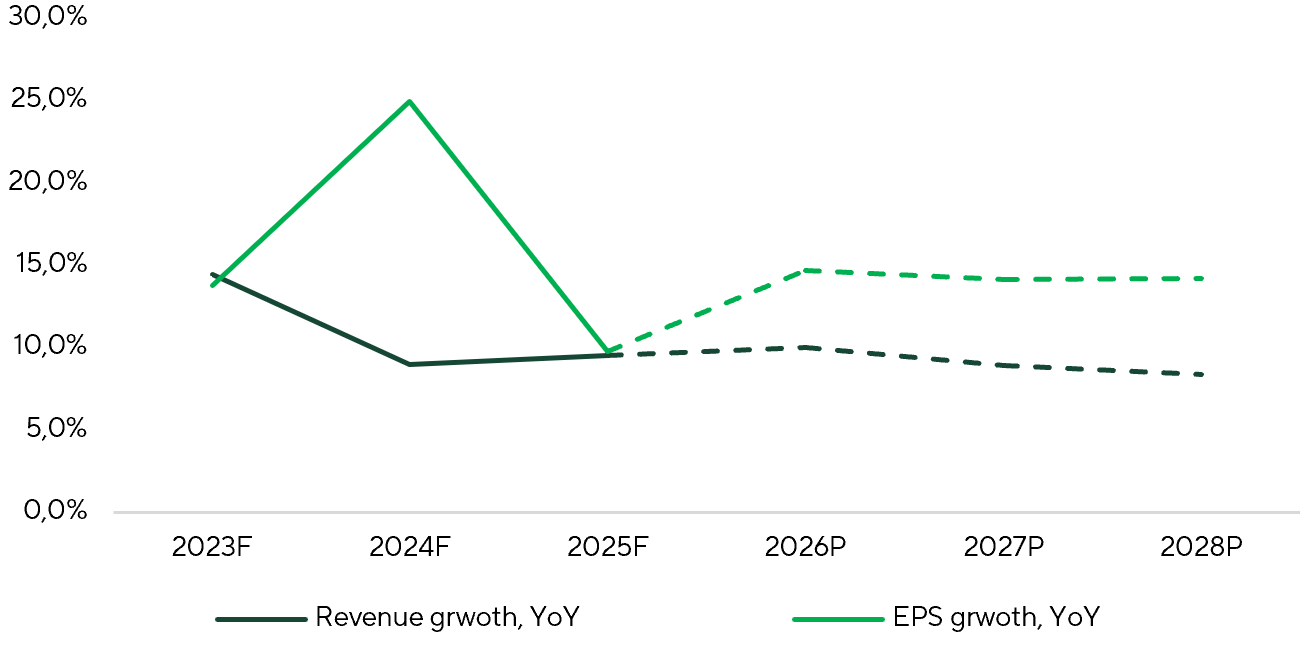
Revenue and EPS
Sources: FactSet, Freedom Broker analysis
Intel
On July 23, Intel Corp. (INTC) reported its quarterly results, which surpassed both the company’s guidance and market expectations. The company posted its highest revenue growth rate in more than 15 years, with the server segment driving the majority of that growth. Demand from the AI infrastructure sector consistently outpaces supply, and the company is profiting primarily from price increases and sales mix shifts, rather than from higher volumes. In the client business, shipments are declining, with part of capacity being deliberately redirected to server processors. Intel’s 18A process technology is being developed ahead of internal schedules, and 14A is on track, but for two quarters straight, the company has not provided information about external customers for advanced nodes, which is a key investor concern. The Q3 outlook and the increased CAPEX guidance exceeded consensus, but the lack of visibility regarding demand for new production capacity remains as much of a concern for investors as the loss of market share in key business segments. As a result, INTC shares declined 2.4% on July 24.
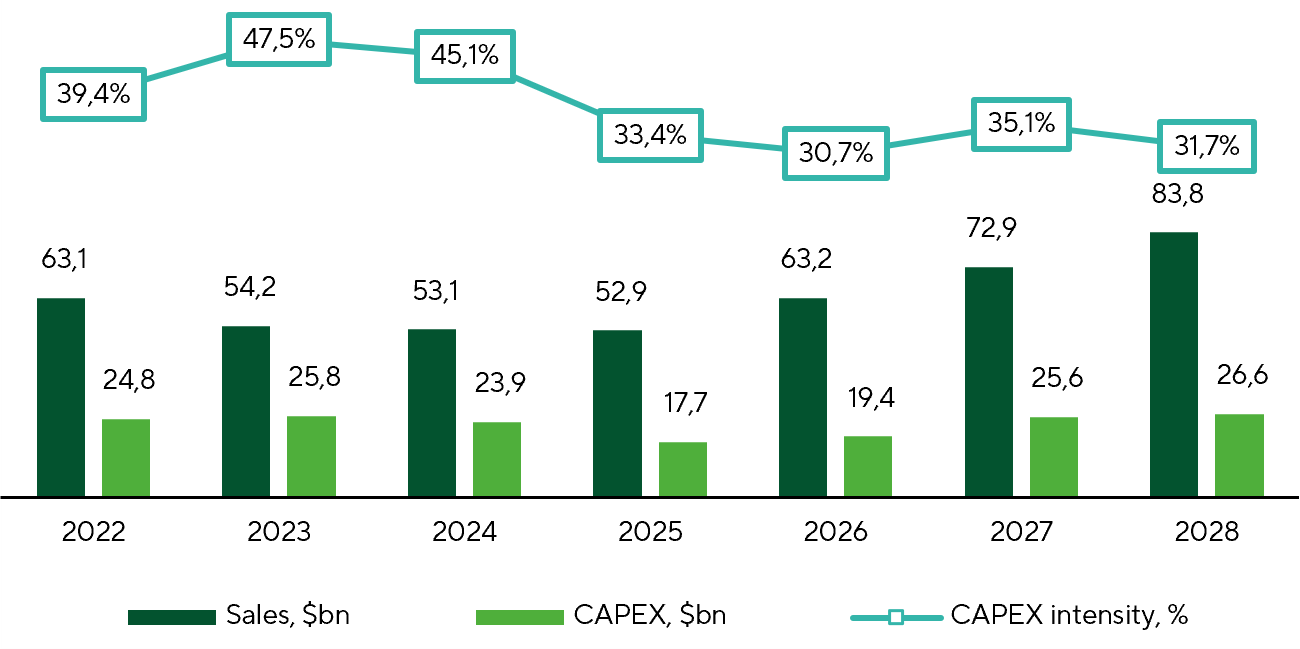
Key Financial Metrics for Intel Corp. (INTC)
Sources: Intel, FactSet, Freedom Broker
AT&T, Verizon, T-Mobile, Comcast, Charter
In Q2, the largest U.S. wireless services operators continued to increase their services revenue and EBITDA amid steady demand for mobile connections and broadband access. Cable companies, contrarily, continue to underperform in traditional broadband and video services, partially offsetting this by rapid growth in mobile services. AT&T (T) achieved quality growth: consolidated revenue increased 2.3% YoY to $31.6bn. In the Advanced Connectivity segment, services revenue grew 5.1% to $23.5bn, and EBITDA rose 8% to $12.0bn.
Net internet connections totaled 646k, including 367k fiber and 279k FWA. FCF reached $4.7bn, allowing the company to reaffirm its 2026 forecast—$18bn or more—and continue deleveraging. Verizon (VZ) also posted strong results, with Mobility & Broadband revenue up 2.8% YoY and the broadband subscriber base increasing by 348k, including 193k FWA and 155k fiber connections, bringing the total to 17.1m. Net postpaid voice additions exceeded 550k.
Adjusted EBITDA reached a record $13.7bn with a 40.1% margin (+7.2% YoY). Despite a decline in net income due to non-operating factors, the company raised its FCF growth forecast to 9–10% YoY. T-Mobile (TMUS) remained the growth and margin leader: core adjusted EBITDA increased 12% YoY to $9.5bn driven by double-digit growth in service revenue, postpaid, and FWA. The company reaffirmed its EBITDA guidance at $37.1–37.5bn and raised its adjusted FCF outlook to $18.4–18.8bn.
Comcast (CMCSA) and Charter (CHTR) continue to lose fixed-line customers. Comcast lost 167k broadband subscribers and 280k video users but added 448k mobile lines. Charter lost 172k internet subscribers, maintaining CAPEX at $2.9bn and focusing on network upgrades and its mobile business.
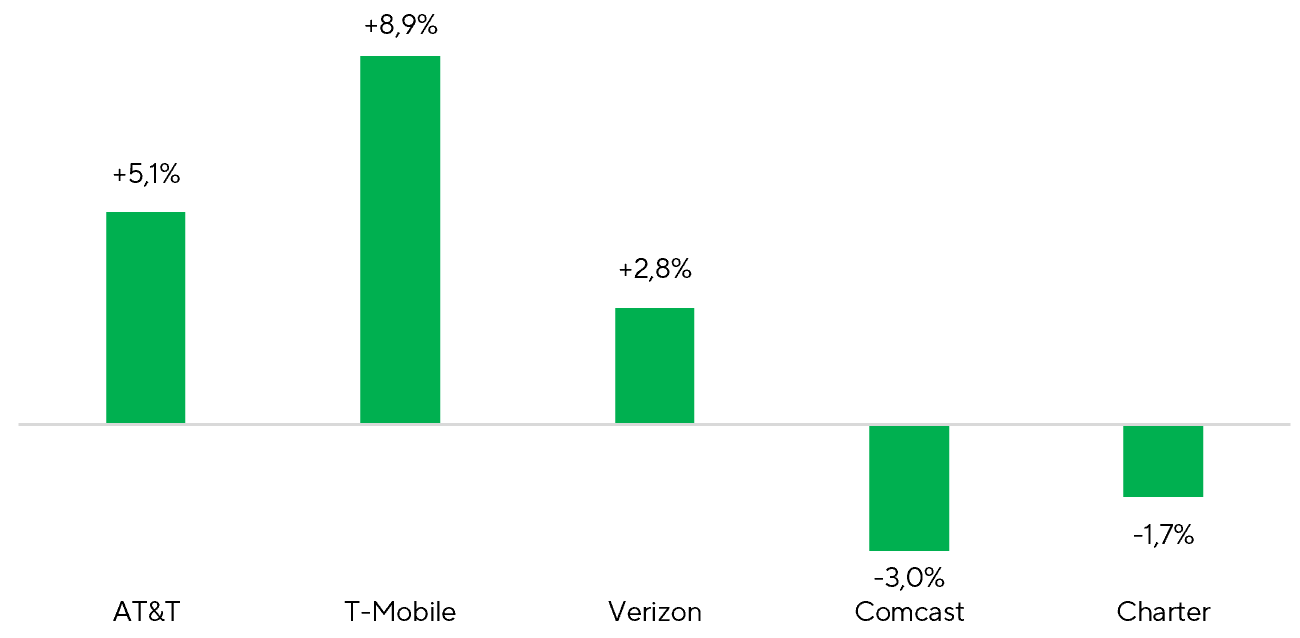
Revenue Trends for Telecommunications Services in 2Q 2026
Source: FactSet, Freedom Broker analysis
Note: For AT&T — growth in the Advanced Connectivity segment; for T-Mobile — service revenue; for Verizon — Mobility & Broadband; for Comcast — Connectivity & Platforms; for Charter — total revenue