
Financier №2 (42) 2026
Guest of the issue: Peter Tuchman
“Pilots spend hundreds of hours in training before flying solo. The same should apply to investing”
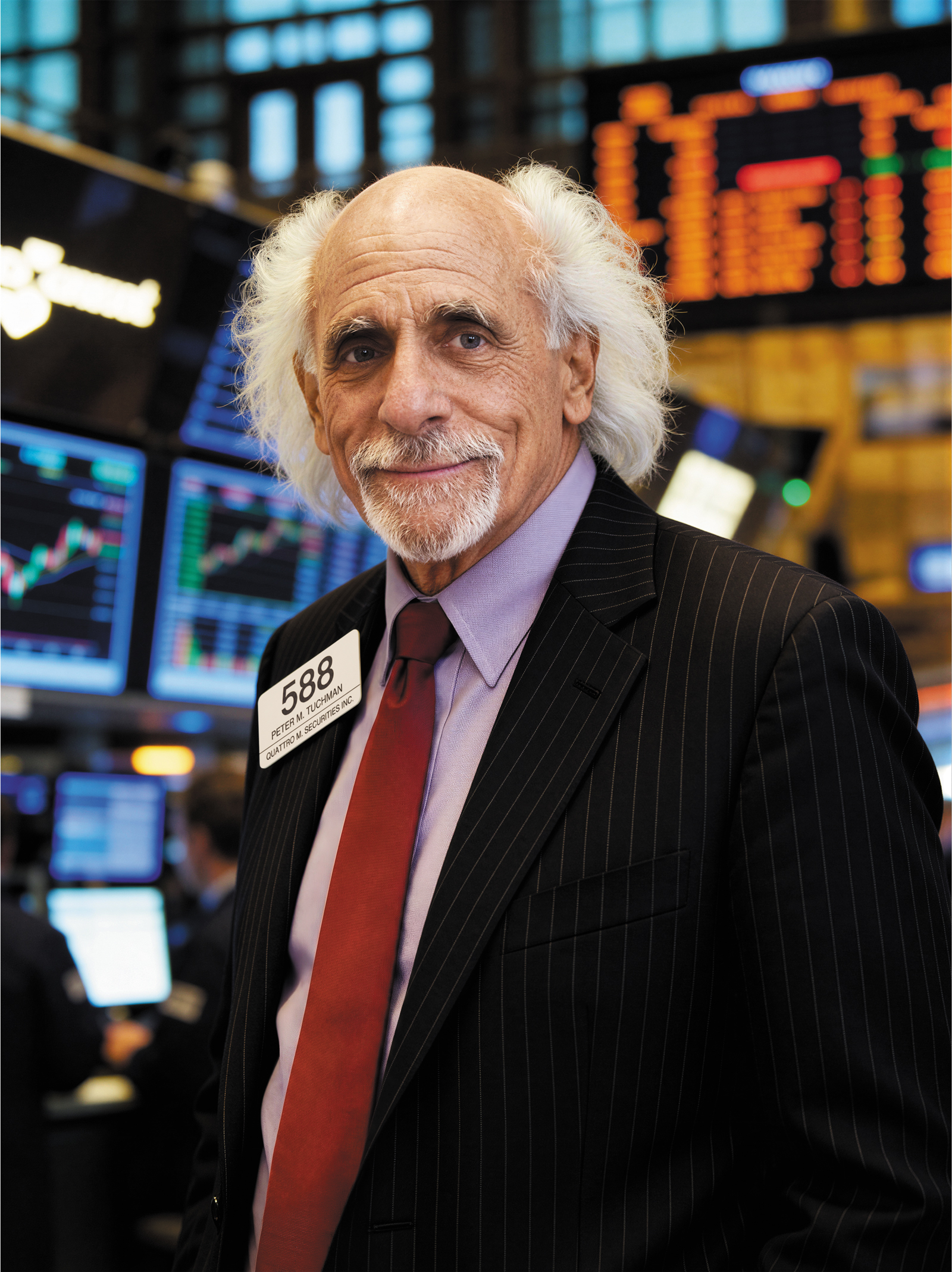
An exclusive interview with Peter Tuchman — a professional with over 40 years of experience at the New York Stock Exchange. His unique appearance has earned him the nickname "Einstein of Wall Street" and he's considered the most photogenic trader. Behind his striking appearance lies a professional who has survived every major stock market crisis.
Peter, how did you get to Wall Street?
I joined the NYSE in 1985. On March 28, I marked my 41st year as a trader. Back then, the exchange employed about 7 thousand people and had five trading floors. We traded thousands of shares. Transactions were executed by shouting out orders and recorded on paper. Scraps of paper littered the floors — they had to be swept several times a day.
Orders came in by phone: a clerk would pass them to a broker. For example, an order would arrive: “Buy 50 thousand IBM shares at $132”. The broker would go into the “crowd”, interact with traders and market makers, and execute the order.
After the trade, he’d record all details — time, volume, counterparty’s name — and come back to pass this information to me. I’d input the data into a teletype machine for clearing. Then the paper was handed to an employee who sent it via a pneumatic tube to the 17th floor. There, the data was re-entered and a quote feed was formed, which was distributed throughout the world.
When my summer internship as a teletype operator ended, I realised this was my place. I was offered a permanent position and became a clerk.
We’re speaking literally the day after the truce announcement (between the US and Iran — Ed.). Markets surged. You’ve lived through many volatile days on Wall Street. Let’s recall Black Monday of 1987. What do you remember about it, and what lessons did you take away?
I’m probably the only broker still active today who’s lived through every crisis over the past four decades. I survived the 1987 crash, the dot‑com bubble of 2000, the 2007–2008 financial crisis, and COVID… Then came the March–April 2024 correction and, of course, last year’s “tariff” downturn.
By the time of the 1987 crash, I was working at Cowen & Co. with institutional and retail clients. That Monday, October 19, the market just collapsed. The electronic DOT system was already in place, and orders flooded in. I spent hours executing sell orders: “Sell 500”, “Sell 500”… Everything was for sale! We were trading Digital Equipment shares: they opened at $168 that day and closed at $48.
Back then, there were so‑called two‑dollar brokers — independent intermediaries handling overflow orders. I had a couple of dozen of them. These brokers were shouting that day: “Sell 100 thousand!” — with no negotiation. Everyone was just dumping assets.
Market makers were supposed to maintain liquidity when there was no other demand, but by 11:30–12:00, all buyers simply vanished. It became clear the market was in free fall. The Dow lost thousands of points. Many companies went bankrupt that evening; many had to merge because they lacked the capital to keep operating.
I was still a clerk then. I remember the expressions on my fellow brokers’ faces — the tension was immense. Instructions from above were simple: “Sell, no questions asked”. Brokers went into the trading “crowd” — no negotiations, no price discussions. There was no usual dialogue about buy or sell prices. Everything came down to commands: “Sell at market”, “Sell immediately, give me a price”. After hitting the price bottom, some stocks started to be bought back. But for every executed order, new sellers emerged. There was practically no respite.
Usually, during such sell‑offs, there’s at least a so‑called dead cat bounce during the day. But that day, there was nothing of the sort.
I’ve lived through all the crises since then, but the fear and tension of that day are unmatched.
This issue is dedicated to generational change in the stock market. In your opinion, what truly changes over time, and what remains constant?
That’s a good question. What doesn’t change is the fundamental integrity of the market. We have a principle: “Our word is our bond”. Regardless of whether the market is rising or falling, whether there are crises or rallies, honesty, relationships between participants, and pricing principles remain unchanged. We never deviate from our main goal: to secure the best possible price for the client when executing a trade.
The changes are primarily tied to the aftermath of COVID, one effect of which was the “democratisation” of trading and investing. Before, you had to be an accredited investor to trade on the market. For example, if you worked with Merrill Lynch or Smith Barney, you had to prove that even a total loss of your investment wouldn’t affect your standard of living for five years. This made the exchange closed and elitist.
There weren’t tens of millions of young retail investors. Your parents and grandparents might have invested in pension savings, but the market itself was isolated from the general public.
With the advent of apps like Webull and Robinhood, the situation has changed. Anyone with an iPhone and $100 could become an investor. This made the market accessible to everyone — regardless of income or status.
The problem was that these apps lacked an educational component. People weren’t warned about risks. It’s like putting someone without training in the pilot’s seat. In reality, pilots spend hundreds of hours in training before flying solo. The same should apply to investing — after all, we’re talking about money and standard of living. As a result, millions of new investors entered the market, and many of them lost money, learning a painful lesson. But the good news is that many came back — now more experienced.
I myself teach trading with my partner, David Green, a former market maker. We teach tens of thousands in technical analysis. And I see retail investors becoming more and more literate.
My audience spans from 8 to 80 years old. Teenagers follow the market; seniors are actively interested too. This is a completely new phenomenon. One of my ideas is to invest in stocks instead of buying things. We live in a consumer society. But if an 18‑year‑old knew that by investing $250 a month in the S&P 500 until age 60, they’d accumulate about $1.4 million, they might think differently about spending.
The key change is attention to the market across all generations. People aren’t just watching — they’re participating: investing and trading. And that, in my view, is the most important thing.
You mentioned Robinhood and the ability to trade from a smartphone. I’d like to ask about a phenomenon: Reddit investors who pile into individual stocks (called meme stocks), ignoring fundamentals. What’s your take?
It was a perfect storm. COVID came — people received stimulus payments and were stuck at home in quarantine. Reddit became a viral social platform where everyone started discussing the market. And a massive inflow into so‑called meme stocks began.
This community decided to focus on GameStop — a company effectively on the brink of bankruptcy. People knew there were huge short positions open on it and started buying shares en masse. As a result, the quote soared from a few cents to $2, then to $20, to $483… and then fell back to around $30.
In my view, this partially undermined market integrity. Reddit is a very powerful and, in a way, destructive tool. I’m not in favour of limiting free speech, but the mechanism of this attack looked alarming.
For people outside the market, it created the impression that Wall Street had lost its former reputation. It seemed as if it could be shaken by groups of internet users deliberately targeting big players and creating chaos.
Was this the best moment for Wall Street? Definitely not. There are far more worthy examples of how the market functions efficiently. The meme‑stock story isn’t one of them.
How do you invest your money?
That's a difficult question. As a registered broker on the exchange, I'm not allowed to hold shares for myself and for clients for 30 days at a time. So for many years—until recently—I didn't own any securities at all. I trade every stock in the S&P 500 index daily, making it virtually impossible to invest in individual stocks myself.
I spent most of my earnings on my children's education. They graduated from university without student loans.
Unfortunately, my wife passed away last year. I received a small inheritance. I've now found a way to transfer some of my funds to someone who manages a small investment portfolio for me. So, at the moment, I'm still somewhat "in the market." I really like the S&P 500 index: it provides excellent diversification.
If you were giving advice to someone who wasn't involved in the stock market and didn't have these limitations, what strategy would you suggest?
First of all, I'm not a financial advisor, but a trader, and I'm not qualified to give investment advice. But overall, I'm a big proponent of index funds: in my opinion, they're the best option for most people who aren't ready to invest seriously and constantly in the market, especially given the current volatility.
The technology sector remains promising, and there are many interesting ETFs. For example, Dan Ives, one of the leading tech analysts, launched his own ETF with a selection of about 30 top companies. He bet on artificial intelligence early on, and he was right.
We're in the midst of the Fourth Industrial Revolution. Hundreds of billions, even trillions, of dollars are being invested in AI, data centers are being built around the world, and demand is huge. Therefore, it makes sense to have some investments in this sector. And the S&P 500 provides broad exposure to all key sectors of the economy. Overall, this is probably the best general approach that can be outlined.
How will generational change impact the stock market?
You know, I recently spoke with an employee of State Street, one of the largest financial firms in the world. We were discussing the future of the industry and new clients. She suggested that the next generation of investors won't simply copy their parents. They'll prefer to open their own accounts and manage their own money.
People today have a much better understanding of finances, where wealth comes from, and how to grow it. They learn this from a variety of sources—from family to social media and universities. Overall, the new generation is much more financially literate. We're on the cusp of a massive redistribution of wealth, but people are increasingly taking control of their own money. Of course, some will still delegate management to professionals, but more and more investors want to participate personally.
I'm amazed at how much attention is focused on the market now. Everything has changed: the hot dog vendor, the Uber driver, or the waiter recognize me, and we discuss stock news, like NVIDIA's (NVDA) earnings report. When such conversations become commonplace, it signifies serious changes. And, in my opinion, for the better.