Financier №2 (42) 2026

Igor Klyushnev
Advisor Freedom Broker
The Chronicle of the Oracle
Why Warren Buffett’s Letters Are the Best Investment Textbook
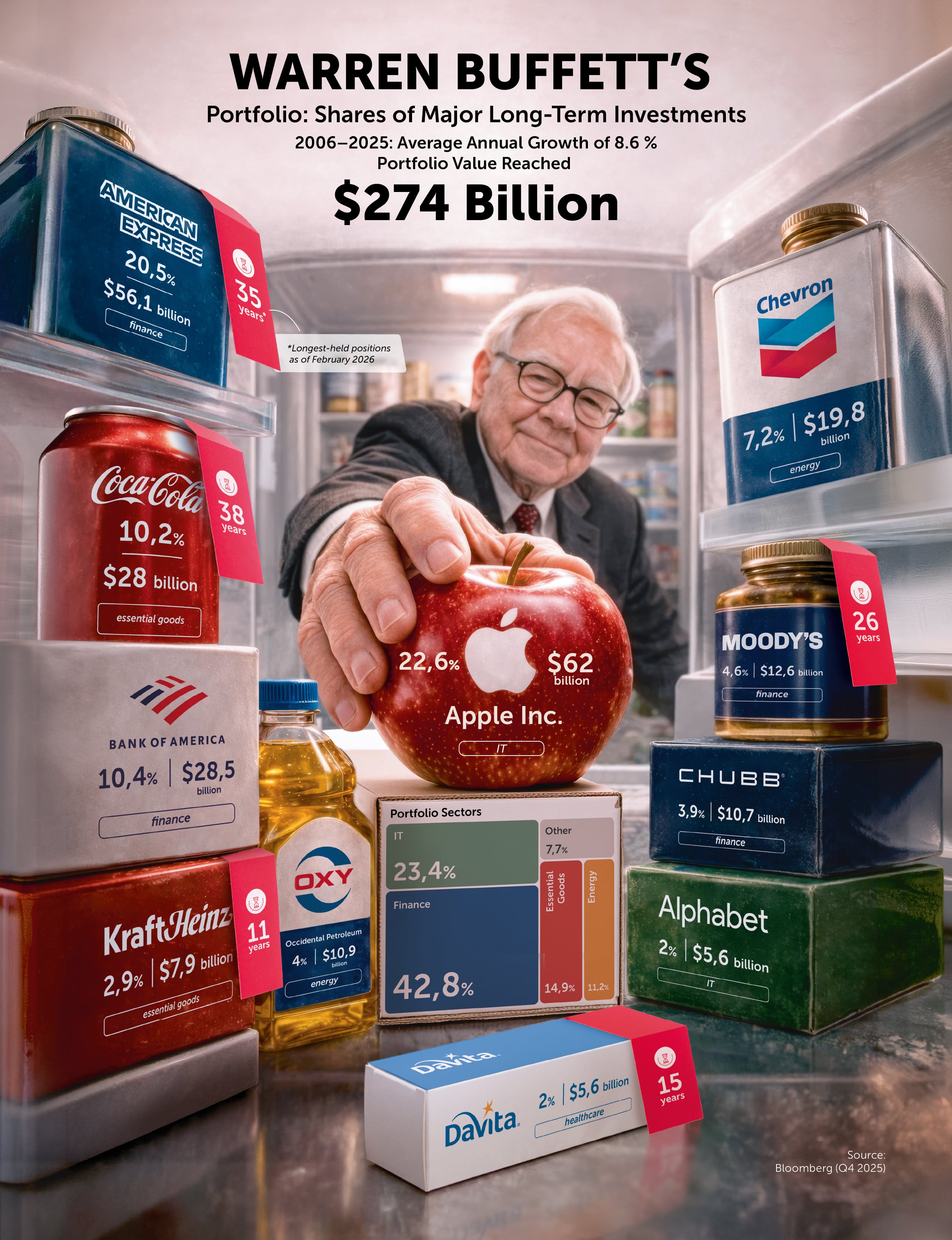
In the stock market, there is one universally recognised benchmark for returns — the S&P 500 Index. However, investors also have an absolute benchmark in terms of approach and reputation — and that, of course, is Warren Buffett. Over 60 years under Buffett’s management, Berkshire Hathaway has outperformed the S&P 500 in 40 out of 60 years, and its average annual return has nearly doubled that of the index. Since 1965, the S&P 500 has closed in the red 13 times, while Berkshire has fallen below the benchmark only twice.
Equally important is the fact that for 48 out of those 60 years, Buffett has been explaining how he manages money. The long‑term distance, success, and transparency make the “Oracle of Omaha” — as the legendary investor is nicknamed in his home country — truly unique. I’m writing this not just to once again emphasise the greatness of this financier, but to show that his wisdom is accessible to absolutely anyone willing to make use of it.
A Half‑Century Blog
Since 1977, Buffett has sent shareholders of Berkshire not a formal press release or corporate report, but a personal letter — one that explains what is happening with their shared money and why. Starting around 1998, all these letters have been publicly available on the company’s website: berkshirehathaway.com.
In essence, Buffett’s letters are the oldest financial blog in history — and quite possibly the most honest one. Long before podcasts, investment YouTube channels, and Telegram newsletters, the owner of Berkshire was producing the most valuable content: he explained in detail, using his own example, how to invest successfully.
I started reading his letters in 2007, but the first truly powerful impression from a Buffett letter came in February 2009. At that time, I had 1.5 years of investing “experience”, but I was acting completely unsystematically, in a chaotic way. With such approach, it was only logical that amid the mortgage crisis, I had experienced several margin calls*, and my losses exceeded 60% of my account. In such conditions, Buffett’s 2008 letter became strong supportive therapy for me.
*Broker warning regarding critically low account balance, which may result in forced liquidation of positions
When someone managing hundreds of billions of dollars simply, without pomp or preaching, writes that he was inactive in some important situations — and because of that, the fund suffered substantial losses — it makes an impression. And his important words about borrowed funds gave a concrete answer to the question of what I had been doing wrong: “Even if your borrowings are small and your positions aren’t immediately threatened by the plunging market, your mind may well become rattled by scary headlines and breathless commentary. And an unsettled mind will not make good decisions”. That’s exactly what I had been doing: I was selling not only because I was forced to, but also because I was very nervous, not knowing when the decline would end.
Buffett’s letters supported me during one of the darkest periods. I dare to assume they have helped not just me. What impressed me most was the relevance of the legendary financier’s notes. In each of his texts, I found something useful “here and now”. For example, my confidence in ETFs as an extremely convenient tool for long‑term investors grew manifold when Buffett, in his 2013 and 2016 letters, not only spoke favourably about index funds but also advised his wife to invest 90% of her savings in them.
Over nearly 20 years, I have drawn a vast number of profound insights from his letters. One could say that Buffett has essentially been an open book for the entire investment community, as everyone could observe his experience and practical decisions.
The Story Continues
In 2026, Greg Abel became CEO of Berkshire. I liked his first letter to shareholders, in which he promised to preserve Berkshire’s culture “for all eternity”: it was sincere and smart. It was very important to read, “Berkshire should have leaders who embody its principles, not principles tailored to specific individuals”.
The investment chronicle that Buffett maintained for nearly half a century will continue. This means that both you and I still have the opportunity to read a new, relevant page of it every year. So, let’s look forward to next February!