
Financier №2 (42) 2026
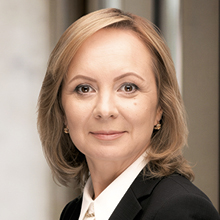
Natalya Khoroshevskaya
Chairperson of the Management Board of KASE Clearing Centre JSC (KACC)
Interview. Natalya Khoroshevskaya (KASE Clearing Centre JSC (KACC)
“Investment Literacy Among the Younger Generation Is Higher Than Among Previous Ones”
What is age group predominantly employed by the KASE stock exchange?
Today, young people are joining the exchange, and we encourage this: not many places in the world train professionals in stock trading at universities. At KASE, we have a fairly high degree of adaptation for employees of any age when they encounter our specific requirements.
We devote a lot of time and effort to improving the investment literacy of Kazakhstanis and Kazakhstani companies. We also invest in enhancing the knowledge level of our employees. Truly engaged people stay with us for the long term. The average age of an employee is 35–37 years at our exchange. I don’t think much has changed in this regard compared to a decade ago.
In recent years, there has been a clear trend: our broker pool is getting younger and expanding. A few years ago, large companies typically had one or two traders — at most five. Now, they have large, fully‑fledged teams.
What influences this process of popularizing the stock exchange business among the younger generation?
Much of it comes down to expanded access to exchanges. Roughly five years ago, banks were very limited in providing brokerage services and could essentially only execute trades in government securities. Since the early 2020s, banks have been allowed to provide brokerage services with virtually no restrictions. This, in turn, has required hiring more professionals. The number of people trading or investing on the Kazakhstan exchange has grown manifold in recent years.
We collaborate with universities to give students as much information as possible about how the stock market operates, how to manage investments and raise financing. We do this for two reasons. First, we strive to participate in the formation of an investor base for our market. Second, we understand that today's young people are the future owners of companies that will eventually become economic actors and will be seeking funding for development. They will be able to invest in a wider range of financial instruments — and we offer many on our platform. Investment strategies of the new generation can sometimes be riskier, but at least more interesting.
Which assets do different generations invest in?
Older investors more often choose shares or bonds issued by Kazakhstan issuers — including quasi‑public sector companies — as well as government securities. Younger investors, it seems to me, are more often drawn to hype: they seek to earn excess returns and become shareholders in several completely different companies.
The generational shift on the exchange directly affects demand for digital solutions, and this influence is certainly positive. Kazakhstan overall has a high level of digitalisation in financial services, and it is growing exponentially. This market will continue to develop. Young people generally have a stronger demand for it, because they are more eager to try new things. There is no such rigidity as “I’ve always done it this way, and I must keep doing it this way”. Perhaps the value of the younger generation lies precisely in the absence of this mindset.
Who has higher financial literacy: young investors and traders or their older counterparts?
I prefer the term investment literacy when referring to stock trading. This metric is objectively higher among the new generation.
When I was a young professional and attended conferences, senior colleagues used to say: “Our market will become truly developed if we achieve public engagement in investing at around 6%.” Now, 30% of the country’s residents are involved in this activity — a very high figure.
Next, we need to work on forming and expanding the middle class: the segment of society that has surplus funds available for investing. And of course, we must ensure the stable development of our market.