Financier №2 (42) 2026

Yelena Belyaeva
Investment Mentor Freedom Finance Global
The Limits of the Algorithm
AI Won’t Replace a Good Investment Analyst
Artificial intelligence is rapidly reshaping the job market. The skills and experience of a whole army of software engineers, data analysts, and other professionals — once considered irreplaceable — can now be replaced by subscriptions to services like ChatGPT or Claude. These changes are already affecting the stock market. For example, mere expectations that AI tools could transform the software development industry led to a 35% drop in Microsoft Corporation (MSFT) stock price from its highs in spring 2026.
Will this trend affect professional stock market analysts? Let’s find out.
The Challenge Is Accepted
Despite the obvious advantages of various smart tools — such as speed of data processing or writing complex code — AI has equally serious limitations. The main one is the very nature of the algorithms embedded in the tool. All of them, including LLMs (large Language Models), operate within a probabilistic worldview and are trained on historical data, which creates a correlation trap. AI excels at finding patterns in the past using backtesting (historical strategy testing). However, as statistics from J.P. Morgan Asset Management (2025–2026) show, relationships that held for decades can collapse instantly under the influence of geopolitical shocks — like the recent crisis in the Persian Gulf. An analyst understands the cause‑and‑effect relationships of such events, while AI sees only statistical coincidences.
When selecting stocks, a robot can analyse a quarterly 10‑K* report or a CEO call transcript, but it cannot sense an uncertain tone or read non‑verbal cues, assess corporate culture, or detect subtle political intrigues within the board of directors. According to the Harvard Business Review, up to 30% of the long‑term market value of public issuers depends precisely on intangible management factors — which AI still evaluates with only 55–60% accuracy, not far from flipping a coin.
*A complete annual release of audited financial performance submitted to the SEC
A professional analyst with 20 years of experience possesses a set of competencies that remain beyond the mathematical capabilities of neural networks. A properly tuned algorithm can process financial documents, monitor news coverage of a specific company, and generate summaries better and faster than a junior analyst. Nevertheless, a professional reads between the lines and draws conclusions based on logical reasoning and practical experience. AI doesn’t know what common sense is. It might recommend buying shares of microchip manufacturers based on rising demand, but it can’t predict how a drought in Taiwan or a new labour law in Europe will affect the supply chain three links down the line. A human uses horizontal synthesis — the ability to connect disparate facts from politics, history, and psychology into a unified picture.
Moreover, investing is not just about numbers — it’s also about values. In 2026, ESG criteria (environmental, social, and governance) have become mandatory for public companies. An analyst makes decisions based on society’s moral vector. AI lacks an ethical compass; it may recommend a profitable but reputationally damaging deal simply because the data doesn’t carry an “unethical” label.
It’s also important to note that algorithms need precise and complete data, while a professional can work with even weak signals. Furthermore, cases of model manipulation through data poisoning have become more frequent. An analyst can make decisions in the absence of sufficient information or when it’s deliberately distorted — which often happens during corporate scandals or military conflicts.
When thousands of algorithms are tuned to the same triggers, an avalanche effect occurs. Flash crashes in cryptocurrency and low‑liquidity stock markets in 2024–2025 were often triggered by AI bots simultaneously receiving sell signals when certain conditions were met. As a result, prices dropped 10–15% in minutes, then recovered just as quickly — leaving retail investors with forcibly closed positions at stop‑loss levels, or even margin calls.
The complexity of using AI creates a black box effect. An investor may simply not understand why the robot made a certain decision, and thus fail to react to changing market conditions.
Source: data from official websites
One Plus One
Instead of competing with AI, leading investment houses have shifted to an Augmented Intelligence model in 2026. The essence of this shift is that algorithms free experts from routine tasks, allowing them to focus on strategy.
At the initial stage, a robot performs primary data screening, processing thousands of reports in seconds and highlighting anomalies. As a result, the analyst obtains a shortlist of five to eight companies instead of several thousand. In the next phase, real‑time market sentiment analysis is conducted: AI monitors social media and news in 50 languages. Then comes stress testing, where the portfolio is run through millions of scenarios (using the Monte Carlo method), helping the analyst identify tail risks.
This approach has a significant advantage. According to statistics from the CFA Institute (2026), analysts using AI tools spend 70% less time on data collection than before, while the quality and depth of analysis improve.
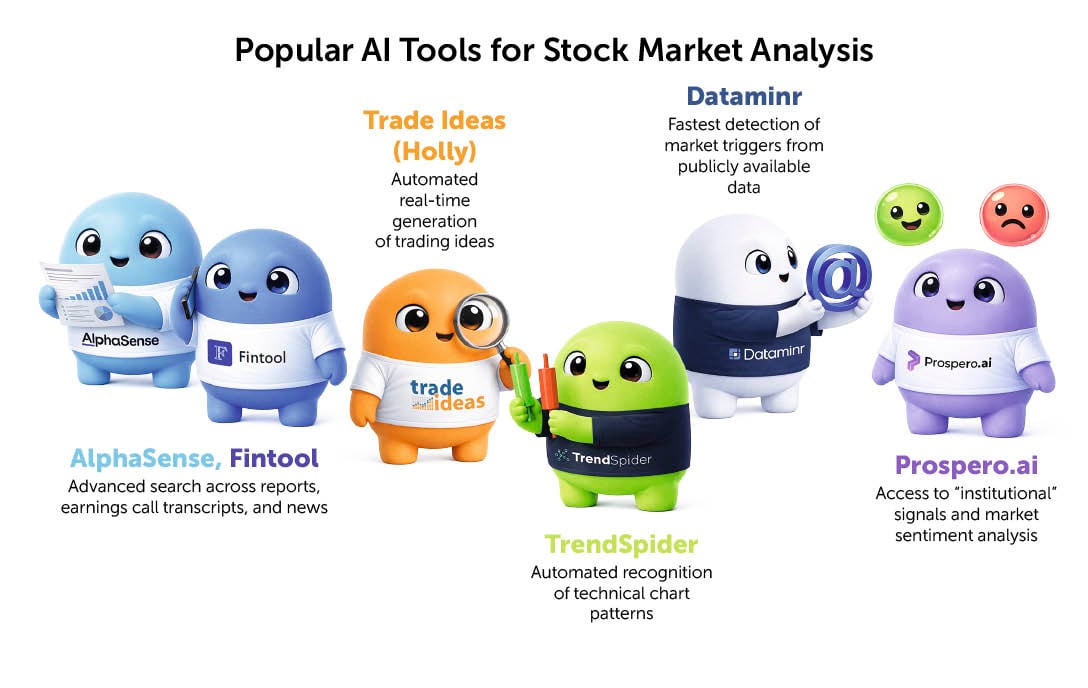
More niche AI‑powered services can also handle complex but monotonous tasks. For instance, neural networks in services like Stock Titan and AlphaSense evaluate not only the content of news but also its emotional tone. They already understand irony, hidden scepticism in report wording, or euphemisms in a CEO’s speech. AI agents like Holly or Intellectia AI allow analysts to perform smart searches — for example, finding stocks that have been steadily rising on declining volumes over the past three days and showed a sharp spike in social media activity today.
Early‑year corrections have confirmed the effectiveness of the hybrid interaction model. Following the market downturn in February–March, portfolios managed solely by AI corrected 18% deeper than actively managed funds with expert involvement. Overall, during the quarter, funds with “human + AI” strategies earned 4.5 percentage points more than those run solely by algorithms, according to Bloomberg and Refinitiv.
Tool, Not a Replacement
Artificial intelligence can take over the grunt work of data collection and primary processing, allowing analysts or traders to focus on the essentials: making final decisions and managing risks. A seasoned professional analyst remains the “architect of sense”. The ability to understand human nature, the fears and hopes of market players, makes them indispensable in a world that cannot be described by numbers alone.