
Financier №2 (42) 2026

Yegor Tolmachev
Senior Analyst Freedom Finance Global
The Fruits of Labour
How Elderly Americans Live
Today’s formula for a dignified retirement is a combination of government support and personal initiative by a person who strives for financial well‑being from a young age.
A prime example of this combination is the U.S. pension system — one of the most developed and transparent in the world. It includes government guarantees alongside a strong culture of personal savings and investments, forming a three‑tier model of financial support in old age. The three pillars of the U.S. pension system are: the Social Security program, corporate pension plans, and individual retirement accounts (IRAs).
Below, we’ll explain what Americans do to secure a decent retirement.
The Government
Social Security is a mandatory government program operating on a pay‑as‑you‑go basis: current workers fund retirees through the FICA (Federal Insurance Contributions Act) payroll tax. As of September 2025, 68 million Americans received payments under this scheme, including 54 million former workers in retirement, with the remainder receiving disability benefits or survivor benefits as family members who lost a breadwinner.
The median payment under this program is about $1 700 per month, with an average pension of approximately $2 100 per month. This is barely enough to live on. According to estimates by the GOBankingRates service, a comfortable life for a retired couple in the U.S. requires between $37.5 thousand per year in West Virginia and $80–90 thousand in Massachusetts and California, with a median estimate for the U.S. as a whole of $52.3 thousand annually. Thus, even in the U.S., more than half of Social Security recipients do not have enough to live comfortably.
The Employer
Corporate pension plans are divided into two groups of fundamentally different types. The first type is Defined Benefit (DB). The second is Defined Contribution (DC). DB plans follow a familiar structure. The employer guarantees the amount of the future lifetime benefit based on the formula: coefficient × years of service × average final salary. The typical coefficient is 1–2% per year, which, with 30 years of service, ensures that 30–60% of the final salary is replaced in retirement.
These pensions are most often provided by traditional industrial corporations, as well as some banks and insurance companies. They offer a lifetime benefit under the formula above, supplementing Social Security payments. According to the National Institute for Retirement Security, about 50 million people in the private and public sectors have DB plans in the U.S., including retirees.
Defined Contribution (DC) plans. This is the modern standard for corporate pensions, guaranteeing not the future benefit amount but the contribution size. Here, the investment risk falls on the employee, not the employer. According to estimates by Carry and the ICI organization, about 70 million Americans actively participate in DC plans, with accumulated assets reaching $14 trillion. On average, median assets per participant over 65 years old are $95 thousand, with an average of $300 thousand. With a typical 4% annual withdrawal strategy, this provides $4–12 thousand in additional income. According to available estimates, about 17% of U.S. retirees aged 62–75 receive such amounts (EBRI data). DC plans differ in that their savings are inheritable.
The Person
Personal savings are a key element of the American pension system. An IRA is an Individual Retirement Account that can be opened with a broker or bank if you have earned income. As of mid‑2024, 44% (57.9 million) of U.S. households held IRAs. For most, this tool supplements rather than replaces a corporate plan. The main advantage of traditional IRA is its tax treatment. A tax benefit is granted at the time of contribution, allowing you to reduce taxable income now. However, when withdrawing funds later (e.g., in retirement), you must pay tax on those amounts. Roth IRA (named after Senator William Roth): There is no tax benefit at contribution, but investment income and withdrawals in retirement are generally tax‑free. Essentially, the choice between these formats is a choice between tax benefits now or in the future. In both IRAs and DC plans, investment risk fully rests with the employee: if the stock market falls before retirement, income will fall accordingly.
Therefore, there are no fixed pensions under IRAs; the final amount depends on how much one saves, how long one invests, and what return is achieved. There is no fixed contribution rate for IRAs. Each person determines the savings amount within established limits. Accumulated capital can be withdrawn gradually, converted into an annuity, or spent following, for example, the “4% per year” rule.
Arithmetic in Action
The scheme described above works successfully only with strict adherence to investment discipline. This means that the future retiree consistently transfers part of their salary to a retirement account and uses those funds to purchase securities. Then, the magic of compound interest turns even small investments into a substantial sum over time.
Suppose a hypothetical American invests $1 thousand per year for 40 years, adjusted for inflation. U.S. prices rise on average 3% annually. Reliable bonds yield 4% per annum, and the stock market delivers 10% or more annually in the long term. These parameters can be used as expected returns. Then, if all savings are invested in stocks and, after retirement, the accumulated capital is invested in reliable bonds, the savings can fund a monthly pension in constant prices (adjusted for inflation) of $737 for 25 years.
Thus, $40 thousand saved during working years will grow to $221 thousand by retirement — the difference comes from investment returns.
What Does It Mean?
For investors in Russia and Kazakhstan, the lesson from the U.S. experience is simple: relying solely on a government pension is pointless, and a comfortable standard of living in old age is nearly unachievable without personal savings.
It is also important to consider the current global demographic trend: a declining ratio of working people per retiree. In the U.S., projections suggest the Social Security trust fund may be depleted by 2032, raising questions about the sustainability of this portion of elderly Americans’ monthly income.
As a benchmark for retirement living standards, one can use the pension replacement ratio. This shows what percentage of salary the retirement payments will be. In the U.S., this parameter — including corporate and individual pensions — is recommended at 70–85%. The International Labour Organization sets the minimum at 40%. In Russia, this figure is 25%; in Kazakhstan, it is 28% for the PAYG pension (a government benefit based on work experience accrued before January 1, 1998) and an additional 13% for the funded pension (only for participants in the relevant program).
In short, to ensure your golden years do not become years of mere survival, it is best to start thinking about a dignified retirement today.
*A PAYG pension in Kazakhstan is a government payment assigned for work experience accumulated before January 1, 1998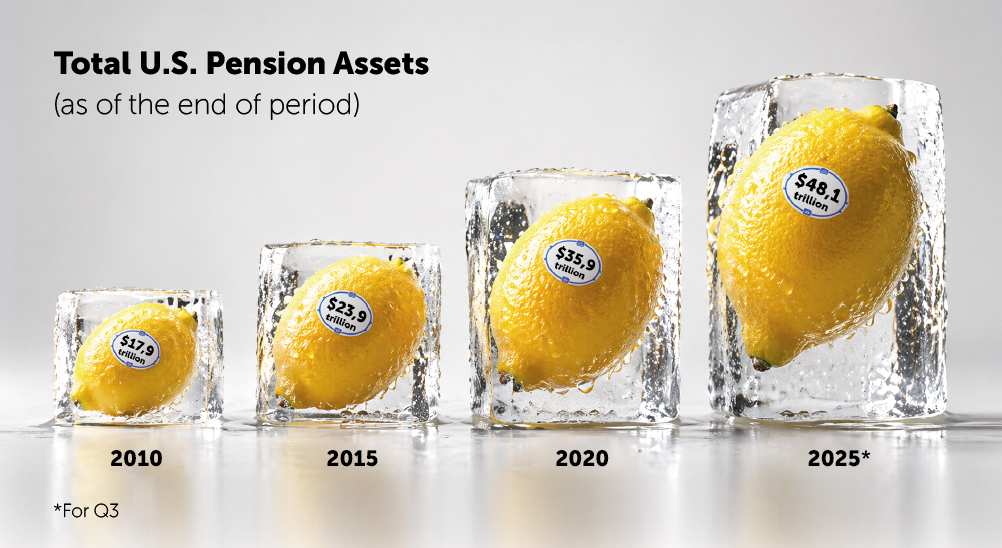
Source: Investment Company Institute