
Financier №2 (42) 2026

Tural Aliyev
Junior Analyst Financial Analysis Department Freedom Broker
New Money
From the Workbench to High‑Tech: A Chronicle of Billion‑Dollar Fortunes
In 1916, U.S. newspapers first wrote about a person whose net worth exceeded $1 billion. A century later, the number of people with such wealth surpassed 3 thousand. During this time, the paths to reaching this financial peak have also changed. The very history of how global billionaires emerged reflects a cross‑section of the most popular assets in different economic eras.
The First One
John D. Rockefeller began his career as an accountant earning $3.57 per week. In 1870, he founded Standard Oil, which systematically acquired or eliminated competitors until it controlled 90 % of U.S. oil refining. The U.S. Congress was forced to develop antitrust legislation to curb the corporation’s influence on the American economy.
When newspapers declared Rockefeller a billionaire, his wealth was estimated at roughly 1–1.5 % of U.S. GDP. Today, that would be equivalent to about $300 billion.
At the turn of the 19th to 20th centuries, billionaires in the modern sense could be counted on one hand. Their fortunes were built on physical assets: pipelines, railroads, blast furnaces. Decades were spent building infrastructure, hiring thousands of workers, and negotiating with labor unions — wealth accumulated very slowly.
Everything changed with the Great Depression (1929–1934). While most people were losing money, a few were buying up discounted assets. For example, U.S. businessman Jean Paul Getty (Getty Oil) invested in oil stocks at the market bottom and by the mid‑1950s became the world’s richest private person, according to Fortune magazine. Howard Hughes (Hughes Aircraft) invested in aviation when its commercial prospects were not yet clear. Both strategies shared one thing: a bet on what others considered too risky.
1960s–1970s: The Era of Oil Power and Unexpected Retail Surges. The 1973 OPEC crisis turned Texas oil barons into dollar magnates in just a few months. In the same period, Sam Walton opened the first Walmart stores in Arkansas, convinced that retail in small towns was an undervalued and promising niche. When Forbes first named him the richest American in 1985 (with a net worth of $2.8 billion), Walmart shares were not yet Wall Street favorites.
As eras changed, so did the “golden lists”. The first Forbes global ranking (1987) included 140 billionaires with a combined net worth of $295 billion. At the time, the top spot went to Japanese real estate developer Yoshiaki Tsutsumi — a name few remember today.
The 1990s: The Rise of the Internet and New Heroes. The mass spread of the internet in the 1990s created new icons. Bill Gates became a billionaire at age 31 — not through oil production or real estate development, but thanks to the Windows operating system he created. It turned out that software code, once written, could be resold indefinitely at no additional cost. By 1999, Gates’s net worth exceeded $100 billion — a milestone no one had reached before.
Billionaires of the 21st Century
In August 2011, an event passed almost unnoticed: Apple (AAPL) surpassed ExxonMobil (XOM) in market capitalization to become the world’s most valuable company. This was not just a financial record — it marked a shift in eras. ExxonMobil had been extracting oil for over a century, owned pipelines across multiple continents, and employed tens of thousands. Apple produced electronics and software.
The difference lies in scalability. To sell twice as much oil, you need to drill twice as many wells. To double iPhone sales, you only need to open another store. Gross margin in the oil industry is about 30–40 %, with a large portion going to capital expenditures. Leading technology companies achieve gross profit margins of 75–90 %, and the marginal cost of producing one additional phone is zero. This arithmetic explains why $1 invested in Apple in 2000 is worth $700 today.
The fate of ExxonMobil is also illustrative. In 2020, its shares were removed from the Dow Jones Industrial Average after nearly a century in the index. Its place was taken by cloud service Salesforce (CRM).
Today’s Forbes list reflects the technological revolution. Of the ten richest people on the planet, eight — Elon Musk (Tesla Motors, TSLA), Jeff Bezos (Amazon, AMZN), Mark Zuckerberg (Meta Platforms, META), Larry Ellison (Oracle, ORCL), Jensen Huang (NVIDIA, NVDA), Steve Ballmer (Microsoft, MSFT), and Larry Page and Sergey Brin of Alphabet (GOOGL) - built their fortunes in high‑tech. Warren Buffett (Berkshire Hathaway, BRKb) and Bernard Arnault (LVMH) are exceptions that prove the rule.
Jensen Huang’s story is especially telling. In 2016, the NVIDIA founder was worth about $3 billion — a solid but not outstanding result for someone who had been building his company for over two decades. Then the world discovered artificial intelligence, and it turned out that AI is impossible without NVIDIA graphics cards.
By 2025, Huang’s net worth had exceeded $170 billion, with nearly 96 % of that sum accumulated in just five years. For comparison, Rockefeller took 46 years to reach his first billion.
From 2010 to 2025, the number of billionaires worldwide tripled — from 1,011 to 3,028 — largely due to growth in the IT sector. The combined net worth of the world’s richest individuals increased 4.5 times over these 15 years, reaching $16.1 trillion.
On to the Next Era
Today, the engine of the economy runs on technological “fuel”, but new resources will emerge, around which the next generation of ultra‑wealthy entrepreneurs will rise. This does not mean that Musk or Zuckerberg should worry about their place on the financial Olympus. It’s simply the logic of global history’s development.
Incidentally, private investors can also benefit from future changes in the global Forbes list. To do so, they need only to stay informed about global trends, think long‑term, and, of course, take advantage of the opportunities the stock market provides.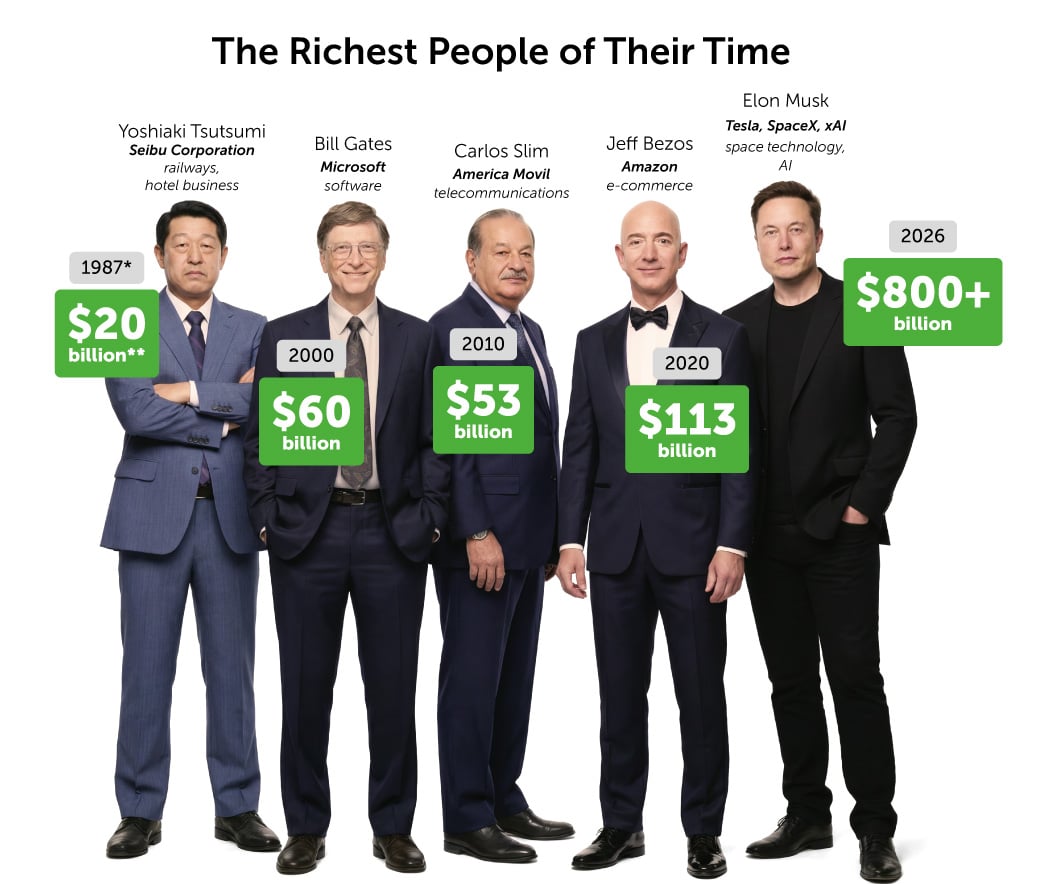
Source: Forbes
*The year in which he was the richest person in the world
**Net worth for that year